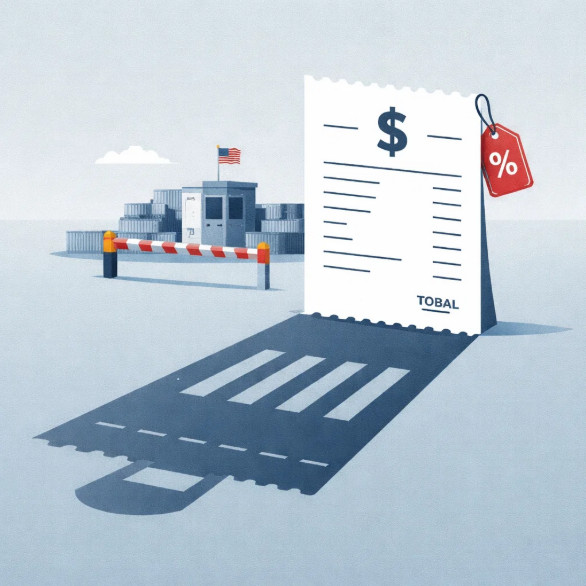
커피값이 오르면 사람들은 원두를 탓한다. 환율을 탓하기도 하고, 물류를 탓하기도 한다. 그런데 어떤 날은 원두도 환율도 물류도 아닌, 국경에서 매겨진 숫자가 조용히 생활비를 흔든다. 관세는 그렇게 작동한다. 정치의 언어로는 “외국에 매기는 벌금”처럼 들리지만, 경제의 언어로는 대개 “국내에서 나눠 내는 세금”에 가깝다. 누군가는 먼저 내고, 그다음 누군가는 더 비싼 가격을 내며, 마지막에는 누군가의 월급이 덜 오른다. 관세가 무서운 이유는 이 과정이 선명한 고지서가 아니라, 수많은 가격표와 계약서 사이에 섞여 나타나기 때문이다.
최근 도널드 트럼프의 관세 강화가 다시 논쟁의 중심에 섰다. 핵심 쟁점은 단순하다. 관세를 올리면 정말 ‘상대국’이 비용을 내는가, 아니면 ‘미국 안’에서 비용이 돌아다니며 최종적으로 소비자에게 안기는가. 여러 실증 연구와 정책 분석은 대체로 후자 쪽에 더 가깝다고 말한다. 관세는 수입업자와 기업의 비용으로 먼저 나타나고, 그 비용은 가격·마진·임금·투자 속도 같은 통로를 통해 결국 국내에 분산된다는 것이다.
여기서부터 관세의 그늘이 시작된다. 관세는 ‘때리는 도구’이면서 동시에 ‘부담을 재배치하는 장치’다. 어떤 산업은 보호받고, 어떤 지역은 일시적으로 숨통이 트일 수 있다. 반대로 어떤 가정의 장바구니는 더 비싸지고, 어떤 기업의 투자 계획은 늦춰지며, 어떤 공급망은 비용이 높은 방향으로 다시 묶인다. 이러한 그늘이 어디로 드리워지는지, 그리고 앞으로의 전망이 왜 ‘관세율’만으로 예측되지 않는지를 알아보자.
관세의 정체: 누가 먼저 내고, 누가 결국 내는가
관세는 세관에서 걷힌다. 법적으로는 수입업자가 낸다. 하지만 경제적으로 중요한 것은 “누가 세관에 납부하느냐”가 아니라 “누가 최종 부담을 지느냐”다. 수입업자는 관세를 비용으로 떠안고 끝낼 수도 있지만, 더 흔한 선택은 비용을 흡수하거나, 가격에 섞어 흘려보내거나, 제품의 형태를 바꾸는 것이다. 이 과정은 여러 갈래로 나뉜다.
직접 전가. 수입품 가격이 오른다. 소비자는 같은 제품을 더 비싼 값에 사거나, 더 싼 대체재로 옮겨간다.
간접 전가. 수입품과 경쟁하던 국내 제품이 “경쟁 압력 완화”를 기회로 가격을 올린다. 관세는 수입품만 비싸게 만드는 것이 아니라, 시장 전체의 가격 기준선을 밀어 올릴 수 있다.
형태 전가. 가격표를 그대로 두고 용량을 줄이거나, 품질과 구성품을 바꾸거나, 서비스 조건을 바꾸는 방식이다. 소비자 입장에서는 “뭔가 손해 본 느낌”이지만, 통계의 물가 지표에는 덜 드러날 수 있다.
시간 전가. 관세는 오늘 붙었는데, 가격은 몇 달 뒤에 오른다. 재고가 소진되고, 계약이 갱신되고, 유통이 재정비되는 시간이 필요하기 때문이다. 그래서 관세의 체감은 늘 늦게 오고, 늦게 사라진다.
이 점에서 “당장 물가가 폭발하지 않았다”는 말은 절반만 맞다. 물가라는 평균값이 즉시 튀지 않는다고 해서 부담이 사라지는 것이 아니다. 부담은 마진, 임금, 업그레이드 지연, 품질 저하, 선택지 축소 같은 형태로 분산되기 때문이다.
“외국이 낸다”는 정치의 문장과 “국내가 나눠 낸다”는 경제의 문장
관세가 인기 있는 이유는 메시지가 간단하기 때문이다. “불공정한 상대를 벌한다.” “일자리를 되찾는다.” “협상을 유리하게 만든다.” 이런 문장들은 유권자에게 닿기 쉽다. 반면 “관세는 국내의 비용 구조를 바꾸고, 가격 신호를 왜곡하며, 소비 여력을 갉아먹을 수 있다”는 문장은 길고 어렵다. 그래서 관세 논쟁은 종종 ‘정치적 직관’이 ‘경제적 메커니즘’을 이기는 구도로 흐른다.
하지만 관세가 넓어질수록, “누가 손해를 보느냐”는 질문은 더 많은 사람의 일상으로 내려온다. 자동차 부품이 오르면 수리비가 오르고, 가전이 오르면 생활비가 오르고, 산업용 부품이 오르면 중소 제조업의 납품단가가 흔들린다. 관세는 때때로 ‘소비자 물가’보다 ‘생활비의 불편’으로 먼저 체감된다.
관세의 그늘이 가장 짙어지는 곳: 평균이 아니라 분포
관세 부담을 “국민 1인당 얼마”로 계산하면 이해는 쉽지만, 정작 현실은 평균이 아니라 분포에서 폭발한다. 같은 100달러의 추가 부담도 누군가에게는 통화료 한 번, 누군가에게는 일주일 식비다. 관세는 대개 역진적 성격을 띠기 쉽다. 필수재, 부품, 생활소비재의 가격이 오르면 저소득층이 더 큰 타격을 받기 때문이다. 또 저소득층은 ‘대체’로 도망갈 수 있는 여지가 작다. 더 싼 브랜드가 관세 영향권에 함께 들어오면 선택지가 줄어든다.
지역도 다르다. 관세로 보호받는 산업이 몰린 지역은 정치적으로 “효과가 있다”는 체감이 생길 수 있다. 반대로 소비 비중이 큰 지역, 유통·서비스 중심 지역은 “비싸졌다”는 체감이 먼저 온다. 이 간극은 선거에서 강력한 감정의 균열을 만든다. 관세의 정치는 ‘국가’의 이익이 아니라 ‘우리 지역’의 이익으로 번역될 때 단단해지고, ‘우리 집’의 부담으로 번역될 때 흔들린다.
기업의 그늘: 가격을 올릴지, 투자를 미룰지, 공급망을 다시 짤지
관세의 직접 표적이 수입품이라 해도, 기업이 느끼는 핵심은 “비용”과 “불확실성”이다. 비용은 단순하다. 더 내야 한다. 불확실성은 더 깊다. 다음 분기에도 같은 관세가 유지될지, 예외가 생길지, 상대국이 보복할지, 규정이 바뀔지 모른다. 기업은 “현재 비용”만이 아니라 “미래 규칙”을 보고 공장을 짓기 때문에, 관세의 충격은 투자 심리를 통해 크게 증폭될 수 있다.
또 하나의 그늘은 경쟁의 완화다. 관세로 보호받은 시장은 단기적으로 숨을 돌릴 수 있지만, 장기적으로는 혁신과 생산성의 긴장이 줄어들 수 있다. 관세가 ‘산업정책’처럼 보이려면 보호만이 아니라, 기술 축적과 생산성 향상으로 이어지는 조건과 설계가 함께 있어야 한다. 보호만 있고 조건이 없으면, 관세는 기업에게 ‘시간’을 주되 ‘방향’을 주지 못한다.
법과 제도의 그늘: 관세가 시장 리스크 프리미엄이 되는 순간
관세가 경제에 미치는 영향은 관세율만이 아니라, 관세를 가능하게 하는 권한과 그 지속 가능성에 달려 있다. 권한 다툼과 해석 논쟁이 길어지면 관세는 “예측 불가능한 정책”으로 굳어진다. 이때 경제에 가장 해로운 것은 관세 자체보다 불확실성의 지속이다. 기업은 확신이 없을 때 투자를 미루고, 고용은 보수적으로 하며, 재고와 가격 전략을 방어적으로 설계한다. 규칙이 안정되지 않으면, 시장은 안도 대신 경계로 반응한다.
동맹과 상대국의 그늘: 보복과 거래, 그리고 관세의 외교화
관세가 커지면 상대국은 가만히 있지 않는다. 보복은 경제적 계산이면서 정치적 계산이다. 흔히 보복 관세는 상대의 민감한 지역구, 상징적 산업, 정치적으로 큰 산업을 겨냥한다. 그래서 관세 전쟁은 종종 ‘경제의 합리성’보다 ‘정치의 취약점’에 더 날카롭게 박힌다.
동시에 관세는 협상의 카드이기도 하다. 관세는 단지 “수입을 억제하는 장치”가 아니라 “교환 가능한 통화”로 작동한다. 특정 관세를 낮추는 대신 구매 확대나 투자 약속을 요구하는 방식으로 외교의 언어로 번역된다. 그 결과 세계 무역은 ‘효율’ 중심에서 ‘소속’ 중심으로 이동할 수 있다. 더 싸게 만드는 대신 더 안전한 곳에서 만들고, 더 멀리 파는 대신 더 가까운 친구에게 판다. 공급망은 길고 얇은 최적화에서 짧고 두꺼운 중복으로 바뀐다. 이 변화는 단기적으로 비용을 올리지만, 장기적으로는 블록화라는 새로운 표준을 만든다.
관세는 끝나지 않고, 형태를 바꾼다
관세의 미래를 한 문장으로 요약하면 이렇다. 관세는 ‘철회’보다 ‘재설계’의 길로 갈 가능성이 크다. 관세는 이미 정치적 도구로 자리 잡았고, 재정 수입과 협상 레버리지라는 유혹을 제공하며, 동시에 ‘완전 철회’는 보호받는 이해관계의 저항을 부른다. 그래서 관세의 미래는 대체로 세 가지 경로 중 하나로 흘러간다.
고관세의 고착, 새로운 정상
관세가 높은 상태가 유지되면 기업은 가격 체계를 새로 정착시킨다. 한번 오른 가격은 잘 내려가지 않는다. 공급망은 관세를 전제로 다시 짜이고, 공장은 그 전제를 전제로 투자된다. 이 경로에서 중요한 변수는 물가 그 자체보다 실질소득이다. 생활비 부담이 커졌다는 감정이 중산층에 넓게 퍼지면, 관세는 ‘애국의 상징’에서 ‘생활의 부담’으로 색이 바뀐다.
선택적 완화, 표적화의 기술
완화가 일어나더라도 전면 철회는 드물 수 있다. 대신 “표적화”가 강화된다. 정치적으로 민감한 품목은 낮추고, 산업적으로 상징적인 품목은 유지하거나 강화하는 방식이다. 표적화는 부담을 줄일 수 있지만, 동시에 기업의 준법·행정 비용을 늘린다. 누가 예외인지, 무엇이 원산지인지, 어떤 부품 비중이면 다른 세율을 적용받는지 따져야 하기 때문이다.
제도적 제동, 불확실성의 장기화
권한과 절차를 둘러싼 갈등이 커질수록 관세는 “예측 불가능한 정책”으로 굳어진다. 이때 관세율이 조금 내려가도 경제 체감이 좋아지지 않을 수 있다. 규칙이 안정되지 않으면, 기업은 투자와 고용을 쉽게 늘리지 않기 때문이다.
관세의 그늘을 측정하는 새 질문들
관세 논쟁을 “찬성/반대”로 끝내면 매번 같은 싸움이 반복된다. 관세가 만들어내는 비용과 이익이 서로 다른 집단에 다르게 분배되기 때문이다. 그래서 앞으로 중요한 것은 가치판단보다 측정의 질문이다. 정책이 지속될수록 질문은 더 구체적이어야 한다.
가계의 질문. 물가가 아니라 실질소득이 얼마나 줄었나. 평균이 아니라 하위 계층의 체감 부담은 얼마나 커졌나.
기업의 질문. 관세로 유도된 투자가 ‘순증’인가 ‘보험’인가. 공급망 재배치의 비용이 생산성에 어떤 흔적을 남겼나.
정치의 질문. 관세가 보호한 산업이 성과로 이어졌나. 보호의 시간이 혁신의 시간으로 바뀌었나.
외교의 질문. 관세가 협상의 레버리지로 작동했나, 아니면 보복과 균열을 키웠나.
관세의 비용은 국경에서 시작하지만, 그 비용이 머무는 곳은 국경 안이다. 그리고 그 비용이 넓게 퍼질수록 관세는 ‘국가의 힘’이 아니라 ‘국민의 지불능력’ 위에서만 지속된다는 사실이 드러난다. 관세의 그늘이 진짜로 무서운 지점은 바로 여기다. 강한 정책은 강한 의지로 시작하지만, 결국 강한 생활비의 압력 앞에서 형태를 바꾸며 살아남는다. 관세가 사라지지 않는다면, 우리가 준비해야 할 것은 관세율의 숫자보다 관세가 바꾸는 일상의 구조다. 가격표, 선택지, 일자리, 그리고 ‘안전’이라는 이름의 비용까지.
Reference
Federal Reserve Bank of New York (Liberty Street Economics), 2026-02-13, “Who Is Paying for the 2025 U.S. Tariffs?”, Blog
Congressional Research Service, 2026-01-12, “Presidential 2025 Tariff Actions: Timeline and Status (R48549)”, Report
Reuters, 2026-02-13, “White House: no changes to Trump metals tariffs unless president announces them”, News
The Wall Street Journal, 2026-02-14, “Trump's Team Considers Overhaul to Steel and Aluminum Tariffs”, Newspaper
Reuters, 2026-02-13, “US, Taiwan finalize deal to cut tariffs”, Video
Tariffs’ Shadow: When a Tax Collected at the Border Shows Up on a Receipt
When coffee prices rise, people blame the beans. Sometimes they blame the exchange rate, and sometimes they blame logistics. But on certain days, it’s not the beans, not the exchange rate, and not logistics—some number set at the border quietly shakes the cost of everyday life. That is how tariffs work. In the language of politics, they can sound like “a fine imposed on foreigners,” but in the language of economics, they are usually closer to “a tax shared and paid domestically.” Someone pays first, then someone pays a higher price, and in the end someone’s paycheck rises less. What makes tariffs frightening is that this process does not appear as a clear bill, but rather emerges mixed in among countless price tags and contracts.
Recently, Donald Trump’s tariff push has returned to the center of debate. The core question is simple. If tariffs go up, do “the other side” truly bear the cost, or does the cost circulate “inside the United States” and ultimately land on consumers? A range of empirical studies and policy analyses generally say it is closer to the latter. Tariffs show up first as costs for importers and firms, and those costs are ultimately spread domestically through channels such as prices, margins, wages, and the pace of investment.
This is where tariffs’ shadow begins. Tariffs are both a tool that “hits” and a device that “reallocates burdens.” Some industries are protected, and some regions may get temporary relief. On the other hand, some households’ shopping baskets become more expensive, some firms’ investment plans are delayed, and some supply chains are re-tied in a higher-cost direction. Let’s examine where this shadow falls, and why the outlook ahead cannot be predicted by “the tariff rate” alone.
The Nature of Tariffs: Who Pays First, and Who Pays in the End
Tariffs are collected at customs. Legally, the importer pays. But economically, what matters is not “who remits payment to customs,” but “who ultimately bears the burden.” An importer could absorb a tariff as a cost and stop there, but more often the choice is to absorb some of the cost, pass it along embedded in prices, or change the form of the product. This process splits into several paths.
Direct pass-through. The price of imported goods rises. Consumers either buy the same product at a higher price or shift to cheaper substitutes.
Indirect pass-through. Domestic products that competed with imports raise prices, treating “reduced competitive pressure” as an opportunity. Tariffs do not only make imports more expensive; they can push up the price baseline for the entire market.
Form pass-through. Keeping the sticker price the same while shrinking volume, changing quality and components, or altering service terms. From the consumer’s perspective it feels like “some kind of loss,” but it can be less visible in official price indexes.
Time-lag pass-through. Tariffs are imposed today, but prices rise months later. Inventory must be depleted, contracts renewed, and distribution reorganized. That is why the lived experience of tariffs arrives late—and fades late.
In this sense, the claim that “prices didn’t explode right away” is only half true. The fact that the average value called “prices” does not jump immediately does not mean the burden disappears. The burden is dispersed in forms such as margins, wages, delayed upgrades, quality deterioration, and reduced choice.
The Political Sentence “Foreigners Pay” and the Economic Sentence “We Share the Cost at Home”
Tariffs are popular because the message is simple. “Punish an unfair counterpart.” “Bring jobs back.” “Gain leverage in negotiations.” These sentences reach voters easily. By contrast, the sentence “tariffs can reshape domestic cost structures, distort price signals, and erode consumers’ purchasing power” is long and difficult. So tariff debates often flow in a structure where “political intuition” beats “economic mechanisms.”
But the wider tariffs spread, the more the question “who is losing” descends into more people’s daily lives. If auto parts rise, repair bills rise; if home appliances rise, the cost of living rises; if industrial components rise, the delivery prices of small and mid-sized manufacturers wobble. Tariffs are sometimes felt first not as “consumer prices,” but as “the inconvenience of living costs.”
Where Tariffs’ Shadow Grows Darkest: Not the Average, but the Distribution
If you calculate the tariff burden as “how much per citizen,” it is easy to understand, but reality explodes not in the average, but in the distribution. The same additional $100 burden is for someone a single phone bill, and for someone else a week of groceries. Tariffs tend to have a regressive character. When prices rise for essentials, parts, and everyday consumer goods, lower-income households take a bigger hit. And lower-income households have less room to “escape” through substitution. If cheaper brands also fall within the tariff’s reach, choices shrink.
Regions differ, too. Regions concentrated in industries protected by tariffs may politically develop the sense that “it works.” Meanwhile, regions with high consumption weight—distribution and service-centered regions—feel “it got expensive” first. This gap creates a powerful emotional rift in elections. The politics of tariffs harden when they are translated not as the interest of “the nation,” but the interest of “our region,” and they shake when they are translated as the burden of “our household.”
The Corporate Shadow: Raise Prices, Delay Investment, or Redraw the Supply Chain
Even if the direct target of tariffs is imported goods, what firms feel at the core is “cost” and “uncertainty.” Cost is simple: you must pay more. Uncertainty runs deeper. Will the same tariffs remain next quarter, will exceptions appear, will the other side retaliate, will rules change? Because firms build factories based not only on “current costs” but on “future rules,” tariff shocks can be greatly amplified through investment sentiment.
Another shadow is the easing of competition. A market protected by tariffs can catch its breath in the short run, but in the long run the tension that drives innovation and productivity can weaken. For tariffs to look like “industrial policy,” what is needed is not protection alone, but conditions and design that lead to technological accumulation and productivity gains. If there is protection without conditions, tariffs can give firms “time,” but not “direction.”
The Shadow of Law and Institutions: When Tariffs Become a Market Risk Premium
The impact of tariffs on the economy depends not only on the tariff rate, but on the authority that enables them and their sustainability. When disputes over authority and interpretation drag on, tariffs harden into an “unpredictable policy.” In that situation, what harms the economy most is not tariffs themselves, but the persistence of uncertainty. When firms lack confidence, they delay investment, become conservative in hiring, and design inventory and pricing strategies defensively. If rules do not stabilize, markets respond with caution rather than relief.
The Shadow on Allies and Counterparts: Retaliation, Deals, and the Diplomacy of Tariffs
When tariffs grow, counterparts do not sit still. Retaliation is both an economic calculation and a political calculation. Often retaliatory tariffs target the other side’s sensitive districts, symbolic industries, and politically large industries. That is why tariff wars often pierce more sharply into “political vulnerabilities” than into “economic rationality.”
At the same time, tariffs can also be a bargaining chip. Tariffs operate not only as “a device to restrain imports,” but as “a tradable currency.” They are translated into the language of diplomacy in the form of demanding expanded purchases or investment commitments in exchange for lowering certain tariffs. As a result, world trade can shift from being centered on “efficiency” to being centered on “belonging.” Instead of making things cheaper, firms make them in safer places; instead of selling farther, they sell to closer friends. Supply chains shift from long, thin optimization to shorter, thicker redundancy. This change raises costs in the short term, but in the long term it creates a new standard of bloc formation.
Tariffs Do Not End; They Change Form
If you summarize the future of tariffs in one sentence, it is this. Tariffs are more likely to move toward “redesign” than “repeal.” Tariffs have already become a political tool, they offer the temptation of fiscal revenue and negotiating leverage, and “full repeal” triggers resistance from protected interests. So the future of tariffs generally flows into one of three paths.
Entrenched high tariffs, a new normal
If high tariffs persist, firms establish a new price system. Once prices rise, they rarely come down. Supply chains are rewoven on the assumption of tariffs, and factories are invested in on that same assumption. In this path, the key variable is not prices themselves, but real income. When the feeling that living-cost burdens have grown spreads broadly through the middle class, tariffs change color—from a “symbol of patriotism” to a “burden of living.”
Selective easing, the technique of targeting
Even if easing happens, full repeal is rare. Instead, “targeting” intensifies. Politically sensitive items are lowered, while industrially symbolic items are maintained or strengthened. Targeting can reduce burdens, but it also raises firms’ compliance and administrative costs. Firms must determine who is exempt, what qualifies as origin, and what share of parts triggers a different rate.
Institutional constraints, prolonged uncertainty
The bigger the conflicts over authority and procedures become, the more tariffs harden into an “unpredictable policy.” In that case, even if tariff rates fall somewhat, the economic feel may not improve. If rules do not stabilize, firms do not easily expand investment and hiring.
New Questions for Measuring Tariffs’ Shadow
If you end tariff debates with “for/against,” the same fight repeats every time, because the costs and benefits tariffs create are distributed differently across groups. So what matters going forward is not value judgments but measurement questions. The longer the policy lasts, the more specific the questions must become.
Household questions. Not prices, but how much has real income fallen? Not the average, but how much has the lower-income group’s felt burden increased.
Corporate questions. Is tariff-induced investment “net new” or “insurance”? What traces does the cost of supply-chain relocation leave on productivity?
Political questions. Did the industries protected by tariffs translate that protection into performance? Did the time of protection become the time of innovation?
Diplomatic questions. Did tariffs function as negotiating leverage, or did they amplify retaliation and fractures?
The cost of tariffs begins at the border, but the place that cost remains is inside the border. And the more widely that cost spreads, the more it becomes clear that tariffs can persist only on top of “citizens’ ability to pay,” not merely “national power.” This is the point at which tariffs’ shadow becomes truly frightening. Strong policy begins with strong will, but it survives by changing form in the face of the strong pressure of living costs. If tariffs do not disappear, what we must prepare for is not the number of the tariff rate, but the structure of daily life that tariffs reshape—price tags, choices, jobs, and even the cost that comes under the name of “security.”
Reference
Federal Reserve Bank of New York (Liberty Street Economics), 2026-02-13, “Who Is Paying for the 2025 U.S. Tariffs?”, Blog
Congressional Research Service, 2026-01-12, “Presidential 2025 Tariff Actions: Timeline and Status (R48549)”, Report
Reuters, 2026-02-13, “White House: no changes to Trump metals tariffs unless president announces them”, News
The Wall Street Journal, 2026-02-14, “Trump's Team Considers Overhaul to Steel and Aluminum Tariffs”, Newspaper
Reuters, 2026-02-13, “US, Taiwan finalize deal to cut tariffs”, Video