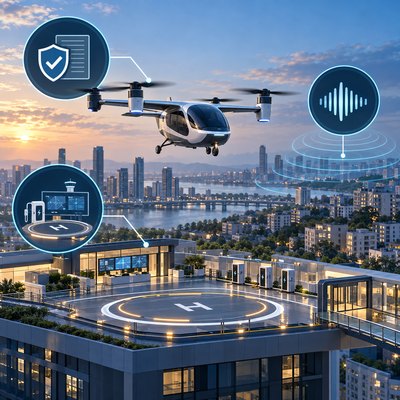
날아오르는 데 성공한 것과 승객을 태우고 도시를 오가는 것은 전혀 다른 문제다. 도심항공 이동체의 경쟁은 화려한 기체 성능을 넘어 안전 인증과 소음, 이착륙장 운영으로 이동하고 있다. 미래의 하늘길을 차지할 승자는 가장 멋진 항공기가 아니라 가장 완성도 높은 도시 교통망을 만든 사업자가 될 가능성이 크다.
[Key Message]
* eVTOL의 경쟁은 기체 개발에서 도시 운영으로 이동하고 있다. 시험비행의 성공만으로는 승객을 태울 수 없다. 인증과 운항허가, 정비, 관제, 이착륙장이 하나의 체계로 연결돼야 상용 서비스가 시작된다.
* 인증은 안전성을 넘어 기업의 자본력과 생산능력을 시험한다. 동일한 품질의 항공기를 반복 생산하고 수년간의 시험비용을 감당해야 한다. 릴리움과 볼로콥터의 위기는 비행 가능한 시제품만으로 시장에 진입할 수 없음을 보여줬다.
* 저소음 기체도 운항 횟수가 늘어나면 새로운 도시 소음원이 될 수 있다. 소음은 데시벨뿐 아니라 음색과 반복성, 비행시간과 항로에 따라 다르게 인식된다. 주민의 수용성을 확보하려면 기체 설계와 도시 항로를 함께 다뤄야 한다.
* 버티포트는 단순한 착륙장이 아니라 작은 공항이자 교통 플랫폼이다. 충전과 관제, 승객 처리, 소방, 지상교통 연결을 모두 갖춰야 한다. 핵심 입지를 선점한 버티포트 사업자가 기체 제조사보다 강한 영향력을 확보할 수도 있다.
* eVTOL의 승자는 가장 빠른 기체보다 가장 완성도 높은 이동망을 구축한 사업자가 될 가능성이 크다. 승객이 구매하는 것은 항공기 자체가 아니라 출발지에서 목적지까지 절약되는 시간이다. 인증과 소음, 버티포트, 지상교통을 하나의 경험으로 연결해야 시장이 열린다.
***
파리의 하늘에서 멈춰 선 미래
2024년 파리올림픽은 도심항공교통의 화려한 데뷔 무대가 될 예정이었다. 독일 볼로콥터(Volocopter)가 개발한 2인승 전기 수직이착륙 항공기 ‘볼로시티(VoloCity)’가 센강과 베르사유궁 주변을 날며 승객을 실어 나르는 장면이 계획됐다. 파리의 역사적인 풍경 위로 미래형 에어택시가 날아가는 모습은 전 세계 방송과 소셜미디어를 장식하기에 충분했다.
기체는 준비됐고 이착륙장도 세워졌다. 파리 공항 운영사 그루프 ADP는 센강 위에 떠 있는 바지선 형태의 버티포트까지 구상했다. 하지만 올림픽이 가까워질수록 사업을 붙잡는 것은 비행 기술이 아니라 인증이었다. 항공기 엔진과 시스템에 대한 유럽 당국의 승인이 예정대로 나오지 않으면서 승객을 태우는 운항은 무산됐다. 결국 진행된 것은 승객 없는 제한적인 시험비행이었다. 미래 교통의 상징이 될 장면은 인증 절차 앞에서 멈춰 섰다. 로이터는 당시 엔진 인증 지연으로 승객 운항 계획이 철회됐다고 전했다.
이 장면은 eVTOL(electric Vertical Take-Off and Landing) 산업이 어디까지 왔는지를 정확히 보여준다. 전기모터와 배터리, 분산 추진 장치로 항공기를 띄우는 기술은 상당한 수준에 도달했다. 여러 기업이 수천 회의 시험비행을 수행했고 속도와 항속거리, 수직이착륙 능력을 입증했다. 그러나 시험장에서 날아오르는 항공기와 대도시 한복판에서 매일 승객을 태우는 항공 서비스 사이에는 거대한 간격이 존재한다.
그 간격을 채우는 것이 형식인증과 생산인증, 운항허가, 조종사 자격, 정비 체계, 보험, 관제, 소음 기준, 이착륙장 승인이다. 한두 가지를 통과한다고 사업이 시작되는 것도 아니다. 기체와 조종사, 운항회사, 버티포트가 모두 제각각의 안전 요건을 충족해야 한다. eVTOL 경쟁은 더 이상 “이 기체가 날 수 있는가”를 묻는 경주가 아니다. “이 기체를 도시의 일상 속에서 반복적으로 운항할 수 있는가”를 증명하는 경주다.
하늘을 나는 자동차가 아닌 새로운 항공기
eVTOL은 ‘전기 수직이착륙 항공기’를 뜻한다. 활주로 없이 수직으로 이착륙하며 배터리와 전기모터를 이용한다. 여러 개의 작은 로터를 장착한 멀티콥터형, 이륙할 때는 프로펠러를 위로 향하게 하고 전진 비행 때는 방향을 바꾸는 틸트로터형, 수직이착륙 장치와 전진 비행용 날개를 분리한 리프트앤드크루즈형 등 설계도 다양하다.
겉모습만 보면 대형 드론에 가까워 보인다. 그러나 규제 당국의 시선에서 eVTOL은 새로운 전자제품이 아니라 사람의 생명을 싣는 항공기다. 스마트폰이나 자동차처럼 먼저 시장에 내놓고 소프트웨어를 업데이트하며 완성도를 높이는 방식은 허용되기 어렵다. 전기모터 하나가 멈췄을 때 어떤 일이 일어나는지, 배터리 셀에서 열폭주가 발생해도 안전하게 착륙할 수 있는지, 비와 강풍 속에서 제어 시스템이 어떻게 반응하는지를 사전에 입증해야 한다.
FAA(미국 연방항공청)은 eVTOL을 단순한 비행기나 헬리콥터가 아닌 ‘파워드리프트(powered-lift)’ 범주로 다룬다. 이 항공기는 헬리콥터처럼 수직으로 뜨지만 비행 중에는 날개를 이용해 비행기처럼 이동하기 때문이다. 기체의 안전성만 확인해서는 부족하다. 조종사가 어떤 교육을 받아야 하는지, 어느 고도와 항로를 이용할지, 공항과 버티포트에서 어떤 절차를 따라야 하는지도 새롭게 정해야 한다.
FAA가 2024년 파워드리프트 운항과 조종사 훈련에 관한 최종 규칙을 마련한 것은 중요한 전환점이었다. 개발기업이 기체의 성능을 설명하는 단계를 넘어 실제 운항을 전제로 한 제도적 틀이 만들어지기 시작했다는 의미다. 다만 규칙이 마련된 것과 개별 기체가 인증받는 것은 별개의 문제다. 설계 기준을 합의한 뒤에도 부품과 소프트웨어, 구조물, 배터리, 비행제어 장치가 기준에 맞는다는 사실을 시험과 분석으로 증명해야 한다.
미국 아처 에비에이션(Archer Aviation)은 4인승 eVTOL ‘미드나이트(Midnight)’의 인증을 추진하면서 2026년 FAA 형식인증 과정의 3단계를 마쳤다고 발표했다. 회사 설명대로라면 인증 방법을 정하는 구간을 지나 실제 시험과 분석으로 적합성을 입증하는 마지막 단계로 이동한 것이다. 그러나 이것은 결승선을 통과했다는 의미가 아니다. 오히려 가장 많은 시간과 비용이 들어갈 수 있는 증명 과정에 진입했다는 뜻에 가깝다.
인증서는 기술보다 많은 것을 요구한다
항공기 인증은 한 번의 비행시험으로 끝나는 합격시험이 아니다. 설계가 안전하다는 사실뿐 아니라 똑같은 품질의 항공기를 계속 생산할 수 있다는 사실까지 보여줘야 한다. 시제품 한 대가 훌륭하게 날았더라도 공장에서 생산한 열 번째와 백 번째 기체가 같은 안전성을 갖지 못한다면 상업 운항은 불가능하다.
이 지점에서 eVTOL 스타트업은 전통적인 항공산업의 무게를 체감한다. 배터리나 모터의 설계를 변경하면 항속거리만 달라지는 것이 아니다. 무게중심과 냉각 성능, 화재 위험, 비상 착륙 절차가 함께 달라진다. 공급업체가 부품 하나를 바꾸더라도 인증 자료를 다시 검토해야 할 수 있다. 빠른 개발과 잦은 개선을 장점으로 삼았던 스타트업의 방식이 항공 인증 체계와 충돌하는 이유다.
인증 기간이 길어지면 자금 문제도 커진다. 시험기와 생산시설을 유지하고 수백 명의 엔지니어를 고용하는 동안 승객 운송 매출은 발생하지 않는다. 독일의 릴리움(Lilium)은 장거리 비행이 가능한 전기 제트라는 야심 찬 구상을 내세웠지만 인증과 생산을 완성하기 전에 자금난에 빠졌다. 볼로콥터 역시 파리올림픽 운항 계획이 늦어진 뒤 필요한 자금을 확보하지 못해 2024년 말 지급불능 절차를 신청했다. 두 사례는 좋은 아이디어와 비행 가능한 시제품만으로 항공회사가 탄생하지 않는다는 사실을 보여줬다. 릴리움의 위기는 인증이 기술인 동시에 자본력의 시험임을 드러냈다.
따라서 eVTOL 시장의 경쟁력은 최고속도나 최대 항속거리만으로 평가하기 어렵다. 규제기관과 얼마나 긴밀하게 협력하는지, 인증에 필요한 자료를 얼마나 체계적으로 생산하는지, 부품 공급망을 얼마나 안정적으로 관리하는지가 더 중요해지고 있다. 자동차 기업과 대형 항공사, 방산업체가 eVTOL 기업에 투자하거나 제휴하는 이유도 여기에 있다. 대량생산 경험과 품질관리 체계, 정비망과 운항 경험이 새로운 추진 기술만큼 중요하기 때문이다.
조용하다는 말과 조용하게 느끼는 것의 차이
eVTOL이 내세우는 대표적인 장점은 저소음이다. 내연기관과 거대한 메인로터를 사용하는 헬리콥터보다 전기모터와 여러 개의 작은 프로펠러를 사용하는 eVTOL이 더 조용할 가능성은 크다. 일부 개발사는 비행 중 소음이 도시의 배경음에 묻힐 정도라고 홍보한다.
그러나 소음은 하나의 데시벨 숫자로 설명되지 않는다. 사람은 소리의 크기뿐 아니라 높낮이와 반복성, 지속시간, 발생 시각에 반응한다. 짧게 지나가는 낮은 소리보다 약한 고주파음이 반복될 때 더 거슬릴 수 있다. 한 시간에 한 대가 지나가는 것과 2분마다 한 대씩 같은 항로를 통과하는 것도 전혀 다른 경험이다.
더구나 eVTOL은 헬리콥터보다 조용하기만 해서는 부족하다. 헬리콥터는 운항 횟수가 제한적이지만 도심항공교통은 높은 운항 빈도를 전제로 수익을 계산한다. 한 대의 소리가 작더라도 수십 대가 하루 종일 오가면 주민이 느끼는 소음 부담은 커진다. 저소음 기체가 고빈도 소음망을 만들 수 있는 역설이다.
기체마다 음색도 다르다. 여러 프로펠러가 서로 다른 속도로 회전하고, 수직비행에서 전진비행으로 전환하는 동안 소리의 방향과 주파수가 바뀐다. 건물 사이에서는 반사음까지 발생한다. 넓은 시험장에서는 조용했던 항공기가 유리 외벽과 콘크리트 건물이 밀집한 도심에서는 다르게 들릴 수 있다.
그래서 소음 경쟁은 모터 기술에만 머물지 않는다. 비행경로와 고도, 운항시간, 접근 방향을 함께 설계해야 한다. 학교와 병원, 주거지역을 피하면서도 승객이 원하는 장소에 빠르게 도착해야 한다. 특정 지역에 소음을 집중시키지 않도록 항로를 분산하면 비행시간과 에너지 소비가 늘어날 수 있다. 주민의 수용성과 운항 효율 사이에서 균형을 찾는 일이 필요하다.
소음은 기술적 허용치의 문제인 동시에 사회적 허가의 문제다. 법적 기준을 지켰더라도 주민이 일상 침해를 느끼면 버티포트 건설과 항로 승인이 지연될 수 있다. eVTOL이 도시의 교통수단이 되려면 “헬리콥터보다 조용하다”는 비교를 넘어 “이 지역에서 이 횟수로 운항해도 받아들일 만하다”는 동의를 얻어야 한다.
활주로보다 작은 공간에 담아야 할 거대한 시스템
버티포트는 흔히 건물 옥상에 그려진 원형 착륙장으로 표현된다. 그러나 실제 버티포트는 페인트로 ‘H’나 ‘V’를 그려 넣은 공간이 아니다. 승객 대기와 탑승, 보안검색, 수하물 처리, 충전, 기체 점검, 소방, 비상대응, 관제와 기상정보 제공이 함께 이뤄지는 작은 공항이다.
eVTOL의 장점은 활주로가 필요 없다는 데 있지만 수직이착륙 공간이 작다고 운영까지 간단해지는 것은 아니다. 항공기 한 대가 착륙한 뒤 승객을 내리고 다시 태우며 배터리를 충전하는 동안 다른 기체가 접근한다. 착륙 패드가 하나뿐이라면 작은 지연도 뒤따르는 항공편 전체에 영향을 준다. 패드를 늘리면 처리 능력은 좋아지지만 넓은 부지와 더 많은 안전거리가 필요하다.
전력도 새로운 병목이다. 여러 대가 짧은 시간에 고속 충전하면 건물 한 채에 상당하는 전력이 순간적으로 필요할 수 있다. 기존 건물 옥상을 버티포트로 바꾸려면 구조 하중뿐 아니라 전력망과 배터리 저장장치, 냉각설비, 화재 대응 체계를 함께 보강해야 한다. 도심의 가장 좋은 입지는 땅값이 비싸고, 값싼 외곽 부지는 승객의 최종 목적지에서 멀다.
유럽항공안전청(EASA)이 제시한 버티포트 기술 사양도 착륙 구역만 다루지 않는다. 장애물 제한, 접근·출발 경로, 안전구역과 비상 절차를 함께 고려한다. 특히 방향을 자유롭게 조정할 수 있는 비행경로는 도심의 건물과 환경·소음 제한을 피하는 수단이 될 수 있다. 버티포트 설계가 기체 성능과 도시계획을 이어주는 접점인 셈이다. EASA의 버티포트 설계 사양은 도심 환경과 소음 제한을 고려한 접근경로의 필요성을 강조한다.
이 때문에 버티포트 사업자는 단순한 부동산 개발회사가 되기 어렵다. 항공기 운항사와 전력회사, 공항, 지방정부, 교통 플랫폼을 동시에 연결해야 한다. 어느 기종이든 이용할 수 있는 개방형 시설로 만들지, 특정 eVTOL 회사의 전용망으로 운영할지도 선택해야 한다. 충전 규격과 데이터 연결 방식이 제각각이라면 초기 버티포트는 특정 기체에 종속될 가능성도 있다.
스마트폰 시장에서 운영체제와 앱스토어가 기기만큼 중요해졌듯, eVTOL 시장에서는 버티포트와 예약·관제 시스템이 플랫폼 역할을 할 수 있다. 좋은 도심 입지를 먼저 확보하고 항공사와 장기 계약을 맺은 사업자는 기체 제조사보다 안정적인 영향력을 가질 수 있다. 미래 항공시장의 귀한 자산은 특허받은 날개가 아니라 공항과 도심을 연결하는 옥상 한 칸일지도 모른다.
두바이는 기체와 도시를 함께 준비한다
이 경쟁을 가장 선명하게 보여주는 도시는 두바이다. 두바이 도로교통청은 조비 에비에이션(Joby Aviation), 버티포트 개발사 스카이포츠 인프라스트럭처(Skyports Infrastructure)와 함께 에어택시 운항망을 준비해왔다. 구상은 항공기를 들여온 뒤 착륙장을 찾는 방식이 아니다. 두바이국제공항과 팜 주메이라, 두바이 마리나, 도심을 연결하는 핵심 지점을 먼저 네트워크로 묶는다.
조비가 제시한 구상에서는 두바이국제공항에서 팜 주메이라까지 자동차로 약 45분 걸리는 이동을 약 12분 비행으로 단축한다. 중요한 것은 ‘12분’이라는 숫자보다 그 앞뒤의 시간이다. 공항 터미널에서 버티포트까지 이동하고 보안 절차를 거쳐 탑승한 뒤, 도착지에서 다시 자동차나 대중교통으로 갈아타야 한다면 체감시간은 길어진다. 에어택시의 상품성은 비행속도보다 환승과 탑승 과정에서 결정된다.
조비가 차량호출 서비스와 항공여행을 하나의 예약 흐름으로 묶으려는 이유도 같다. 승객은 eVTOL 자체를 구매하는 것이 아니라 출발지에서 목적지까지 단축된 시간을 구매한다. 버티포트가 지하철이나 공항, 호텔과 제대로 연결되지 않으면 빠른 항공기도 도시교통 서비스가 되지 못한다.
두바이는 강한 행정 추진력과 비교적 유연한 도시계획, 프리미엄 교통 수요를 갖추고 있다. 사막 지역에서 시험비행을 진행하기 쉽고 새로운 기반시설을 계획적으로 배치할 여지도 크다. 그럼에도 인증과 버티포트 건설, 실제 운항허가가 모두 맞물려야 서비스가 시작된다. 2025년 현지 시험비행이 이뤄졌지만 시험비행과 정기 유상운송 사이에는 여전히 규제와 운영의 단계가 남아 있다. 두바이는 초기 네 곳의 버티포트를 기반으로 서비스를 준비해왔다.
로스앤젤레스도 2028년 올림픽을 계기로 eVTOL 도입을 준비한다. 아처는 경기장과 로스앤젤레스국제공항, 할리우드, 산타모니카 등을 연결하는 운항망을 제시했다. 파리올림픽의 좌절을 경험한 산업이 다시 올림픽을 대규모 시범무대로 선택한 것이다. 다만 이번 경쟁의 질문은 “기체가 행사장 위를 날 수 있는가”에서 “행사 이후에도 지속 가능한 교통망으로 남을 수 있는가”로 바뀌고 있다.
승자는 가장 많이 날린 회사가 아닐 수 있다
초기 eVTOL 시장은 모든 시민이 하늘을 나는 통근 시대를 맞이할 것처럼 묘사됐다. 도로 정체를 피해 집 근처에서 곧바로 도심으로 날아가는 미래였다. 하지만 실제 사업은 공항 셔틀과 관광, 고급 이동 서비스, 의료·응급 운송처럼 노선과 수요를 예측하기 쉬운 영역에서 시작할 가능성이 크다.
그 이유는 경제성에 있다. 조종사를 포함해 네다섯 명만 탑승하는 항공기를 운항하면서 기체 감가상각과 정비, 보험, 전력, 버티포트 이용료를 부담해야 한다. 요금을 낮추려면 높은 탑승률과 빠른 회전율이 필요하다. 하지만 배터리 충전과 점검시간을 지나치게 줄이면 안전과 수명이 문제된다. 저렴한 대중교통을 표방하기 전에 프리미엄 서비스로 수요와 운영 경험을 축적하려는 전략이 현실적이다.
버티포트 입지도 서비스의 성격을 바꾼다. 부유층이 이용하는 호텔과 리조트, 기업단지에만 착륙장이 생기면 eVTOL은 교통 혁신보다 새로운 고급 이동수단으로 인식될 수 있다. 반대로 기존 공항과 철도역, 버스터미널에 연결하면 도시 전체의 교통망을 보완할 수 있다. 어느 지역에 이착륙장을 허용할 것인가는 기술기업의 결정이 아니라 도시의 공공정책이 된다.
산업의 승자를 가르는 기준도 달라지고 있다. 가장 긴 항속거리를 제시한 회사가 아니라 인증 일정을 버틸 자본을 확보한 회사, 주민이 받아들일 소음 수준을 만든 회사, 핵심 입지와 전력망을 선점한 회사, 지상교통까지 매끄럽게 연결한 회사가 앞서갈 수 있다. 기체 제조사가 주도할 수도 있지만 항공사나 공항 운영사, 버티포트 개발사, 예약 플랫폼이 더 강력한 위치를 차지할 가능성도 있다.
eVTOL은 이미 날고 있다. 그러나 산업의 진짜 도약은 시험기가 지면에서 떠오르는 순간이 아니라 평범한 승객이 예약하고 탑승한 뒤 예정된 시간에 안전하게 도착하는 순간 완성된다. 그때 필요한 것은 항공기 한 대가 아니다. 인증서와 조용한 항로, 충전 가능한 이착륙장, 숙련된 조종사와 정비사, 주민의 동의가 하나의 시스템으로 연결돼야 한다.
미래의 도심 하늘은 가장 빠른 기체가 차지하지 않을 수 있다. 도시가 기꺼이 문을 열어줄 만큼 안전하고 조용하며, 반복해서 운영할 수 있는 사업자가 차지할 가능성이 크다. eVTOL 경쟁의 무대는 이미 설계도와 시험장을 벗어났다. 이제 승부는 도시의 옥상과 규제기관의 심사실, 그리고 비행경로 아래 주민들의 일상에서 벌어지고 있다.
Reference
Federal Aviation Administration, October 2024, Final Rule on Powered-Lift Pilot Certification and Operations
European Union Aviation Safety Agency, March 2022, Prototype Technical Design Specifications for Vertiports
Reuters, August 2024, Plans to Fly Air Taxis with Passengers during Paris Olympics Scrapped
Reuters, July 2025, Dubai Aims to Beat the Traffic with Joby Air Taxi Service
Archer Aviation, May 2026, First Quarter 2026 Results and FAA Certification Progress
Flying Taxis Are Now Competing for Places to Land
- Competition in the eVTOL industry is shifting from aircraft development to certification, noise management, and vertiport operations
Successfully taking off and carrying passengers through a city are two entirely different challenges. Competition in urban air mobility is moving beyond impressive aircraft performance toward safety certification, noise management, and takeoff and landing operations. The winner in the race for the urban skies may not be the company that builds the most striking aircraft, but the one that creates the most complete urban transportation network.
[Key Message]
Competition in the eVTOL industry is shifting from aircraft development to urban operations. A successful test flight alone does not permit an aircraft to carry passengers. Certification, operating approval, maintenance, air traffic management, and landing infrastructure must function as one system before commercial service can begin.
Certification tests a company’s financial endurance and manufacturing capability as well as aircraft safety. A developer must produce aircraft of consistent quality while financing years of testing and engineering. The crises at Lilium and Volocopter showed that a flyable prototype alone is not enough to enter the market.
Even a low-noise aircraft can become a new source of urban disturbance when flight frequency increases. Noise perception depends on tone, repetition, operating hours, and flight paths as well as decibel levels. Aircraft design and urban route planning must therefore be addressed together to secure community acceptance.
A vertiport is not merely a landing pad but a small airport and a transportation platform. It must combine charging, traffic control, passenger processing, firefighting, and connections to ground transportation. Vertiport operators that secure prime locations may gain more influence than aircraft manufacturers.
The eVTOL winner is more likely to be the operator with the most complete mobility network than the company with the fastest aircraft. Passengers are not buying the aircraft itself; they are buying the time saved between departure and destination. The market will open only when certification, noise management, vertiports, and ground transportation are integrated into one seamless experience.
***
A Future Grounded in the Skies over Paris
The 2024 Paris Olympics was expected to provide a spectacular debut for urban air mobility. The plan was for VoloCity, a two-seat electric vertical takeoff and landing aircraft developed by Germany’s Volocopter, to carry passengers over the Seine and around the Palace of Versailles. The sight of a futuristic air taxi flying above the historic Paris skyline seemed tailor-made for international broadcasts and social media.
The aircraft was ready, and takeoff and landing facilities had been built. Groupe ADP, the operator of the Paris airports, even envisioned a floating vertiport installed on a barge on the Seine. As the Olympics approached, however, it was certification?not flight technology?that held the project back. European regulatory approval for the aircraft’s motors and related systems did not arrive as scheduled, forcing the cancellation of passenger operations. What remained was a limited demonstration flight without passengers. A scene intended to symbolize the future of transportation was grounded by the realities of aviation certification. Reuters reported that delayed motor certification led to the cancellation of passenger flights.
The episode accurately illustrated how far the eVTOL industry had progressed?and how far it still had to go. The technology required to lift an aircraft using electric motors, batteries, and distributed propulsion systems had reached a significant level of maturity. Several companies had completed thousands of test flights and demonstrated speed, range, and vertical takeoff and landing capabilities. Yet a vast gap remained between flying an aircraft at a test site and carrying passengers through a major city every day.
That gap must be filled with type certification, production certification, operating approval, pilot qualifications, maintenance systems, insurance, air traffic management, noise standards, and landing-site permits. Passing one or two requirements does not open the door to commercial service. The aircraft, pilots, operator, and vertiport must each satisfy their own safety requirements. The eVTOL race is no longer about proving that an aircraft can fly. It is about demonstrating that the aircraft can operate repeatedly and reliably within the daily life of a city.
Not a Flying Car, but a New Kind of Aircraft
eVTOL stands for “electric vertical takeoff and landing aircraft.” It takes off and lands vertically without a runway and is powered by batteries and electric motors. Designs vary widely. Some resemble multicopters equipped with numerous small rotors. Tilt-rotor models point their propellers upward during takeoff and rotate them for forward flight. Lift-and-cruise designs use separate systems for vertical lift and forward movement.
From the outside, an eVTOL may look like a large drone. In the eyes of aviation regulators, however, it is not a new electronic gadget but an aircraft carrying human lives. It cannot be released first and perfected later through software updates in the manner of a smartphone or automobile. Developers must demonstrate in advance what happens when an electric motor stops, whether the aircraft can land safely during a battery-cell thermal runaway, and how its control systems respond to rain and strong winds.
The US Federal Aviation Administration classifies eVTOL aircraft as “powered-lift” rather than simply as airplanes or helicopters. These aircraft rise vertically like helicopters but use wings to travel like airplanes during forward flight. Verifying the safety of the aircraft alone is not sufficient. Regulators must also determine how pilots should be trained, which altitudes and routes the aircraft should use, and which procedures must be followed at airports and vertiports.
The FAA’s adoption of a final rule concerning powered-lift operations and pilot training in 2024 represented an important turning point. It indicated that the industry was moving beyond developers explaining aircraft performance and toward the establishment of an institutional framework for actual operations. The creation of regulations, however, does not mean that an individual aircraft has been certified. Even after regulators and developers agree on certification standards, the company must prove through testing and analysis that its components, software, structure, batteries, and flight-control systems comply with those standards.
US-based Archer Aviation has been pursuing certification of Midnight, its four-passenger eVTOL aircraft. In 2026, Archer announced that it had completed Phase 3 of the FAA’s four-phase type-certification process. According to the company, this meant it had moved beyond the stage of establishing certification methods and entered the final phase, in which compliance must be demonstrated through actual tests and analyses. It did not mean that Midnight had crossed the finish line. Rather, it suggested that the aircraft had entered what could be the most expensive and time-consuming part of certification. Archer reported the completion of Phase 3 in its first-quarter 2026 results.
Certification Requires More than Technology
Aircraft certification is not a pass-or-fail examination completed with a single test flight. A company must demonstrate not only that its design is safe but also that it can continue manufacturing aircraft of the same quality. Even if one prototype flies perfectly, commercial service cannot begin unless the tenth and hundredth aircraft produced at the factory can deliver the same level of safety.
This is where eVTOL startups begin to feel the full weight of the traditional aviation industry. Changing the design of a battery or motor affects more than range. It may also change the aircraft’s center of gravity, cooling performance, fire risk, and emergency-landing procedures. Even when a supplier replaces a single component, certification documents may need to be reviewed again. The startup approach, which regards rapid development and frequent improvement as strengths, can therefore collide with the requirements of aviation certification.
The longer certification takes, the greater the financial pressure becomes. Companies must maintain test aircraft and production facilities and employ hundreds of engineers without earning revenue from passenger transportation. Germany’s Lilium presented an ambitious vision of an electric jet capable of longer-distance travel but encountered severe financial difficulties before it could complete certification and production. Volocopter also entered insolvency proceedings at the end of 2024 after its Paris Olympic plans were delayed and it failed to secure sufficient funding. Both cases demonstrated that an attractive idea and a flyable prototype were not enough to create a functioning aviation business. The crises at Lilium and Volocopter showed that certification is a test of both technology and financial endurance.
Competitiveness in the eVTOL market cannot therefore be assessed only by maximum speed or range. A company’s ability to cooperate with regulators, systematically produce certification evidence, and maintain a stable supply chain is becoming more important. This also explains why automakers, major airlines, and defense companies are investing in or forming partnerships with eVTOL developers. Experience in mass production, quality control, maintenance networks, and flight operations matters as much as new propulsion technology.
The Difference between Being Quiet and Feeling Quiet
Low noise is one of the principal advantages claimed for eVTOL aircraft. An eVTOL powered by electric motors and multiple small propellers is likely to be quieter than a helicopter using an internal-combustion engine and a large main rotor. Some developers claim that the sound of their aircraft during flight will blend into the background noise of a city.
Noise, however, cannot be explained by a single decibel measurement. People respond not only to the volume of a sound but also to its pitch, repetition, duration, and timing. A weak, high-frequency sound repeated continuously can be more irritating than a louder, lower-frequency noise that passes quickly. One aircraft passing every hour also creates a completely different experience from one flying along the same route every two minutes.
Furthermore, it is not enough for eVTOL aircraft simply to be quieter than helicopters. Helicopter operations are relatively infrequent, whereas the business case for urban air mobility is based on high flight frequency. Even if each aircraft produces less noise, the burden on residents may grow when dozens of aircraft fly throughout the day. A low-noise aircraft can paradoxically create a high-frequency noise network.
The acoustic character of each aircraft also differs. Multiple propellers rotate at different speeds, while the direction and frequency of the sound change as the aircraft transitions from vertical to forward flight. Reflected sound adds another layer between buildings. An aircraft that seems quiet at an open test site may sound very different in a city filled with glass facades and concrete structures.
Noise competition is therefore not limited to motor technology. Operators must design flight paths, altitudes, operating hours, and approach directions together. They must avoid schools, hospitals, and residential neighborhoods while reaching the locations passengers want quickly. Dispersing routes to prevent noise from being concentrated over one district may increase both flight time and energy consumption. A balance must be found between community acceptance and operating efficiency.
Noise is as much a question of social permission as it is of technical compliance. Even if a service meets legal limits, residents who feel that it intrudes on their daily lives can delay vertiport construction and route approval. For eVTOL aircraft to become part of a city’s transportation system, operators must go beyond the comparison that they are quieter than helicopters. They must secure public acceptance that a particular number of flights over a particular neighborhood is reasonable.
A Vast System Compressed into a Space Smaller than a Runway
Vertiports are often illustrated as circular landing pads painted on rooftops. An actual vertiport, however, is not merely a space marked with an “H” or “V.” It is a small airport combining passenger waiting and boarding, security screening, baggage handling, charging, aircraft inspection, firefighting, emergency response, traffic control, and weather information.
The absence of a runway is one of the great advantages of eVTOL aircraft, but a smaller takeoff and landing area does not make operations simple. One aircraft lands, passengers disembark, new passengers board, and the battery is charged while another aircraft approaches. If there is only one landing pad, a minor delay can affect every subsequent flight. Adding more pads improves capacity but requires more land and greater safety distances.
Electricity can also become a bottleneck. If several aircraft use high-speed chargers within a short period, the facility may require as much instantaneous power as a substantial building. Converting the roof of an existing building into a vertiport requires more than reinforcing it to bear additional structural loads. The electrical grid, battery-storage systems, cooling equipment, and fire-response facilities may all require upgrades. The most desirable urban locations have high property costs, while cheaper sites on the outskirts are far from passengers’ final destinations.
The technical specifications for vertiports developed by the European Union Aviation Safety Agency address more than the landing area. They consider obstacle limitations, arrival and departure paths, safety zones, and emergency procedures. Flexible flight paths can help aircraft avoid buildings and comply with environmental and noise restrictions in cities. Vertiport design therefore becomes the point where aircraft performance and urban planning meet. EASA’s vertiport design specifications emphasize approach paths that reflect urban conditions and noise restrictions.
A vertiport operator cannot function as a conventional property developer alone. It must connect aircraft operators, electricity providers, airports, local governments, and transportation platforms. It must also decide whether the facility will be open to various aircraft types or operated as a proprietary network for one eVTOL company. If charging standards and data systems differ, early vertiports may become dependent on particular aircraft manufacturers.
Just as operating systems and app stores became as important as devices in the smartphone market, vertiports and reservation and traffic-management systems could become platforms in the eVTOL industry. A company that secures prime urban locations and long-term airline contracts may gain more stable influence than an aircraft manufacturer. The most valuable asset in the future aviation market may not be a patented wing but a section of rooftop connecting an airport with the center of a city.
Dubai Is Preparing the Aircraft and the City Together
Dubai offers one of the clearest examples of this emerging competition. The Dubai Roads and Transport Authority has been preparing an air-taxi network with Joby Aviation and vertiport developer Skyports Infrastructure. Its approach is not to import aircraft first and search for landing sites later. Instead, the plan begins by connecting key locations, including Dubai International Airport, Palm Jumeirah, Dubai Marina, and the city center, as a network.
Under Joby’s proposal, the journey from Dubai International Airport to Palm Jumeirah?approximately 45 minutes by car?could be reduced to a flight of about 12 minutes. More important than the figure of 12 minutes, however, is the time required before and after the flight. If passengers must travel from an airport terminal to the vertiport, pass through security, board, and then transfer to a car or public transportation at their destination, the perceived journey time becomes much longer. The commercial value of an air taxi will be determined less by its flight speed than by the efficiency of the transfer and boarding process.
This is why Joby has sought to connect ride-hailing and air travel within a single reservation journey. Passengers do not purchase an eVTOL aircraft; they purchase a reduction in the time required to move from their point of departure to their final destination. If a vertiport is not properly connected to a subway station, airport, or hotel, even a fast aircraft will fail to become a genuine urban transportation service.
Dubai has strong administrative capacity, relatively flexible urban planning, and demand for premium transportation. Test flights can be conducted more easily in desert areas, while the city has room to place new infrastructure strategically. Even so, service can begin only when certification, vertiport construction, and operating approval are all in place. Local test flights were conducted in 2025, but regulatory and operational steps still remain between a demonstration flight and scheduled commercial passenger transportation. Dubai has been preparing its initial service around a network of four vertiports.
Los Angeles is also preparing to introduce eVTOL services around the 2028 Olympic Games. Archer has proposed a network connecting sports venues with Los Angeles International Airport, Hollywood, Santa Monica, and other locations. After the industry’s disappointment in Paris, the Olympics is once again being chosen as a major demonstration stage. The central question, however, is shifting from whether an aircraft can fly over an Olympic venue to whether the service can remain a sustainable transportation network after the event ends.
The Winner May Not Be the Company with the Most Aircraft in the Air
Early visions of the eVTOL market suggested that every citizen would soon commute through the sky, bypassing road congestion by flying directly from a neighborhood landing site to the city center. In practice, initial services are more likely to begin with airport shuttles, tourism, premium transportation, and medical or emergency missions, where routes and demand are relatively predictable.
The reason is economic. An operator must cover aircraft depreciation, maintenance, insurance, electricity, and vertiport charges while carrying only four or five people, including the pilot. Lower fares require high passenger occupancy and rapid aircraft turnaround. Reducing charging and inspection time too aggressively, however, can create safety and battery-life problems. A strategy of building demand and operational experience through premium services is more realistic than immediately presenting eVTOLs as affordable public transportation.
The location of vertiports will also define the character of the service. If landing facilities are built only at hotels, resorts, and corporate campuses used by affluent passengers, eVTOLs may be perceived as another luxury transportation option rather than a mobility revolution. If they connect with airports, railway stations, and bus terminals, they could complement the broader urban transportation network. Decisions about where to permit takeoff and landing facilities will therefore become matters of public policy rather than choices made solely by technology companies.
The criteria determining the industry’s winners are changing as well. The leading company may not be the one promising the longest range. It may be the company that secures enough capital to survive certification, creates a noise profile residents can accept, obtains key sites and electricity capacity, and connects smoothly with ground transportation. Aircraft manufacturers may lead the market, but airlines, airport operators, vertiport developers, or reservation platforms could occupy more powerful positions.
eVTOL aircraft are already flying. The industry’s real takeoff, however, will occur not when a prototype rises from the ground but when an ordinary passenger books a flight, boards the aircraft, and arrives safely at the scheduled time. That requires far more than one aircraft. Certificates, quiet flight paths, chargeable landing facilities, trained pilots and mechanics, and community consent must be connected as a single system.
The fastest aircraft may not claim the future urban skies. Those skies are more likely to belong to an operator that is safe and quiet enough for cities to open their doors and reliable enough to repeat the service every day. The eVTOL race has already moved beyond design drawings and test sites. The contest is now unfolding on urban rooftops, inside regulatory offices, and in the daily lives of residents living beneath future flight paths.
Reference
Federal Aviation Administration, October 2024, Final Rule on Powered-Lift Pilot Certification and Operations
European Union Aviation Safety Agency, March 2022, Prototype Technical Design Specifications for Vertiports
Reuters, August 2024, Plans to Fly Air Taxis with Passengers during Paris Olympics Scrapped
Reuters, July 2025, Dubai Aims to Beat the Traffic with Joby Air Taxi Service
Archer Aviation, May 2026, First Quarter 2026 Results and FAA Certification Progress