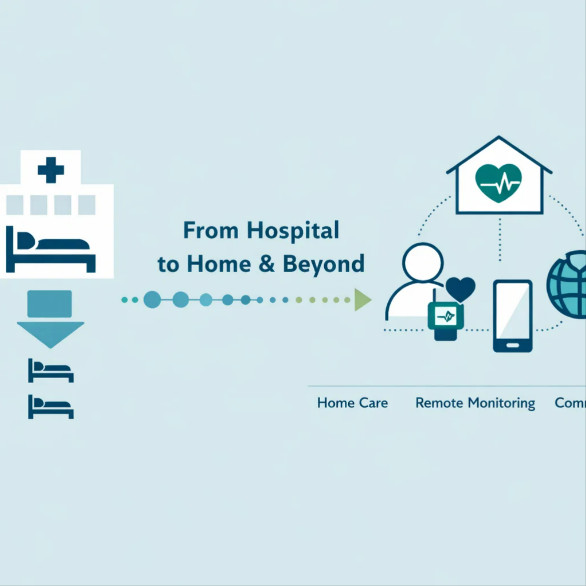
* 병원 밖 치료는 편의의 문제가 아니라 의료체계 생존 전략이다. 고령화와 만성질환, 인력 부족, 병상 압박이 겹치면서 치료를 병원 밖으로 확장하는 흐름은 선택이 아니라 구조적 대응이 되고 있다.
* 앞으로 병원은 모든 환자를 붙잡는 공간이 아니라, 정말 위중한 환자에게 집중하는 공간이 된다. 응급, 중환자, 고난도 처치에 병원의 역량을 집중하고, 회복기와 만성질환 관리는 집과 지역사회로 분산하는 방향이 강화되고 있다.
* 집은 회복의 공간을 넘어 제도적 치료의 공간으로 바뀌고 있다. 재택 치료, 방문진료, 원격 모니터링이 결합되면서 퇴원 이후의 공백을 줄이고, 치료의 연속성을 집 안에서도 유지하는 구조가 확산되고 있다.
* 병원 밖 치료의 성패는 기술보다 운영과 제도에 달려 있다. 웨어러블 기기나 앱보다 더 중요한 것은 환자 선별, 위기 대응 기준, 인력 배치, 보험 보상, 지역 돌봄 연계 같은 제도적 설계다.
* 미래 의료의 경쟁력은 병상 수보다 환자를 집에서 얼마나 안전하게 관리할 수 있는가에 달려 있다. 앞으로 의료기관과 국가의 경쟁력은 큰 병원을 얼마나 많이 갖췄느냐보다, 퇴원 뒤 환자를 얼마나 안정적으로 추적하고 지켜낼 수 있느냐로 평가될 가능성이 크다.
***
병원은 오랫동안 치료의 중심이었다. 상태가 나빠지면 입원하고, 안정되면 퇴원하는 구조가 의료의 기본 문법처럼 여겨졌다. 그러나 앞으로의 의료는 이 단순한 선을 따라가지 않는다. 치료는 입원실 안에서만 이뤄지지 않고, 퇴원 이후의 집과 지역사회, 그리고 디지털 장비가 연결된 생활 공간으로 길게 이어진다.
재택 치료와 원격 모니터링이 중요해지는 이유도 여기에 있다. 이것은 편리한 서비스 몇 가지가 늘어나는 변화가 아니라, 병원 중심 체계가 스스로의 한계를 인정하고 운영 방식을 바꾸는 움직임에 가깝다. 세계적으로 고령 인구가 빠르게 늘고, 만성질환 관리 수요가 커지는 가운데, 병상과 인력만으로 의료 수요를 감당하기 어려워지고 있다는 점이 이 전환의 배경이다.
왜 이런 변화가 커지는가. 가장 큰 배경은 고령화와 만성질환의 확대다. 앞으로 의료가 감당해야 할 환자는 한 번 입원해서 끝나는 사람이 아니라, 오래 지켜보고 자주 개입해야 하는 사람이 많아진다. 심부전, 당뇨, 만성 호흡기 질환, 허약 노인 관리, 수술 후 회복기, 암 치료 이후의 경과 관찰처럼 상태는 불안정할 수 있지만 반드시 병동에 오래 머무를 필요는 없는 환자가 늘어난다.
동시에 병상을 운영할 인력은 충분하지 않고, 재정도 무한하지 않다. 결국 의료는 병원이라는 건물 안에 모든 환자를 오래 머무르게 하는 방식 대신, 꼭 병원에 있어야 하는 시간만 압축하고 나머지는 밖에서 이어가는 방식으로 이동하고 있다. 영국과 미국, 캐나다를 비롯한 여러 나라가 가상병동과 호스피탈앳홈(hospital-at-home) 모델을 확산시키는 것도 같은 문제의식에서다. 호스피탈앳홈은 입원 수준의 치료를 집에서 제공하는 재택의료 모델이다.
병원의 역할은 더 선명해진다
이 변화는 병원이 약해진다는 뜻이 아니다. 오히려 병원이 가장 잘해야 하는 일과 그렇지 않은 일을 구분하는 과정에 가깝다. 응급 대응, 중환자 관리, 수술과 시술, 급성 악화에 대한 집중 치료는 여전히 병원 안에서 이뤄져야 한다. 하지만 모든 회복과 관찰, 경과 추적까지 병동이 전담하는 구조는 점점 비효율적이 된다. 앞으로 병원은 더 짧고 더 강한 치료의 공간이 되고, 회복과 추적은 바깥으로 이어지는 구조가 표준에 가까워질 가능성이 크다. 병원은 건물로서의 병원이 아니라, 필요할 때 높은 밀도의 처치를 제공하는 핵심 거점으로 다시 정의되고 있다.
이렇게 보면 재택 치료와 원격 모니터링은 입원을 단순히 줄이는 저비용 정책이 아니다. 그것은 병원이 정말 필요한 환자를 위해 병상을 비워두는 운영 기술이다. 많은 나라가 병상 자원을 더 효율적으로 써야 한다는 압력을 받고 있다. 중요한 것은 병상을 무조건 늘리는 것이 아니라, 어떤 환자를 병원 안에 두고 어떤 환자를 밖에서 관리할 수 있는지를 정교하게 나누는 능력이다. 병상은 물리적 공간이지만, 실제 의료의 성패는 환자를 어디에 두느냐보다 어떤 강도로 감시하고 개입하느냐에 달려 있다. 그래서 미래의 병원 경쟁력은 단지 수술 건수나 장비 규모뿐 아니라, 퇴원 이후 환자를 얼마나 안정적으로 붙잡아 둘 수 있는가로도 평가받게 될 가능성이 크다.
또 한 가지 중요한 변화는 입원과 퇴원의 의미 자체가 바뀐다는 점이다. 예전의 퇴원은 치료가 거의 끝났다는 신호에 가까웠다. 하지만 지금은 퇴원이 치료의 중단이 아니라 관리 방식의 전환이 된다. 병원 안의 직접 감시가 끝나면, 그다음은 집에서의 간접 감시와 조기 개입이 시작된다. 특히 고령 환자나 만성질환자는 퇴원 직후 며칠과 몇 주가 가장 불안정한 구간이 되기 쉽다. 재입원은 종종 병원 안에서의 치료 실패라기보다, 병원 밖으로 이어지는 관리의 끈이 느슨했다는 신호에 가깝다. 그래서 현대 의료는 퇴원 이후를 별개의 사후 관리가 아니라 본치료의 연장선으로 보기 시작한다.
병원의 역할이 더 선명해진다는 말은, 병원이 해야 할 일이 줄어든다는 말이 아니다. 오히려 더 어려운 일에 집중하게 된다는 뜻에 가깝다. 중증 환자, 응급 환자, 고난도 처치가 필요한 환자에게 더 빠르고 더 깊게 개입해야 하는 상황에서 병원이 덜 중요한 환자까지 오래 안고 있으면, 정작 가장 위험한 순간에 자원이 부족해질 수 있다. 따라서 병원 밖 치료의 확대는 병원을 대체하는 흐름이 아니라 병원의 핵심 기능을 살리는 흐름이다. 병원을 비워야 할 때 비우고, 병원에 남겨야 할 때 남기는 분류 능력이야말로 앞으로 의료체계의 수준을 가르는 기준이 될 가능성이 크다.
집이 회복의 공간을 넘어 치료의 공간이 된다
집은 원래 회복에 유리한 장소다. 익숙한 환경, 생활 리듬의 유지, 가족과의 거리, 심리적 안정 같은 요소는 병실이 쉽게 제공하지 못하는 회복 자원이다. 특히 고령자에게는 낯선 병원 환경이 오히려 혼란과 기능 저하를 부를 수 있다. 장기간 입원은 근육 감소, 수면 장애, 섬망 위험, 정서적 위축으로 이어질 수 있고, 그 자체가 또 다른 건강 위험이 되기도 한다. 그래서 어떤 환자에게는 병원에 더 오래 있는 것이 반드시 더 좋은 치료가 아닐 수 있다. 문제는 그동안 집이 회복의 장소이기는 했어도, 제도적으로는 충분한 치료의 장소로 인정받지 못했다는 데 있다.
과거의 의료는 퇴원 이후의 시간을 상당 부분 환자와 가족의 몫으로 남겨두곤 했다. 퇴원 교육을 하고, 약 처방을 내고, 다음 외래 일정을 잡으면 병원의 역할은 일단 끝난 것으로 간주되기 쉬웠다. 그러나 현실은 그렇게 단순하지 않다. 집으로 돌아간 환자는 약을 제대로 복용하지 못할 수도 있고, 갑작스러운 호흡곤란이나 체중 증가, 부종, 발열 같은 이상 신호를 스스로 판단하기 어려울 수도 있다. 보호자가 있어도 전문 지식이 부족하면 응급실로 바로 갈지 조금 더 지켜볼지 결정하기 어렵다. 그 사이에 상태는 악화되고, 결국 다시 입원하는 경우가 반복된다. 병원 밖 치료의 제도화는 바로 이 회색지대를 줄이려는 움직임이다.
집이 치료의 공간이 된다는 것은 단지 의사가 영상통화를 한 번 하는 수준을 뜻하지 않는다. 혈압, 혈당, 체중, 심박수, 산소포화도 같은 신호를 계속 추적하고, 이상이 감지되면 의료진이 먼저 개입하고, 필요하면 방문진료와 방문간호, 약물 조정, 응급 이송까지 연결하는 체계를 의미한다. 즉 집이 병원을 흉내 내는 것이 아니라, 집이라는 공간의 장점을 살리면서도 병원의 관찰 기능 일부를 이식받는 것이다. 치료의 장소가 병원에서 집으로 옮겨가는 것이 아니라, 치료의 경계선이 길게 늘어나는 것에 가깝다.
이 모델이 특히 힘을 발휘하는 환자군도 비교적 분명하다. 급성 악화를 지나 어느 정도 안정된 회복기 환자, 만성질환으로 장기적 관찰이 필요한 환자, 퇴원 직후 재입원 위험이 높은 고령자, 허약으로 인해 입원 자체가 또 다른 합병증 위험이 되는 환자가 대표적이다. 이들에게 중요한 것은 병원에 더 오래 머무르는 것이 아니라, 집으로 돌아간 뒤에도 상태 변화를 놓치지 않는 일이다. 병원 밖 치료는 치료 강도를 무조건 낮추는 것이 아니라, 치료가 필요한 시간을 더 길게 붙잡아 두는 방식이라고 봐야 한다.
집이 치료의 장소가 될수록, 의료는 더 이상 건물 중심의 서비스가 아니게 된다. 그것은 사람의 생활을 따라 움직이는 서비스로 바뀐다. 이 변화는 환자 경험에도 큰 영향을 준다. 집에서 치료를 받는다는 것은 단순한 편의 이상의 문제다. 환자는 병원의 시간표가 아니라 자신의 생활 리듬에 더 가까운 방식으로 회복할 수 있고, 가족은 상태 변화를 더 직접적으로 이해하게 된다. 물론 보호자 부담이 증가할 가능성도 있지만, 잘 설계된 체계에서는 오히려 환자와 가족 모두에게 더 안정적인 회복 경험을 제공할 수 있다. 결국 집이 치료의 장소가 된다는 말은, 의료가 환자에게 오게 된다는 뜻이기도 하다.
데이터가 병상을 대신 감시하는 시대
병원 밖 치료의 핵심은 장소 이동보다 감시 방식의 전환에 있다. 예전의 병원은 환자를 한 공간에 모아 두고 눈으로 상태를 지켜보는 체계였다. 간호사는 정해진 시간마다 활력징후를 확인하고, 의사는 회진을 돌며 상태를 살폈다. 앞으로의 의료는 환자를 흩어 두되, 데이터를 통해 계속 바라보는 체계로 바뀌고 있다. 환자가 병원 침대 위에 없더라도 의료의 시야에서 완전히 사라지지 않는 구조다. 이것은 병원이 물리적 공간 중심의 감시 체계에서, 연결된 정보 중심의 감시 체계로 이동하고 있음을 뜻한다.
이 변화의 의미는 단순하지 않다. 체중이 며칠 사이 급격히 늘거나, 산소포화도가 떨어지거나, 심박이 불안정해지는 변화는 환자가 본격적으로 이상을 느끼기 전에 먼저 나타날 수 있다. 특히 심부전, 만성 폐질환, 당뇨, 허약 고령 환자처럼 상태가 서서히 나빠지는 사람들에게는 이런 미세한 신호를 빨리 잡아내는 것이 매우 중요하다. 과거에는 환자가 숨이 차서 응급실을 찾거나, 증상이 악화된 뒤에야 병원이 개입하는 경우가 많았다면, 이제는 증상이 폭발하기 전에 경고 신호를 보고 먼저 약을 조정하거나 방문 진료를 연결하는 방식이 가능해지고 있다. 치료의 무게중심이 사후 대응에서 사전 개입으로 옮겨가는 것이다.
해외에서 확산되는 가상병동과 호스피탈앳홈 모델은 바로 이런 발상을 제도화한 것이다. 환자는 집에 있지만 시스템 안에서는 사실상 하나의 분산형 병상처럼 관리된다. 다시 말해 병상이라는 개념이 더 이상 병원 건물 안의 침대만을 뜻하지 않게 된다. 의료는 “환자를 어디에 눕혀둘 것인가”보다 “환자의 상태를 어떤 방식으로 놓치지 않을 것인가”를 중심으로 재구성되고 있다. 이 변화는 병상 수 자체의 경쟁에서, 병상 밖에서도 병원 수준의 감시와 대응을 유지할 수 있는가를 묻는 경쟁으로 이어질 가능성이 크다.
다만 데이터가 많아진다고 곧바로 더 좋은 의료가 되는 것은 아니다. 데이터는 신호일 뿐이며, 그것을 해석하고 행동으로 바꾸는 체계가 함께 있어야 의미가 생긴다. 하루에도 수십 번 올라오는 수치를 누가 볼 것인지, 어떤 수치 변화에 즉시 반응할 것인지, 경고 신호가 울렸을 때 환자에게 전화를 걸지 방문을 보낼지 응급실 이송을 결정할지 같은 판단 구조가 중요하다. 데이터가 쌓이기만 하고 실제 대응이 따라오지 않으면 환자는 더 안전해지는 것이 아니라, 오히려 관리되고 있다는 착각 속에 놓일 수 있다.
그래서 병원 밖 치료는 디지털 장비의 확산보다 운영 체계의 정교함이 더 중요하다. 해외 연구들을 종합해 보면, 이 모델은 특정 환자군에서 충분히 실행 가능하고 환자 만족도가 높은 편이며, 병상 압박을 덜어주는 잠재력이 있다. 그러나 비용 절감이나 재입원 감소가 모든 조건에서 자동으로 따라오는 것은 아니다. 결국 핵심은 기술의 유무가 아니라 설계의 밀도다. 누가 대상인지, 어떤 강도로 모니터링할 것인지, 위기 대응 기준을 어떻게 세울 것인지가 성패를 가른다. 병원 밖 치료는 단순한 기술 유행이 아니라, 아주 세밀한 운영의학이라고 보는 편이 더 정확하다.
기술보다 더 중요한 것은 제도와 인력이다
많은 사람은 원격 모니터링을 이야기할 때 먼저 웨어러블 기기, 앱, 화상진료 플랫폼을 떠올린다. 그러나 실제로 가장 어려운 문제는 장비보다 사람이다. 누가 환자를 병원 밖 치료 대상으로 선별할 것인지, 어느 정도 이상이면 다시 병원으로 옮길 것인지, 밤이나 주말에는 누가 대응할 것인지, 집에서 수집된 데이터를 누가 매일 검토할 것인지가 더 중요하다. 병원 안에서는 비교적 익숙한 절차와 인력 배치가 작동하지만, 병원 밖에서는 이 모든 것을 새롭게 설계해야 한다. 제도가 촘촘하지 않으면 재택 치료는 치료의 연장이 아니라 책임의 공백이 된다.
여기에는 의료인력의 역할 변화도 포함된다. 병원 밖 치료가 늘어나면 의사는 진료실 안에서 환자를 만나는 역할만으로는 충분하지 않다. 간호사는 단순 처치 인력이 아니라 상태 변화를 조기에 발견하고 교육하며, 병원과 가정을 연결하는 핵심 축이 된다. 약사는 복약 순응도를 높이고 약물 부작용을 조기에 감지하는 역할을 맡을 수 있고, 지역사회 돌봄 인력은 식사와 이동, 생활 유지라는 의료 외적 조건을 떠받친다. 결국 병원 밖 치료는 의료를 약하게 만드는 것이 아니라, 더 많은 직종과 더 많은 연결을 요구하는 구조다. 치료가 병원 바깥으로 나갈수록 오히려 협업의 밀도는 더 높아진다.
또 하나의 핵심은 보험과 보상 체계다. 병원 안에서는 병상, 처치, 검사, 수술처럼 눈에 보이는 행위가 비교적 명확하게 보상된다. 그러나 병원 밖 치료는 그렇게 단순하지 않다. 원격으로 수치를 확인하고, 환자 상태를 전화로 점검하고, 방문간호를 조정하고, 돌봄 서비스와 연결하는 시간은 실제로 매우 많은 노동을 요구하지만 기존 보상 체계에서는 충분히 반영되지 않을 수 있다. 이 부분이 정리되지 않으면 의료기관은 병원 밖 치료를 확대할 유인을 갖기 어렵고, 현장은 좋은 취지를 알면서도 지속 가능성을 확보하지 못한다. 병원 밖 치료의 제도화는 기술 허용의 문제가 아니라, 보상과 책임의 재설계 문제이기도 하다.
이 변화에는 분명한 위험도 있다. 집은 어떤 환자에게는 가장 좋은 회복 공간이지만, 어떤 환자에게는 가장 취약한 장소일 수도 있다. 혼자 사는 고령자, 디지털 기기에 익숙하지 않은 사람, 가족 돌봄이 부족한 가구, 주거 환경이 불안정한 환자에게는 병원 밖 치료가 오히려 불안정성을 키울 수 있다. 원격으로 수치가 들어온다고 해서 그것이 곧 안전을 보장하는 것은 아니다. 정작 환자가 밥을 제대로 먹지 못하고, 약을 놓치고, 응급상황에서 도움을 요청할 사람이 없다면 기술은 한계에 부딪힌다. 그래서 병원 밖 치료는 의료 서비스만으로 완성되지 않는다. 장기요양, 방문간호, 지역 돌봄, 주거 지원, 통신 환경, 개인정보 보호가 함께 가야 한다.
결국 기술보다 중요한 것은 제도와 인력이라는 말은, 병원 밖 치료가 의료의 축소판이 아니라 의료의 확장판이기 때문이다. 병원 안에서는 하나의 기관이 상당 부분을 책임졌지만, 병원 밖에서는 여러 기관과 여러 직종이 한 사람의 삶을 중심으로 다시 연결돼야 한다. 이것은 단순한 디지털 헬스의 문제가 아니라, 사회 전체의 조직 능력을 시험하는 문제에 가깝다. 의료가 병원을 떠날수록 국가는 더 많은 조정 능력을 요구받고, 지역사회는 더 높은 협업 역량을 요구받는다. 병원 밖 치료의 제도화는 그래서 의료정책이면서 동시에 사회정책이다.
해외가 먼저 보여준 것, 한국이 곧 마주할 것
해외 사례를 보면 방향은 비교적 분명하다. 영국은 가상병동을 통해 병원 수준의 급성기 치료 일부를 환자의 거주지로 이동시키는 모델을 확대해 왔다. 미국은 호스피탈앳홈 프로그램을 통해 가정 내 병원급 치료가 어떤 환자군에서 가능하고, 어떤 조건에서 안전하게 운영될 수 있는지를 실험해 왔다. 캐나다와 호주를 비롯한 다른 나라들 역시 재택 기반의 급성기 관리, 퇴원 이후의 집중 추적, 디지털 모니터링과 방문진료 결합 모델을 확대하고 있다. 나라별 제도와 재정 구조는 다르지만 공통된 방향은 분명하다. 병원의 기능을 없애는 것이 아니라, 병원이 담당해야 할 구간과 병원 밖에서 이어갈 수 있는 구간을 더 세밀하게 나누려는 시도라는 점이다.
해외 연구와 정책 흐름이 보여주는 핵심은 두 가지다. 첫째, 병원 밖 치료는 적절히 선별된 환자에게는 충분히 실행 가능하다는 점이다. 둘째, 성공 여부는 기술보다 운영과 지원 체계에 더 크게 좌우된다는 점이다. 환자 만족도는 대체로 높게 나타나는 경우가 많고, 일부 조건에서는 병상 압박 완화나 회복 경험 개선에도 기여할 수 있다. 그러나 모든 경우에 비용이 획기적으로 줄거나 재입원이 자동으로 감소하는 것은 아니다. 따라서 병원 밖 치료는 마법 같은 정답이 아니라, 잘 설계했을 때 효과를 내는 정교한 해법으로 보는 편이 맞다.
한국은 이 흐름과 무관한 나라가 아니다. 오히려 더 큰 압박 속에 있다. 빠른 고령화, 수도권 대형병원 쏠림, 지역 의료 인력 부족, 가족 돌봄 여력 약화라는 조건이 동시에 진행되고 있기 때문이다. 병원과 병상을 계속 늘리는 방식만으로는 감당하기 어려운 시대가 다가오고 있다. 따라서 한국에서도 재택의료, 방문진료, 원격 모니터링, 통합돌봄이 앞으로 더욱 하나의 묶음으로 논의될 가능성이 높다. 해외에서 먼저 나타난 흐름은 한국에서 더 절실한 문제로 나타날 가능성이 크다.
특히 한국은 병원 접근성이 비교적 높고 대형병원 이용 문화가 강한 편이어서, 병원 밖 치료의 제도화가 단순히 기술 도입으로 해결되지는 않을 것이다. 환자와 보호자가 병원 바깥에서도 병원 수준의 안전감을 느낄 수 있어야 하고, 의료진 역시 퇴원 뒤 관리까지 책임지는 구조에 대해 명확한 기준과 보상을 가져야 한다. 이 점에서 한국은 해외 사례를 그대로 복제하기보다, 해외가 어떤 실패와 성공을 경험했는지 살펴보며 제도적 설계를 더 촘촘하게 가져갈 필요가 있다. 해외 자료가 중요한 이유는 한국이 이미 비슷한 문제 앞에 서 있기 때문이다.
앞으로의 예측, 병상 경쟁에서 관리 역량 경쟁으로
앞으로 몇 년간 세계 의료에서 가장 중요한 변화 중 하나는 병상 수 자체보다 병상 대체 역량이 더 중요한 지표가 되는 일일 것이다. 병원은 여전히 중요하지만, 병원 밖 관리 능력이 약한 체계는 병상 압력을 계속 견디기 어렵다. 반대로 집과 지역사회에서 환자를 안전하게 붙잡아 둘 수 있는 체계는 같은 병상 수로도 더 많은 수요를 버틸 수 있다. 결국 의료의 미래는 공간의 확대보다 운영의 정교화 쪽으로 움직일 가능성이 크다. 더 큰 병원을 짓는 경쟁이 아니라, 병원 밖에서도 병원 수준의 연속성을 유지하는 경쟁이 시작되는 셈이다.
또 하나의 예측은 병원 밖 치료가 특정 기술의 유행으로 끝나지 않고, 퇴원 이후 관리의 표준으로 자리 잡을 가능성이 높다는 점이다. 특히 고령자, 만성질환자, 허약 환자, 회복기 환자부터 이런 변화가 더 빠르게 나타날 가능성이 있다. 병상에서 보내는 시간은 더 짧아지고, 집에서 관리받는 시간은 더 길어질 것이다. 그 과정에서 병원은 수술과 응급 대응, 고난도 처치에 더 집중하고, 의료의 성패는 퇴원 이후 1주일과 1개월을 얼마나 안정적으로 관리하느냐에서 갈릴 것이다. 입원 그 자체보다 퇴원 후 연결 능력이 더 중요한 시대가 오는 것이다.
동시에 새로운 격차도 생길 수 있다. 데이터를 잘 보내는 환자만 더 잘 보이고, 디지털 기기를 다룰 수 있는 사람만 더 쉽게 관리받고, 가족 돌봄 자원이 있는 집만 더 큰 혜택을 얻는 구조가 만들어질 위험이 있다. 그래서 미래의 승부는 기술 도입 속도가 아니라, 누가 제도 밖으로 밀려나는지를 줄이는 설계 능력에서 날 가능성이 크다. 병원을 비우는 데 성공했는데 돌봄 부담만 가정으로 옮겨 놓는다면 그것은 혁신이 아니라 비용 이전에 그칠 것이다. 병원 밖 치료의 제도화는 양적 확대보다 질적 설계에서 평가받게 될 가능성이 높다.
마지막으로 예상할 수 있는 것은 의료기관의 경쟁 방식 변화다. 지금까지 병원의 경쟁력은 의사 수, 수술 건수, 첨단 장비, 브랜드 이미지 같은 지표로 많이 평가돼 왔다. 앞으로는 여기에 한 가지가 더해질 수 있다. 퇴원한 환자를 얼마나 오래, 얼마나 안전하게, 얼마나 인간답게 관리할 수 있느냐는 능력이다. 병원 안에서만 잘하는 기관보다, 병원 밖까지 포함해 환자의 치료 경로 전체를 설계할 수 있는 기관이 더 높은 신뢰를 얻을 가능성이 있다. 결국 미래의 의료는 병원 중심에서 환자 경로 중심으로 이동하고, 병원 밖 치료는 그 변화의 가장 상징적인 장면이 될 수 있다.
결국 병원 밖 치료의 제도화는 의료를 축소하는 과정이 아니다. 오히려 병원이 꼭 필요한 순간에 더 강하게 작동하도록 만들고, 환자의 일상과 치료를 더 오래 연결하려는 방향이다. 병원이 치료의 전부였던 시대에서, 병원은 핵심 거점이 되고 치료는 그 바깥으로 길게 뻗어 나가는 시대로 넘어가고 있다. 앞으로 의료의 경쟁력은 큰 건물의 수보다, 환자를 집에서 얼마나 안전하게 지켜낼 수 있느냐로 점점 더 평가받게 될 가능성이 크다. 병상을 늘리는 시대에서, 병상 없이도 치료를 이어가는 시대가 시작되고 있다.
Reference
World Health Organization. 2025. Ageing and Health. Geneva: WHO.
OECD. 2025. Health at a Glance 2025: OECD Indicators. Paris: OECD Publishing.
Cathers, Shelley, and Clare Lally. 2025. Virtual Wards and Hospital at Home. POSTnote 744. London: Parliamentary Office of Science and Technology, UK Parliament. Published April 28, 2025.
Edgar, Kirsty, Mark Shepperd, Helen Williams, Iain A. Langhorne, and colleagues. 2024. “Admission Avoidance Hospital at Home.” Cochrane Database of Systematic Reviews 2024, no. 2: CD007491.
NIHR Evidence. 2025. Hospital at Home and Virtual Wards: What Works? National Institute for Health and Care Research, March 31, 2025. ([NIHR Evidence][6])
Levine, David M., Meghna P. Desai, Sarah Barthel, and colleagues. 2025. “Hospital-Level Care at Home for Adults Living in Rural Settings: A Randomized Clinical Trial.” JAMA Network Open 8, no. 12: e2545712.
Centers for Medicare & Medicaid Services. 2024. Report on the Study of the Acute Hospital Care at Home Initiative. Baltimore, MD: CMS. Fact sheet released September 30, 2024.
Beds Are Shrinking, and Care Is Expanding Beyond the Hospital
[Key Message]
* Care outside the hospital is not about convenience, but about the survival of the healthcare system. As aging, chronic disease, staffing shortages, and bed pressure intensify, expanding treatment beyond the hospital is becoming not an option but a structural response.
* Hospitals are no longer spaces that hold every patient, but spaces that concentrate on the most critical ones. Hospitals are increasingly focusing their capacity on emergencies, intensive care, and high-complexity treatment, while recovery care and chronic disease management move into the home and the community.
* The home is evolving from a place of recovery into an institutional space of treatment. As home-based care, visiting care, and remote monitoring are combined, the gap after discharge is narrowing and continuity of treatment is being sustained even at home.
* The success of care outside the hospital depends more on systems and operations than on technology. More important than wearables or apps are patient selection, crisis-response protocols, staffing, reimbursement, and connections with community care.
* The future competitiveness of healthcare will depend less on the number of beds and more on how safely patients can be managed at home. In the future, the strength of hospitals and healthcare systems will likely be judged less by how many large facilities they have and more by how well they can monitor and protect patients after discharge.
***
For a long time, hospitals were the center of treatment. The structure in which a patient was admitted when their condition worsened and discharged once stabilized was regarded as the basic grammar of medicine. But the healthcare of the future will not follow that simple line. Treatment will no longer take place only inside hospital rooms; it will continue outward into homes, local communities, and everyday spaces connected by digital devices after discharge. That is why home-based care and remote monitoring are becoming so important. This is not merely a change in which a few convenient services are added. It is closer to a movement in which a hospital-centered system acknowledges its own limits and changes the way it operates. Around the world, rapidly aging populations and growing demand for chronic disease management are making it harder to meet healthcare needs with beds and staffing alone.
Why is this change growing? The biggest background factor is the expansion of aging and chronic illness. Increasingly, the patients healthcare systems must care for are not those whose treatment ends with a single hospitalization, but those who must be watched over for a long time and require repeated intervention. More patients now live with conditions such as heart failure, diabetes, chronic respiratory disease, frailty in old age, postoperative recovery, and post-cancer follow-up—conditions that may remain unstable but do not necessarily require prolonged stays in a hospital ward. At the same time, there are not enough personnel to operate hospital beds, and financial resources are not unlimited. As a result, healthcare is moving away from keeping all patients inside hospital buildings for long periods and toward compressing only the time that truly must be spent in the hospital, while continuing the rest of treatment outside. The expansion of virtual wards and hospital-at-home models in countries including the United Kingdom, the United States, and Canada reflects the same recognition.
The Role of the Hospital Becomes Clearer
This change does not mean that hospitals are becoming weaker. Rather, it is closer to a process of distinguishing what hospitals do best from what they do not. Emergency response, intensive care, surgery and procedures, and concentrated treatment for acute deterioration must still take place inside hospitals. But a structure in which wards also take full responsibility for every stage of recovery, observation, and follow-up is becoming increasingly inefficient. In the future, hospitals are likely to become places of shorter but more intensive treatment, while recovery and follow-up extend outward beyond their walls. Hospitals are being redefined not as buildings in themselves, but as core hubs that deliver high-density care when it is needed.
Seen this way, home-based care and remote monitoring are not low-cost policies aimed simply at reducing admissions. They are operational techniques for keeping beds available for patients who truly need hospital care. Many countries are under pressure to use bed capacity more efficiently. What matters is not expanding beds without limit, but developing the ability to distinguish precisely which patients must remain inside the hospital and which can be managed outside it. A hospital bed is a physical space, but in practice the success or failure of healthcare depends less on where a patient is placed than on how intensely they are monitored and how effectively intervention takes place. For that reason, the competitiveness of hospitals in the future is likely to be judged not only by surgical volume or the scale of their equipment, but also by how stably they can keep patients connected to care after discharge.
Another important change is that the very meaning of admission and discharge is changing. In the past, discharge was close to a signal that treatment was nearly complete. But now discharge is becoming not the interruption of care, but a change in the method of management. Once direct monitoring inside the hospital ends, indirect monitoring at home and early intervention begin. For elderly patients and those with chronic disease in particular, the first few days and weeks after discharge are often the most unstable period. Readmission is often less a sign that treatment inside the hospital failed than a sign that the thread of care extending beyond the hospital had become too loose. That is why modern healthcare is beginning to view the post-discharge period not as separate aftercare, but as part of treatment itself.
To say that the role of the hospital becomes clearer does not mean that hospitals will have less to do. On the contrary, it means that they will be forced to concentrate on more difficult work. At a time when hospitals must intervene faster and more deeply for critically ill patients, emergency patients, and those needing high-complexity procedures, if they continue to hold on to less critical patients for too long, resources may become insufficient at the very moments of greatest danger. In that sense, the expansion of care outside the hospital is not a movement to replace hospitals, but one that preserves their core function. The ability to empty the hospital when it should be emptied, and to keep patients there when they must remain, is likely to become one of the key standards dividing strong healthcare systems from weak ones.
The Home Becomes Not Only a Place of Recovery but a Place of Treatment
The home is, by nature, a place favorable to recovery. Familiar surroundings, the preservation of daily routines, proximity to family, and psychological stability are all sources of healing that hospital rooms cannot easily provide. For older adults in particular, an unfamiliar hospital environment can itself cause confusion and functional decline. Prolonged hospitalization can lead to muscle loss, sleep disruption, delirium risk, and emotional withdrawal, and can become another health risk in its own right. So for some patients, staying longer in the hospital is not necessarily the better treatment. The problem is that although the home has long been a place of recovery, it has not been fully recognized institutionally as a place of treatment.
In the past, healthcare systems often left the post-discharge period largely to patients and families. Once discharge education was given, prescriptions were written, and the next outpatient appointment scheduled, the hospital’s role was often treated as essentially complete. But reality is not that simple. Patients returning home may fail to take medication correctly, or may have difficulty judging warning signs such as sudden shortness of breath, weight gain, swelling, or fever. Even when a caregiver is present, a lack of medical knowledge can make it hard to decide whether to go straight to the emergency room or wait and watch a little longer. In that interval, the condition worsens, and repeated readmissions follow. The institutionalization of care outside the hospital is an effort to reduce precisely this gray zone.
To say that the home is becoming a place of treatment does not mean merely that a doctor has a video call once. It means a system in which signals such as blood pressure, blood glucose, body weight, heart rate, and oxygen saturation are continuously tracked; when abnormalities are detected, clinicians intervene first; and if necessary, home visits by doctors, visiting nursing, medication adjustment, and even emergency transfer are connected. In other words, the home is not imitating the hospital. Rather, it is receiving part of the hospital’s monitoring function while preserving the advantages of being home. Treatment is not simply moving from the hospital to the house; the boundary of treatment itself is being extended.
The patient groups for whom this model is especially effective are relatively clear. They include patients in recovery after acute deterioration has passed and their condition has stabilized to some degree, patients requiring long-term monitoring for chronic disease, elderly patients at high risk of readmission shortly after discharge, and patients whose frailty means that hospitalization itself poses another risk of complications. For these patients, what matters is not remaining in the hospital longer, but not missing changes in condition after returning home. Care outside the hospital should not be understood as automatically lowering the intensity of treatment, but rather as lengthening the period during which treatment remains actively sustained.
As the home becomes a place of treatment, healthcare ceases to be a service centered on buildings. It becomes a service that follows the course of a person’s life. This transformation also has a major impact on patient experience. Receiving treatment at home is not merely a matter of convenience. Patients can recover in a way that is closer to their own daily rhythm rather than the timetable of a hospital, and families can understand changes in condition more directly. Of course, caregiver burden may increase, but in a well-designed system it can instead offer a more stable recovery experience for both patients and families. In the end, to say that the home is becoming a place of treatment is also to say that healthcare is beginning to come to the patient.
An Era in Which Data Watches in Place of the Bed
The core of care outside the hospital lies less in changing location than in changing the method of observation. In the past, hospitals gathered patients into one space and watched them with the human eye. Nurses checked vital signs at set intervals, and physicians made rounds to assess condition. The healthcare of the future is shifting toward a system that keeps patients dispersed but continuously visible through data. Even when a patient is not lying in a hospital bed, that patient does not completely disappear from the medical field of vision. This means that hospitals are moving from a model of surveillance centered on physical space to one centered on connected information.
The meaning of this shift is not simple. Changes such as rapid weight gain over several days, falling oxygen saturation, or unstable heart rate can appear before the patient subjectively feels that something is seriously wrong. For patients with heart failure, chronic lung disease, diabetes, or frailty in old age, whose conditions often worsen gradually, detecting such subtle signals early is critically important. In the past, hospitals often intervened only after patients arrived in the emergency room short of breath or after symptoms had already worsened. Now it is becoming possible to detect warning signs before symptoms explode, adjust medication first, or connect a home visit before the situation becomes severe. The center of gravity in medicine is moving from response after the fact to intervention in advance.
Virtual wards and hospital-at-home models spreading abroad are precisely the institutionalization of this idea. Patients are at home, but within the system they are managed almost like distributed hospital beds. In other words, the concept of a bed no longer refers only to a bed inside a hospital building. Healthcare is being reorganized around not “Where should the patient lie?” but “How can we avoid missing the patient’s condition?” This shift is likely to lead from competition over the number of beds themselves to competition over whether hospital-level observation and response can be maintained even outside the hospital.
But more data does not automatically produce better care. Data is only a signal; it becomes meaningful only if a system exists to interpret it and translate it into action. Who will look at the numbers coming in dozens of times a day? What changes in those numbers require immediate response? When an alert goes off, should the patient be called, should a visit be sent, or should emergency transfer be arranged? These judgment structures matter. If data merely accumulates without corresponding response, patients do not become safer; they may instead be left inside the illusion that they are being managed.
That is why, in care outside the hospital, the sophistication of the operating system matters more than the spread of digital devices. When studies from abroad are considered together, this model appears feasible for certain patient groups, tends to show high patient satisfaction, and has the potential to ease pressure on hospital beds. But lower costs or reduced readmissions do not automatically follow in every context. In the end, the key is not whether technology exists, but how dense and careful the design is. Who is selected, how intensively they are monitored, and what criteria are used for crisis response determine success or failure. Care outside the hospital is less a passing technological trend than a form of highly detailed operational medicine.
More Important Than Technology Are Institutions and People
When many people hear about remote monitoring, they first think of wearable devices, apps, or video consultation platforms. But in practice, the hardest issue is not equipment but people. Who will select patients for care outside the hospital? At what point should they be transferred back into the hospital? Who will respond at night or on weekends? Who will review the data gathered at home every day? Inside hospitals, familiar procedures and staffing structures operate with relative stability. Outside hospitals, all of this must be newly designed. If institutions are not dense and well-built, home-based care becomes not an extension of treatment but a void of responsibility.
This also involves changes in the roles of healthcare professionals. As care outside the hospital expands, physicians cannot remain limited to seeing patients inside exam rooms. Nurses become not merely providers of procedures, but key actors who detect changes early, educate patients, and connect the hospital with the home. Pharmacists can help improve medication adherence and detect adverse effects early, while community care workers support non-medical conditions such as meals, transportation, and daily functioning. In the end, care outside the hospital does not make healthcare weaker; it creates a structure that demands more professions and more connections. As treatment moves outside the hospital, the density of collaboration actually has to increase.
Another core issue is insurance and reimbursement. Inside hospitals, visible acts such as bed use, procedures, tests, and surgery are relatively clearly reimbursed. But care outside the hospital is not so simple. Time spent reviewing data remotely, checking on patients by phone, coordinating visiting nurses, and linking patients with community care services requires substantial labor, yet may not be adequately reflected in existing payment systems. If this is not addressed, healthcare institutions will have little incentive to expand care outside the hospital, and even if the goals are widely supported, the system may fail to become sustainable. The institutionalization of care outside the hospital is therefore not just a question of whether technology is permitted, but of redesigning reimbursement and responsibility.
This transformation also carries clear risks. The home may be the best place of recovery for some patients, but for others it may be the most vulnerable place. For elderly people living alone, those unfamiliar with digital devices, households lacking family caregiving capacity, or patients living in unstable housing, care outside the hospital can actually increase instability. The fact that numerical readings are coming in remotely does not in itself guarantee safety. If a patient is not eating properly, misses medications, or has no one to call for help in an emergency, technology reaches its limit. That is why care outside the hospital cannot be completed by medical services alone. Long-term care, visiting nursing, community support, housing assistance, communication infrastructure, and data privacy protection must all move together.
Ultimately, the reason institutions and people matter more than technology is that care outside the hospital is not a scaled-down version of medicine, but an expanded version of it. Inside the hospital, a single institution took responsibility for much of care. Outside the hospital, multiple institutions and professions must be reconnected around one person’s life. This is not merely a question of digital health, but something closer to a test of society’s overall capacity for coordination. The farther healthcare moves beyond the hospital, the more states are asked for coordination capacity and communities for collaborative strength. That is why the institutionalization of care outside the hospital is both healthcare policy and social policy.
What Overseas Systems Have Already Shown, and What Korea Will Soon Face
If one looks at examples abroad, the direction is relatively clear. The United Kingdom has expanded a model in which part of hospital-level acute care is shifted to the patient’s place of residence through virtual wards. The United States has experimented through hospital-at-home programs to determine which patient groups can safely receive hospital-level treatment at home and under what conditions this can be run safely. Canada, Australia, and other countries are also expanding models that combine home-based acute care, intensive follow-up after discharge, digital monitoring, and home visits. Institutional and financial arrangements differ from country to country, but the common direction is unmistakable. The point is not to eliminate the hospital’s function, but to divide more precisely the segment that hospitals must handle from the segment that can continue outside them.
What overseas studies and policy trends show can be reduced to two essentials. First, care outside the hospital is sufficiently feasible for appropriately selected patients. Second, success depends more on operations and support systems than on technology itself. Patient satisfaction is often relatively high, and in some settings such models can help ease bed pressure or improve the experience of recovery. But costs do not always fall dramatically, nor do readmissions automatically decline in every case. Therefore, care outside the hospital should be seen not as a magical answer, but as a carefully engineered solution that works when well designed.
Korea is not a country untouched by this trend. In fact, it faces even greater pressure. Rapid aging, concentration on major hospitals in the Seoul metropolitan area, shortages of regional medical staff, and the weakening of family caregiving capacity are all progressing at once. The era is approaching in which building more hospitals and adding more beds will no longer be enough. For that reason, home-based care, home visits, remote monitoring, and integrated community care are likely to be discussed more and more as one connected package in Korea as well. Trends that appeared earlier abroad are likely to emerge as even more urgent problems in Korea.
In particular, Korea has relatively high hospital accessibility and a strong culture of using large hospitals, so the institutionalization of care outside the hospital will not be resolved merely by adopting technology. Patients and families must be able to feel hospital-level safety even outside the hospital, and healthcare professionals must also have clear standards and reimbursement structures for taking responsibility after discharge. In that sense, Korea needs not simply to copy overseas models, but to examine where those systems succeeded and failed, and then design its own institutions more carefully. Overseas materials matter because Korea is already standing before very similar problems.
The Coming Shift: From Competition Over Beds to Competition Over Management Capacity
One of the most important changes in global healthcare over the next several years is likely to be that the ability to substitute for beds becomes a more important indicator than the number of beds itself. Hospitals will still matter, but systems that are weak at managing patients outside the hospital will find it difficult to endure continuing pressure on beds. By contrast, systems that can safely hold patients in homes and communities will be able to absorb greater demand with the same number of beds. In the end, the future of healthcare is likely to move less toward expanding physical space and more toward refining operations. The competition will no longer be over who can build the bigger hospital, but over who can maintain hospital-level continuity even outside it.
Another prediction is that care outside the hospital will not remain a passing fashion tied to a specific technology, but will increasingly become the standard model for post-discharge management. This change is likely to appear first and fastest among the elderly, people with chronic disease, frail patients, and those in recovery. Time spent in beds will become shorter, while the period of management at home becomes longer. In that process, hospitals will focus more on surgery, emergency response, and high-complexity procedures, while the success of healthcare will depend increasingly on how stably the first week and first month after discharge are managed. An era is coming in which the ability to connect care after discharge matters more than admission itself.
At the same time, new inequalities may emerge. There is a risk of creating a structure in which only patients who can transmit data well are clearly visible, only those able to handle digital devices can be easily managed, and only households with family caregiving resources can enjoy the greatest benefits. That is why the real contest in the future may not be the speed of technological adoption, but the ability to reduce the number of people pushed outside the system. If the hospital is successfully emptied but the burden of care is simply moved into the household, that would not be innovation but a transfer of cost. The institutionalization of care outside the hospital is likely to be judged less by quantitative expansion than by the quality of its design.
Finally, one can expect the way medical institutions compete to change. Until now, hospital competitiveness has often been judged by indicators such as the number of physicians, surgical volume, advanced equipment, and brand image. In the future, one more criterion may be added: the ability to manage discharged patients for a long time, safely, and in a humane way. Institutions that are capable not only inside the hospital, but across the patient’s entire path of care extending beyond discharge, may earn greater trust than those that excel only within their walls. In the end, healthcare is likely to move from being hospital-centered to being patient-pathway-centered, and care outside the hospital may become one of the most symbolic scenes of that transformation.
Ultimately, the institutionalization of care outside the hospital is not a process of shrinking medicine. On the contrary, it is an effort to ensure that hospitals can operate more powerfully at the moments they are truly needed, while connecting patients’ daily lives and their treatment over a longer span of time. We are moving from an era in which the hospital was the whole of treatment to one in which the hospital becomes the core hub, and care extends far beyond it. The competitiveness of future healthcare is likely to be judged increasingly not by the number of large buildings, but by how safely patients can be protected at home. The era of expanding beds is giving way to an era of continuing treatment even without them.
Reference
World Health Organization. 2025. Ageing and Health. Geneva: WHO.
OECD. 2025. Health at a Glance 2025: OECD Indicators. Paris: OECD Publishing.
Cathers, Shelley, and Clare Lally. 2025. Virtual Wards and Hospital at Home. POSTnote 744. London: Parliamentary Office of Science and Technology, UK Parliament. Published April 28, 2025.
Edgar, Kirsty, Mark Shepperd, Helen Williams, Iain A. Langhorne, and colleagues. 2024. “Admission Avoidance Hospital at Home.” Cochrane Database of Systematic Reviews 2024, no. 2: CD007491.
NIHR Evidence. 2025. Hospital at Home and Virtual Wards: What Works? National Institute for Health and Care Research, March 31, 2025. ([NIHR Evidence][6])
Levine, David M., Meghna P. Desai, Sarah Barthel, and colleagues. 2025. “Hospital-Level Care at Home for Adults Living in Rural Settings: A Randomized Clinical Trial.” JAMA Network Open 8, no. 12: e2545712.
Centers for Medicare & Medicaid Services. 2024. Report on the Study of the Acute Hospital Care at Home Initiative. Baltimore, MD: CMS. Fact sheet released September 30, 2024.