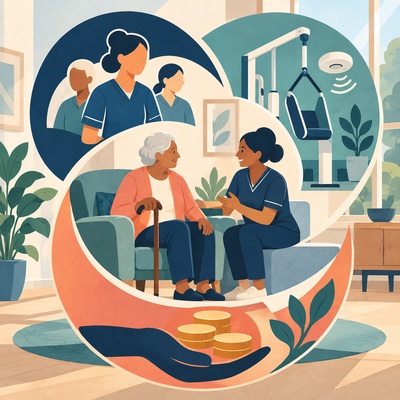
부모의 퇴원 날짜가 잡히는 순간, 가족에게는 병원 밖의 생활을 누가 어떻게 도울지라는 새로운 과제가 시작된다. 고령화로 이런 상황이 늘어나면서 돌봄은 가정의 시간과 비용을 넘어 기업의 인력 운영, 기술의 활용, 사회의 재정 배분을 함께 움직인다. 늘어난 수요를 안정적인 서비스로 연결하려면 돌봄 인력의 처우와 보조기술, 비용을 나누는 체계를 하나의 구조로 설계해야 한다.
[Key Message]
* 돌봄 수요의 증가가 안정적인 공급을 자동으로 만들지는 않는다. 인력이 오래 일할 조건과 이용자가 감당할 비용, 사업자가 서비스를 지속할 수입 구조가 함께 마련돼야 한다.
* 돌봄 인력의 처우는 산업의 공급 능력을 결정하는 요소다. 임금과 함께 이동시간, 교육, 안전, 경력 경로를 설계해야 숙련이 현장에 남는다.
* 보조기술의 가치는 사람과 함께 수행하는 업무에서 드러난다. 장비를 얼마나 도입했는지보다 직원의 부담과 이용자의 불편을 얼마나 줄였는지 확인해야 한다.
* 돌봄 산업에서는 서비스를 이용하는 사람과 비용을 지불하는 주체가 서로 다를 수 있다. 이용자·가족·공공재정·서비스 제공자의 이해를 연결하는 지불 방식이 중요하다.
* 한국의 돌봄경제는 개별 서비스 확대와 함께 연결의 역량을 키워야 한다. 의료·요양·생활지원 사이의 공백을 줄이고, 그 조정에 필요한 인력과 시간을 정당하게 평가해야 한다.
***
퇴원 뒤의 하루가 산업의 지도를 바꾼다
병원에서는 퇴원할 수 있다고 한다. 그러나 집에서 혼자 지내도 된다는 뜻인지는 다른 문제다. 침대에서 일어나 화장실까지 갈 수 있는지, 식사를 준비할 수 있는지, 약을 제때 챙길 수 있는지 확인해야 한다. 자녀가 며칠 휴가를 내더라도 그다음 주의 생활은 남는다. 치료가 끝나는 시점과 도움이 필요 없어지는 시점 사이에는 간격이 있다.
이 장면은 특정 가정의 사건이 아니라 돌봄 수요가 발생하는 구조를 보여주는 예시다. 가족은 방문 서비스를 알아보고, 이동을 도울 사람을 찾고, 집 안의 위험한 곳을 살핀다. 각각의 서비스는 존재해도 어떤 순서로 얼마나 이용해야 하는지는 분명하지 않을 수 있다. 가족이 직접 연락하고 일정을 맞추며 정보를 전달하는 일이 또 하나의 업무가 된다.
돌봄경제를 산업의 관점에서 살펴야 하는 이유가 여기에 있다. 필요한 것은 돌봄을 제공하는 사람의 수와 함께 그 사람이 안정적으로 일할 조직, 상태에 맞는 서비스를 고르는 절차, 이동과 기록을 돕는 기술, 비용을 나누는 제도다. 어느 한 요소만 늘려서는 생활의 공백을 충분히 메우기 어렵다.
돌봄경제의 범위는 넓다. 아동 돌봄과 고령자 지원, 장애인의 일상생활 지원, 유급 서비스와 가족의 무급 돌봄까지 포함한다. 이 가운데 고령화와 직접 맞물리는 영역은 장기간 일상생활을 돕는 서비스다. 식사와 목욕, 이동을 지원하고 건강 상태의 변화를 살피며 혼자 할 수 있는 생활을 유지하도록 돕는 일이 중심에 놓인다.
국제노동기구(ILO)의 2025년 1월 세계 고용·사회 전망 보고서는 무급 돌봄의 불균등한 분담을 여성의 노동시장 참여를 가로막는 구조적 장벽 가운데 하나로 다룬다. 돌봄은 해당 분야의 고용 문제이면서 다른 산업에서 일할 수 있는 조건의 문제이기도 하다. 가족이 서비스를 구하지 못해 근무시간을 줄이거나 일을 그만두면 그 영향은 가정 밖으로 이어진다.
ILO가 같은 해 7월 발표한 돌봄경제 자료는 보편적 아동 돌봄과 장기요양 서비스에 대한 투자를 통해 2035년까지 약 3억 개의 일자리가 만들어질 잠재력을 제시한다. 이는 특정 투자 확대를 전제로 한 추정이며, 고령자 돌봄에서만 발생하는 일자리 수나 확정된 고용 전망이 아니다. 돌봄의 경제적 의미를 읽을 때에는 대상과 투자 조건을 함께 봐야 한다.
시장의 크기도 같은 방식으로 해석해야 한다. 도움이 필요한 사람이 많아진다는 사실과 충분한 서비스가 실제로 거래된다는 사실 사이에는 거리가 있다. 이용자가 비용을 감당할 수 없거나 제공자가 인력을 유지하지 못하면 수요는 있어도 공급은 이어지지 않는다. 돌봄경제의 성장은 인구 변화와 함께 이 간격을 줄이는 제도와 운영 능력에 달려 있다.
사람이 부족한 산업에서 사람이 떠나는 이유
돌봄 인력 부족을 해결하는 가장 빠른 방법처럼 보이는 것은 채용 확대다. 교육생을 모집하고 자격 취득을 지원하며 더 많은 사람을 현장에 투입한다. 그러나 새로 들어오는 사람이 늘어도 기존 인력이 계속 떠난다면 공급 능력은 기대만큼 커지지 않을 수 있다. 채용의 규모와 근속의 조건을 함께 살펴야 한다.
돌봄 현장에서 인건비는 큰 비용 항목이지만, 사람은 동시에 서비스의 핵심 생산 능력이다. 익숙한 직원은 이용자의 평소 상태와 선호, 불편을 표현하는 방식을 안다. 새로 온 직원이 같은 정보를 파악하려면 시간이 필요하다. 인력 교체가 잦을수록 채용과 교육뿐 아니라 관계를 다시 형성하는 비용도 발생한다.
경제협력개발기구(OECD)의 2023년 장기요양 노동조건 보고서는 낮은 보수와 육체적·정신적 부담, 일하기 어려운 시간대 등을 인력 확보를 어렵게 하는 요소로 다룬다. 인력이 부족한데도 임금과 근로조건이 충분히 개선되지 않는 이유로는 재원 부족과 노동자의 약한 협상력 등 여러 구조적 요인을 살핀다.
이 분석은 돌봄 공급을 일반적인 구인·구직의 문제로만 보기 어렵게 한다. 사업자가 더 좋은 조건을 제시하고 싶어도 서비스 수입이 이를 뒷받침하지 못할 수 있다. 반대로 재원이 늘어나도 그 돈이 인력의 보수와 안전, 교육에 얼마나 연결되는지 확인할 장치가 약하면 현장의 변화는 제한적일 수 있다.
싱가포르는 지역사회 돌봄 분야의 보상 수준을 가시화하는 접근을 보여준다. 보건부가 2026년 4월 갱신한 임금 가이드라인은 대부분 직무에서 연간 총보상을 약 7% 이상 높이는 방향을 권고한다. 직무별 초임과 중간 수준의 기본급, 연간 총보상의 중위값 등을 제시해 구직자와 종사자가 보상 구조를 이해하도록 돕는다. 의무 기준은 아니며 실제 이행은 기관별 조정을 거친다.
여기서 주목할 부분은 인상률과 함께 직무의 가격을 설명하는 방식이다. 어떤 일을 맡고 어떤 경력을 쌓으면 어느 수준의 보상을 기대할 수 있는지가 보여야 사람도 진입과 근속을 판단할 수 있다. 돌봄을 보람 있는 일이라고 소개하는 것과 직업으로 선택할 근거를 제공하는 것은 함께 이루어져야 한다.
방문 돌봄에서는 시급 외의 시간도 중요하다. 가령 한 직원이 하루에 여러 가정을 방문한다면 직접 서비스를 제공하는 시간 사이에 이동과 대기, 기록이 들어간다. 이 시간이 근무계획과 보상에서 어떻게 다뤄지는지에 따라 실제 노동의 부담은 달라진다. 일정표에 적힌 방문시간만으로 하루의 일을 파악하기는 어렵다.
경력 경로 역시 공급 능력에 영향을 준다. 숙련이 쌓인 직원이 계속 같은 역할만 수행해야 하는지, 교육과 현장 지도, 일정 조정이나 사례관리로 역할을 넓힐 수 있는지 검토할 필요가 있다. 돌봄 산업이 사람을 확보하려면 들어오는 문과 함께 오래 머물 수 있는 길을 만들어야 한다.
로봇의 가격표보다 중요한 사용 이후의 비용
돌봄기술을 소개하는 장면에는 눈에 띄는 장비가 자주 등장한다. 몸을 옮기는 일을 돕는 기기, 움직임을 감지하는 센서, 상태를 기록하는 시스템이다. 그러나 현장에서 기술의 가치를 결정하는 것은 전시장에서의 성능과 함께 매일의 업무에 들어갔을 때 생기는 변화다.
이동 보조기기를 구입했다고 가정해보자. 직원이 사용법을 충분히 익히지 못하거나 보관 장소가 멀고 준비에 오래 걸리면 급한 상황에서는 기존 방식으로 일할 수 있다. 장비가 있다는 사실과 장비를 자연스럽게 사용하는 상태 사이에는 교육, 공간 배치, 유지보수와 업무 절차가 놓여 있다.
일본의 정책 변화는 기술의 범위를 넓혀 보는 사례다. 후생노동성과 경제산업성은 2024년 6월 기존의 돌봄 로봇 활용 중점 분야를 개정하고 명칭을 돌봄기술 활용 중점 분야로 바꾼다. 개정 체계는 2025년 4월부터 운영하는 일정으로 제시되며, 총 9개 분야 16개 항목으로 확대된다.
추가된 분야에는 기능훈련 지원, 식사·영양 관리 지원, 치매 생활지원·돌봄 지원이 포함된다. 기술 활용의 시야가 특정 신체 작업을 돕는 장치에서 생활 전반의 지원으로 넓어지는 흐름이다. 다만 정책상 중점 분야로 선정됐다는 사실이 개별 기기의 효과나 모든 현장의 도입 성과를 보장하지는 않는다.
사업자에게 중요한 질문은 어느 작업의 어떤 부담을 줄일 것인가다. 기록을 한 번 입력해 여러 업무에 활용할 수 있는지, 직원이 이용자를 부축할 때 필요한 힘을 줄일 수 있는지, 야간 확인이 필요한 상황을 구분하는 데 도움이 되는지 구체적으로 정해야 한다. 목적이 분명해야 도입 전후의 변화를 확인할 수 있다.
기술이 줄이는 업무와 새로 만드는 업무도 함께 계산해야 한다. 센서가 알림을 보내면 누군가는 이를 확인하고 대응해야 한다. 알림이 지나치게 많으면 확인 업무가 늘고, 누가 책임질지 정하지 않으면 중요한 정보가 전달돼도 행동으로 이어지지 않을 수 있다. 감지 기능과 대응 체계는 한 묶음으로 설계해야 한다.
비용 역시 구입비에서 끝나지 않는다. 통신과 소프트웨어 이용료, 수리, 교육, 장비 교체, 기존 시스템과의 연결 비용이 뒤따를 수 있다. 지원금으로 장비를 들여온 뒤 운영비를 마련하지 못하면 현장에서는 유지하기 어려운 자산이 된다. 초기 도입과 지속 사용을 나눠 보지 않는 재정 설계가 필요하다.
돌봄기술의 성과를 직원 한 명이 더 많은 사람을 맡게 됐는지로만 평가하는 것도 좁은 접근이다. 신체 부담을 덜고 기록 시간을 줄인 결과를 이용자와 대화할 시간, 필요한 관찰, 직원의 회복에 어떻게 배분했는지도 살펴야 한다. 기술이 확보한 여력이 서비스의 질로 이어지는 경로를 만들어야 한다.
작은 팀이 큰 조직보다 유연할 수 있다
돌봄 산업의 규모화는 모든 현장을 같은 방식으로 움직이게 만드는 일과 구분할 필요가 있다. 구매와 회계, 교육, 정보시스템은 함께 운영할 수 있지만 이용자의 생활을 돕는 판단에는 현장의 정보가 중요하다. 중앙에서 통일할 업무와 팀이 조정할 업무를 어떻게 나누는지가 조직 설계의 과제가 된다.
네덜란드의 지역사회 간호 조직 부르트조르흐는 작은 자율팀을 중심에 두는 사례다. 조직이 공개한 운영 모델은 약 12명으로 구성된 팀이 지역에서 돌봄을 제공하면서 업무 조직과 책임 분담, 의사결정을 함께 맡는 방식을 설명한다. 이용자의 생활과 관계를 이해하고 지역의 다른 전문가들과 연결하는 활동도 중요하게 다룬다.
이 사례를 적은 관리 인력만으로 비용을 줄이는 해법으로 단순화하기는 어렵다. 팀이 판단하려면 전문성과 정보, 협업할 시간과 지원이 필요하다. 해당 모델의 설명만으로 모든 환경에서 비용 절감이나 서비스 개선이 같은 크기로 나타난다고 말할 수도 없다. 참고할 지점은 판단할 사람에게 필요한 권한을 어떻게 배치하는지다.
예를 들어 방문 일정표에서는 같은 30분이라도 이용자의 상태에 따라 필요한 지원이 달라질 수 있다. 평소보다 움직임이 불편하거나 설명을 이해하기 어려워하는 상황이 생길 수 있기 때문이다. 직원에게 조정할 여지가 전혀 없다면 계획을 지키는 일과 필요한 돌봄을 제공하는 일이 충돌할 수 있다.
반대로 모든 판단을 개인에게 맡기면 서비스의 편차와 책임의 불명확성이 커질 수 있다. 현장의 자율성과 함께 공통 안전기준, 기록 방식, 도움을 요청할 경로가 필요하다. 팀이 해결할 수 있는 범위와 다른 전문기관에 연결해야 할 상황을 구분해야 자율성이 지속 가능한 운영 방식이 된다.
산업화의 가치는 이런 지원을 개별 직원이나 작은 기관이 혼자 마련하지 않아도 되게 하는 데서도 나온다. 교육 자료와 대체 인력, 일정 관리, 구매와 정산 같은 기반을 공유하면 현장은 돌봄에 필요한 판단에 더 집중할 여지가 생긴다. 조직이 커질수록 사람 사이의 접점을 지탱하는 공통 기반도 정교해져야 한다.
연속성 역시 중요한 경쟁력이다. 매번 새로운 직원이 방문하면 이용자와 가족은 같은 설명을 되풀이해야 한다. 팀 단위로 정보를 공유하고 부재 시 자연스럽게 이어받을 수 있으면 특정 직원 한 사람에게만 의존하는 위험을 줄일 수 있다. 관계의 지속성과 인력 운영의 유연성을 함께 확보하는 방향이다.
필요한 사람과 돈을 내는 사람이 다르다
돌봄 산업의 사업모델을 어렵게 만드는 특징은 이용자와 구매자, 비용을 부담하는 주체가 반드시 일치하지 않는다는 점이다. 서비스를 받는 사람은 고령자지만 선택 과정에는 가족이 참여할 수 있고, 비용은 본인과 가족, 공적 제도가 나눠 부담할 수 있다. 좋은 서비스의 기준을 맞추는 일부터 여러 이해관계가 얽힌다.
도움이 필요한 정도와 지불 능력도 일치하지 않는다. 지원이 많이 필요한 사람에게 더 큰 비용이 발생할 수 있지만 그 사람이 이를 충분히 감당할 수 있다는 보장은 없다. 반대로 비용을 낮추기 위해 공급자의 수입을 지나치게 압박하면 인력 유지와 품질 관리에 필요한 자원이 부족해질 수 있다.
OECD의 2024년 고령자 돌봄 비용 보고서는 공적 지원이 비용 부담과 빈곤 위험을 줄이는 정도를 국가별로 비교한다. 핵심 쟁점은 이용자가 감당할 수 있는 서비스와 재정적으로 지속 가능한 제도를 함께 만드는 일이다. 지원의 유무와 함께 필요도와 소득, 자산에 따라 실제로 남는 부담을 살펴야 한다.
지불 방식은 제공자의 행동에도 영향을 준다. 방문 건수나 시간에 주로 수입이 연결된다면 일정과 서비스량 관리가 중요해진다. 반면 기관 사이의 정보 전달이나 가족과의 조정에 필요한 시간이 충분히 평가되지 않으면 모두에게 필요한 업무인데도 맡을 유인이 약해질 수 있다. 연결을 요구하려면 연결하는 일의 비용을 인정해야 한다.
그렇다고 성과에 따라 비용을 지급하면 문제가 자동으로 해결되는 것은 아니다. 상태가 복잡한 이용자를 맡는 기관과 비교적 지원이 적게 필요한 이용자를 맡는 기관의 결과를 단순 비교하면 왜곡이 생길 수 있다. 측정하기 쉬운 지표만 개선하거나 서비스 제공이 어려운 사람을 피하게 만들 위험도 검토해야 한다.
재정모델을 설계할 때에는 최소한 세 가지를 함께 봐야 한다. 이용자에게 필요한 서비스가 실제로 제공되는지, 인력이 적절한 조건에서 일하는지, 제공자가 안전과 교육에 투자하며 사업을 유지할 수 있는지다. 어느 한쪽의 비용만 줄이면 다른 쪽에 부담이 옮겨갈 수 있다.
가족의 시간도 계산에서 빠져서는 안 된다. 공적 서비스가 부족할 때 가족이 방문과 이동, 일정 조정을 맡으면 재정 지출은 적어 보일 수 있다. 그러나 그 대가로 근무시간이 줄거나 휴가가 소진될 수 있다. 예산에서 보이지 않는 비용이 사라진 비용은 아니다.
돌봄 투자가 고용 참여와 생활 안정에 도움이 될 수 있다는 점도 이런 맥락에서 이해해야 한다. 다만 모든 지출이 같은 효과를 내거나 투자 비용이 자동으로 회수된다고 단정할 수는 없다. 누구의 어떤 부담을 줄였고 서비스가 얼마나 지속됐는지 확인하면서 재원과 공급 방식을 조정해야 한다.
한국의 다음 과제는 서비스 사이의 빈칸이다
한국에서도 돌봄의 연결 구조는 중요한 정책 과제가 된다. 보건복지부가 제시한 지역사회 통합돌봄 제도는 2026년 3월 시행을 기반으로 의료·요양·생활지원 등을 연계하는 방향을 담는다. 개인별 필요를 살펴 지원계획을 세우고 서비스를 연결한 뒤 상태 변화에 따라 점검하는 체계다.
산업의 관점에서 주목할 지점은 개별 서비스의 수와 함께 서비스 사이의 이동이다. 병원에서 집으로 돌아오는 시점에 누가 정보를 전달하는지, 방문 지원이 시작되기 전까지의 공백을 누가 확인하는지, 상태가 바뀌면 어느 기관이 계획을 조정하는지가 중요하다. 연결이 끊기는 순간에는 이용자와 가족이 그 일을 떠안을 수 있다.
여기에는 새로운 전문성과 사업 기회도 생긴다. 이용자의 필요를 파악하고 여러 제공자의 일정을 맞추는 운영, 적절한 장비를 골라 설치하고 사용을 지원하는 서비스, 현장 종사자의 교육과 대체 인력을 제공하는 기반 사업 등을 생각할 수 있다. 각각은 가능한 확장 방향이며 수익성과 효과는 실제 수요와 제도에 맞춰 검증해야 한다.
정보를 연결하는 일도 중요하지만 모든 데이터를 한곳에 모으는 것으로 목적을 대신할 수는 없다. 어떤 정보가 누구에게 필요한지, 이용자가 무엇에 동의했는지, 오류를 어떻게 수정하는지 정해야 한다. 새로운 시스템이 생겼는데 직원이 같은 내용을 다시 입력한다면 연결을 위한 기술이 현장의 추가 업무가 될 수 있다.
지역 간 공급 여건도 고려해야 한다. 서비스 대상자가 밀집한 곳과 이동거리가 긴 곳의 운영비는 다를 수 있다. 이용자의 수만으로 수입을 설계하면 방문이 어려운 지역의 공급이 취약해질 가능성이 있다. 필요한 서비스의 양과 함께 이동과 대기, 긴급 대응을 유지하는 비용도 살펴야 한다.
일반 기업에도 이 변화는 남의 일이 아니다. 직원이 가족의 돌봄을 맡게 될 때 필요한 것은 하루의 휴가일 수도 있지만, 몇 달 동안의 일정 조정과 정보일 수도 있다. 기업이 모든 서비스를 직접 제공할 수는 없어도 이용 가능한 지원을 안내하고 업무를 조정할 경로를 만들 수 있다. 돌봄 부담을 이해하는 인력 운영은 숙련된 직원이 일을 지속할 조건과 연결된다.
돌봄경제를 키우는 과정에서는 이용자의 선택권도 구체적으로 다뤄야 한다. 서비스가 늘어도 이용자가 내용을 이해하거나 바꿀 수 없다면 선택은 형식적일 수 있다. 무엇을 받을 수 있고 누가 방문하며 불편할 때 어떻게 조정하는지 알기 쉽게 설명하는 능력 역시 서비스의 품질이다.
돌봄 산업의 경쟁력을 가를 다섯 가지 변화
앞선 자료와 사례가 보여주는 공통 과제는 수요 증가를 감당할 공급 구조를 만드는 일이다. 사람을 더 모집하고 기술을 더 구입하는 각각의 노력은 중요하다. 여기에 인력이 머무는 조건, 기술을 지속해서 쓰는 과정, 비용을 나누는 기준이 연결돼야 산업의 기반이 두꺼워진다.
이 관점에서 앞으로 주목할 변화는 다섯 가지다. 다음 전망은 개별 보고서가 확정한 미래가 아니라 앞선 정책과 사례를 바탕으로 한 산업 구조의 분석이다.
첫째, 인력 확보의 성과는 채용 인원과 함께 근속과 숙련의 축적으로 평가될 가능성이 커진다. 얼마나 많은 사람이 들어왔는지뿐 아니라 교육을 받고 역할을 넓히며 현장에 남는지 보는 방식이다. 제공자는 보상과 일정, 안전을 묶어 설명해야 하고 재정을 지원하는 주체도 그 조건을 확인할 필요가 커진다.
둘째, 돌봄기술의 경쟁은 장비 공급에서 현장 정착으로 넓어질 수 있다. 설치 뒤 교육하고, 고장을 해결하며, 기존 기록과 업무에 연결하는 능력이 중요해지는 방향이다. 사용하지 않는 기기를 늘리는 것보다 어떤 작업을 얼마나 개선했는지 보여주는 기업이 신뢰를 얻을 여지가 있다.
셋째, 서비스의 연결을 맡는 조정 역량이 더 분명한 가치를 가질 수 있다. 병원과 재택, 요양과 생활지원 사이에서 필요한 정보를 전달하고 담당자를 바꾸며 공백을 확인하는 일이다. 이를 가족의 보이지 않는 노동에만 맡기지 않으려면 담당자의 전문성과 시간, 책임 범위를 제도와 계약 안에서 다뤄야 한다.
넷째, 비용을 평가하는 범위가 개별 서비스의 가격에서 이용자의 생활 전체로 넓어질 수 있다. 방문 한 번이 저렴한지와 필요한 지원이 끊김 없이 제공되는지는 다른 질문이다. 가족의 부담과 접근성, 인력의 근로조건을 함께 확인해야 저렴해 보이는 서비스의 실제 비용을 파악할 수 있다.
다섯째, 규모를 키우는 방식은 지역의 판단과 공통 기반을 결합하는 방향으로 발전할 수 있다. 현장은 이용자의 생활을 이해하고, 조직은 교육과 기술, 대체 인력과 관리체계를 지원하는 구조다. 표준화할 업무와 개인에게 맞춰 조정할 업무를 구분하는 능력이 경쟁력의 한 축이 된다.
이 변화에는 긴장이 따른다. 처우를 개선하려면 재원이 필요하고 이용자의 부담은 낮춰야 한다. 기술을 도입하면 교육과 관리 업무가 생기며 서비스 연계를 늘리면 책임을 정하는 작업도 복잡해진다. 돌봄경제를 산업으로 설계한다는 것은 이런 문제를 하나의 해법으로 지우기보다 서로 연결된 선택으로 다루는 일이다.
경영자에게 중요한 질문도 시장이 얼마나 커질 것인가에서 더 나아간다. 어떤 인력을 어떤 조건으로 유지할 수 있는가. 누가 비용을 지불하고 어느 업무까지 수입으로 인정하는가. 기술을 도입한 뒤 누가 사용과 유지에 책임지는가. 이 질문에 답할 수 있어야 늘어나는 수요가 지속 가능한 사업과 서비스로 이어진다.
직장인에게 돌봄경제는 미래의 유망 산업이라는 말보다 생활의 문제로 먼저 다가올 수 있다. 부모가 퇴원하는 날, 가족이 혼자 움직이기 어려워진 날, 자신이 도움을 받아야 하는 날에는 여러 제도가 하루의 생활 안에서 동시에 작동해야 한다. 서비스가 있다는 사실만큼 필요할 때 이용할 수 있다는 확신이 중요하다.
돌봄의 규모가 커질수록 산업이 지켜야 할 기준도 분명해진다. 일하는 사람에게는 계속 일할 수 있는 조건이, 이용자에게는 자신의 생활을 유지할 지원이, 비용을 부담하는 사회에는 자원이 어떻게 쓰이는지 확인할 근거가 필요하다. 사람과 기술과 돈을 함께 설계하는 이유는 그 세 가지 약속을 오래 유지하기 위해서다.
Reference
ILO, January 2025, World Employment and Social Outlook: Trends 2025
ILO, July 2025, Advancing Decent Work and the Care Economy: An Essential Component of Social Development
OECD, June 2023, Beyond Applause? Improving Working Conditions in Long-Term Care
OECD, October 2024, Is Care Affordable for Older People?
Ministry of Health, Singapore, April 2026, Updated Salary Guidelines for the Community Care Sector to Benefit More Than 23,000 Staff Across Community Care Organisations
Ministry of Health, Labour and Welfare, Japan, June 2024, Revision of Priority Fields in the Use of Technologies for Long-Term Care
Buurtzorg International, Our Story, History and Model of Care
Ministry of Health and Welfare, Republic of Korea, March 2026, Roadmap for Nationwide Implementation of Integrated Community Care
The Age of Care: Redesigning People, Technology, and Finance
- What the care economy needs to turn growing demand into sustainable services
The moment a parent's hospital discharge date is set, a family faces a new question: who will help with life outside the hospital, and how? As population aging makes such situations more common, care extends beyond household time and expense to shape corporate workforce management, technology use, and the allocation of public funds. Connecting rising demand with reliable services requires an integrated approach to care workers' conditions, assistive technology, and the arrangements for sharing costs.
[Key Message]
* Growing demand for care does not automatically create reliable supply. Conditions that allow workers to stay, costs that users can afford, and revenue structures that keep providers operating must develop together.
* Care workers' conditions help determine the sector's capacity to deliver services. Pay must be considered alongside travel time, training, safety, and career pathways if skills are to remain in the field.
* The value of assistive technology emerges in the tasks it performs alongside people. Assessment should focus on how much it reduces staff burdens and users' difficulties, rather than simply how much equipment is installed.
* In the care sector, the person receiving a service and the party paying for it may differ. Payment arrangements must connect the interests of users, families, public funders, and service providers.
* Korea's care economy needs stronger coordination alongside the expansion of individual services. Closing gaps between medical care, long-term care, and daily living support requires appropriate recognition of the people and time needed to coordinate them.
***
A Day After Discharge Redraws the Industry Map
The hospital says a parent can be discharged. Whether that means they can live alone at home is a separate question. Can they get out of bed and reach the bathroom, prepare meals, and take medication on time? Even if an adult child takes a few days off, the following week's arrangements remain unresolved. There is a gap between the end of treatment and the end of the need for help.
This is an illustrative scenario showing how care needs arise, rather than an account of one particular family. Relatives look for home visiting services, someone to help with mobility, and hazards around the house. Individual services may exist, yet the order and extent of their use may remain unclear. Making calls, coordinating schedules, and passing on information become another job for the family.
This is why the care economy warrants an industry perspective. Alongside the number of people providing care, it needs organizations in which they can work reliably, procedures for selecting services appropriate to a person's condition, technology that helps with mobility and recordkeeping, and systems for sharing costs. Expanding just one element is unlikely to close the gaps in everyday life.
The care economy has a broad scope. It includes childcare, support for older people, assistance with daily living for people with disabilities, paid services, and unpaid family care. The part most directly linked to population aging involves long-term help with everyday activities. Its central tasks include assistance with eating, bathing, and mobility, observing changes in health, and helping people maintain the activities they can perform independently.
The January 2025 World Employment and Social Outlook report from the International Labour Organization (ILO) identifies the unequal distribution of unpaid care as one structural barrier to women's labor market participation. Care concerns employment within the sector and the conditions that enable people to work in other industries. When a family member reduces working hours or leaves employment because services are unavailable, the effects extend beyond the household.
An ILO care economy brief published in July of the same year identifies the potential to create nearly 300 million jobs by 2035 through investment in universal childcare and long-term care services. This estimate assumes a particular expansion of investment. It is neither a count of jobs in older people's care alone nor a guaranteed employment forecast. Understanding care's economic significance requires attention to both its coverage and the investment assumptions.
Market size needs a similar interpretation. More people needing help and sufficient services actually being purchased are different things. If users cannot afford care or providers cannot retain workers, demand can exist without sustained supply. Alongside demographic change, growth in the care economy depends on institutions and operating capabilities that narrow this gap.
Why People Leave an Industry That Needs More People
Expanding recruitment may seem the quickest solution to care workforce shortages. Recruit trainees, support qualifications, and bring more people into the field. Yet even a larger intake may not increase capacity as expected if existing workers keep leaving. The scale of recruitment must be considered alongside the conditions that support retention.
Labor is a major cost in care, but people are also its core productive capacity. An experienced worker knows a user's usual condition, preferences, and ways of expressing discomfort. A new colleague needs time to learn the same information. Frequent turnover creates costs not only for recruitment and training but also for rebuilding relationships.
A 2023 report on long-term care working conditions from the Organisation for Economic Co-operation and Development (OECD) examines low pay, physical and psychological demands, and burdensome working hours as obstacles to attracting workers. It also explores structural factors, including inadequate funding and workers' limited bargaining power, that help explain why wages and conditions do not improve sufficiently despite shortages.
This analysis makes it difficult to treat care supply purely as a conventional recruitment problem. A provider may want to offer better conditions but lack the service revenue to support them. Conversely, increased funding may have limited effects on the ground if there are weak mechanisms for checking how it translates into pay, safety, and training.
Singapore offers an approach that makes compensation in community care more visible. Salary guidelines updated by its Ministry of Health in April 2026 recommend increasing annual total compensation by about 7% or more for most roles. Recommended starting and midpoint base salaries and median annual total compensation help jobseekers and workers understand the pay structure. The guidelines are not mandatory, and implementation involves adjustments by individual organizations.
What matters here is how the value of a role is explained, alongside the increase itself. People need to see what compensation they can expect for particular responsibilities and career development in order to decide whether to enter and stay. Presenting care as meaningful work should go hand in hand with providing reasons to choose it as a career.
In home care, time beyond the hourly service itself also matters. A worker visiting several households in a day spends time traveling, waiting, and keeping records between direct care sessions. How that time is treated in scheduling and compensation changes the actual burden of work. The visiting times listed on a schedule alone do not capture the working day.
Career pathways also affect supply capacity. Organizations need to consider whether experienced staff must remain in the same role or can move into training, frontline mentoring, scheduling, or case management. To secure workers, the care sector needs both an entry route and a path that allows people to stay.
The Costs After Purchase Matter More Than a Robot's Price Tag
Demonstrations of care technology often feature striking equipment: devices that assist transfers, sensors that detect movement, and systems that record a person's condition. But the value of technology in practice depends on the changes it produces in daily work as well as its performance in a showroom.
Suppose a provider purchases a mobility assistance device. If staff have not learned to use it adequately, or if it is stored far away and takes too long to prepare, they may revert to familiar methods when pressed for time. Training, spatial layout, maintenance, and procedures stand between owning equipment and using it routinely.
A policy change in Japan illustrates a broader view of technology. In June 2024, the Ministry of Health, Labour and Welfare and the Ministry of Economy, Trade and Industry revise the priority fields for using care robots and rename them the priority fields for the use of care technologies. The revised framework sets out an April 2025 start and expands to nine fields covering 16 items.
The additions include support for functional training, meal and nutrition management, and daily living and care for people with dementia. The scope broadens from devices assisting particular physical tasks to support across everyday life. Designation as a policy priority, however, does not guarantee the effectiveness of an individual device or successful adoption at every workplace.
The key question for providers is which burden in which task they intend to reduce. They need to specify whether information can be entered once and used across tasks, whether staff need less physical effort to support a user, or whether a system helps distinguish situations requiring night-time checks. A clear purpose makes it possible to assess changes before and after adoption.
The work technology removes and the work it creates must be assessed together. When a sensor sends an alert, someone must check it and respond. Too many alerts can increase checking work; without a clear assignment of responsibility, important information may not lead to action. Detection capabilities and response arrangements need to be designed as a package.
Costs do not end with purchase. Connectivity and software fees, repairs, training, replacement equipment, and integration with existing systems can follow. Equipment purchased with a subsidy can become difficult to maintain if operating funds are unavailable afterward. Financial design needs to consider initial adoption and continued use together.
Measuring success solely by whether one employee can care for more people is also too narrow. Organizations should examine how reductions in physical strain and recordkeeping time are allocated to conversations with users, necessary observation, and staff recovery. A pathway is needed for the capacity released by technology to improve service quality.
Small Teams Can Be More Flexible Than Large Organizations
Scaling the care sector should be distinguished from making every workplace operate identically. Purchasing, accounting, training, and information systems can be shared, while decisions that support a user's daily life require local knowledge. Dividing responsibilities between centrally standardized functions and tasks adjusted by teams becomes an organizational design challenge.
The Dutch community nursing organization Buurtzorg offers an example centered on small, self-managing teams. Its published operating model describes teams of around 12 people providing care locally while organizing their work, sharing responsibilities, and making decisions. Understanding users' lives and relationships and connecting with other local professionals are also important activities.
It is difficult to reduce this example to a cost-saving formula based on fewer managers. Teams need expertise, information, time to collaborate, and support in order to make decisions. The model's description alone cannot establish that equivalent cost savings or service improvements will occur in every environment. The relevant lesson concerns how necessary authority is placed with those expected to exercise judgment.
For example, the same 30-minute visit on a schedule may require different support depending on the user's condition. Someone may find movement harder than usual or struggle to understand an explanation. Without any scope for adjustment, staff may face a conflict between following the plan and delivering the care that is needed.
Conversely, leaving every decision to individuals can increase variation in services and uncertainty over accountability. Local autonomy needs common safety standards, recording practices, and routes for requesting help. Distinguishing what a team can resolve from situations requiring another specialist organization makes autonomy a sustainable operating approach.
Industrial development also creates value by making this support available without requiring each employee or small provider to build it alone. Shared training materials, backup staff, scheduling, purchasing, and payment administration can give frontline teams more scope to focus on care decisions. As an organization grows, the shared infrastructure supporting human relationships must become more sophisticated too.
Continuity is another important capability. When a different worker visits each time, users and families must repeat the same explanations. Sharing information within teams and enabling smooth coverage during absences can reduce dependence on one particular employee. The aim is to secure continuity in relationships alongside flexibility in staffing.
The Person Who Needs Care May Not Be the Person Paying
One feature complicating care business models is that the user, purchaser, and payer do not necessarily coincide. An older person may receive the service, family members may participate in choosing it, and costs may be shared by the individual, the family, and public systems. Multiple interests are involved even in agreeing on what constitutes a good service.
The level of need and the ability to pay also differ. Someone requiring substantial support may face higher costs without being able to afford them. Conversely, placing excessive pressure on provider revenue to lower prices can leave inadequate resources for staffing and quality management.
The OECD's 2024 report on the affordability of care for older people compares how far public support reduces costs and poverty risks across countries. The central challenge is to develop services users can afford alongside financially sustainable systems. In addition to whether support exists, the burden remaining for individuals must be examined in relation to need, income, and assets.
Payment arrangements also influence provider behavior. If revenue is primarily linked to visits or hours, managing schedules and service volumes becomes important. If time spent sharing information between organizations or coordinating with families is insufficiently recognized, providers may have weak incentives to perform work everyone needs. Requiring coordination also means recognizing its cost.
Paying for outcomes does not automatically solve these problems. A simple comparison of results between organizations serving people with complex conditions and those serving people who need relatively little assistance can be misleading. The risks of improving only easily measured indicators or avoiding people who are difficult to serve also require examination.
Financial models need to consider at least three things together: whether users actually receive the services they need, whether staff work under appropriate conditions, and whether providers can sustain operations while investing in safety and training. Cutting costs for only one party can transfer burdens to another.
Family time must also enter the calculation. Public expenditure may appear low when relatives fill gaps in services by making visits, helping with transport, and coordinating schedules. Yet the price may be reduced working hours or depleted leave. A cost absent from the budget has not disappeared.
The potential for care investment to support employment participation and more stable lives should be understood in this context. It cannot be assumed that every expenditure produces the same effect or that investment costs are automatically recovered. Funding and delivery arrangements should be adjusted while checking whose burdens were reduced, in what way, and how long services were sustained.
Korea's Next Challenge Lies Between Services
The organization of care coordination is also an important policy challenge in Korea. The integrated community care system presented by the Ministry of Health and Welfare is built around implementation in March 2026 and links medical care, long-term care, and daily living support. It involves assessing individual needs, developing support plans, connecting services, and reviewing them as circumstances change.
From an industry perspective, transitions between services deserve attention alongside the number of services available. Who passes on information when someone returns home from hospital? Who checks the gap before home support begins? Which organization adjusts the plan when a person's condition changes? When connections fail, users and families can be left to perform that work.
New areas of expertise and business opportunities can emerge here. Possible activities include understanding users' needs and coordinating multiple providers' schedules; selecting, installing, and supporting the use of suitable equipment; and providing workforce training and backup staffing infrastructure. These are potential directions for expansion, whose profitability and effectiveness must be tested against actual demand and institutional arrangements.
Connecting information matters, but collecting every piece of data in one place cannot substitute for a clear purpose. Organizations need to decide what information is needed by whom, what the user has consented to, and how errors will be corrected. If staff must enter the same material again after a new system is introduced, technology intended to improve coordination can become additional frontline work.
Differences in local supply conditions also matter. Operating costs can differ between areas with concentrated demand and places requiring long journeys. Designing revenue solely around the number of users may leave provision vulnerable in areas that are difficult to reach. Alongside service volumes, planners must consider the costs of travel, waiting, and maintaining emergency response capacity.
This change also concerns businesses outside the care sector. An employee taking on family care may need a day of leave, or several months of scheduling adjustments and information. Even without providing every service directly, employers can create routes to available support and work adjustments. Workforce management that recognizes care burdens helps create conditions in which experienced employees can remain in work.
Developing the care economy also requires making user choice meaningful in practice. More services do not necessarily create meaningful choice if people cannot understand or change what they receive. Clearly explaining available support, who will visit, and how arrangements can be adjusted when problems arise is part of service quality.
Five Changes That Will Shape Competitiveness in Care
The common challenge emerging from these sources and examples is to build supply structures capable of meeting growing demand. Recruiting more people and purchasing more technology are both important. The sector's foundations become stronger when these efforts connect with conditions that retain workers, arrangements for continued technology use, and principles for sharing costs.
From this perspective, five developments warrant attention. These are interpretations of possible changes in industry structure based on the policies and examples discussed, rather than futures established by any individual report.
First, workforce performance is increasingly likely to be assessed through retention and accumulated skills alongside recruitment. The question becomes not just how many people enter, but whether they receive training, broaden their roles, and remain in the field. Providers will need to explain compensation, schedules, and safety together, while funders will have greater reason to examine those conditions.
Second, competition in care technology may expand from equipment supply to effective adoption in practice. Training after installation, resolving faults, and integration with existing records and work will become more important. Companies that demonstrate which tasks they improve, and by how much, may earn greater trust than those that simply add unused devices.
Third, the capability to coordinate services may gain a clearer value. This involves passing information between hospitals and homes, and between long-term care and daily living support; changing responsible contacts; and checking gaps. Avoiding reliance on invisible family labor requires recognizing coordinators' expertise, time, and responsibilities within institutions and contracts.
Fourth, cost assessment may broaden from the price of individual services to the user's life as a whole. Whether one visit is inexpensive and whether necessary support is delivered without interruption are different questions. Family burdens, accessibility, and staff working conditions must be considered together to understand the real costs of apparently cheap services.
Fifth, scaling may increasingly combine local judgment with shared infrastructure. Frontline teams understand users' lives, while organizations support them through training, technology, backup staff, and management systems. Distinguishing tasks to standardize from those to tailor to individuals becomes one source of competitiveness.
These changes involve tensions. Improving working conditions requires funding, while users' burdens need to remain affordable. Technology introduces training and management tasks, and more service coordination makes the allocation of responsibility more complex. Designing care as an industry means treating these as connected choices rather than expecting a single solution to eliminate them.
For business leaders, the important questions extend beyond how large the market will become. Which workers can be retained, and under what conditions? Who pays, and which tasks are recognized in revenue? Who is responsible for use and maintenance after technology is introduced? Answering these questions is necessary for rising demand to translate into sustainable businesses and services.
For employees, the care economy may first arrive as a problem of daily life rather than as a promising future industry. On the day a parent leaves hospital, a relative struggles to move independently, or they themselves need help, several systems must function together within an ordinary day. Confidence that support will be available when needed matters as much as the existence of services.
As care expands, the standards the sector must uphold become clearer. Workers need conditions that allow them to keep working; users need support to maintain their own lives; and the society funding care needs evidence of how resources are used. Designing people, technology, and finance together is about sustaining those three commitments over time.
Reference
ILO, January 2025, World Employment and Social Outlook: Trends 2025
ILO, July 2025, Advancing Decent Work and the Care Economy: An Essential Component of Social Development
OECD, June 2023, Beyond Applause? Improving Working Conditions in Long-Term Care
OECD, October 2024, Is Care Affordable for Older People?
Ministry of Health, Singapore, April 2026, Updated Salary Guidelines for the Community Care Sector to Benefit More Than 23,000 Staff Across Community Care Organisations
Ministry of Health, Labour and Welfare, Japan, June 2024, Revision of Priority Fields in the Use of Technologies for Long-Term Care
Buurtzorg International, Our Story, History and Model of Care
Ministry of Health and Welfare, Republic of Korea, March 2026, Roadmap for Nationwide Implementation of Integrated Community Care