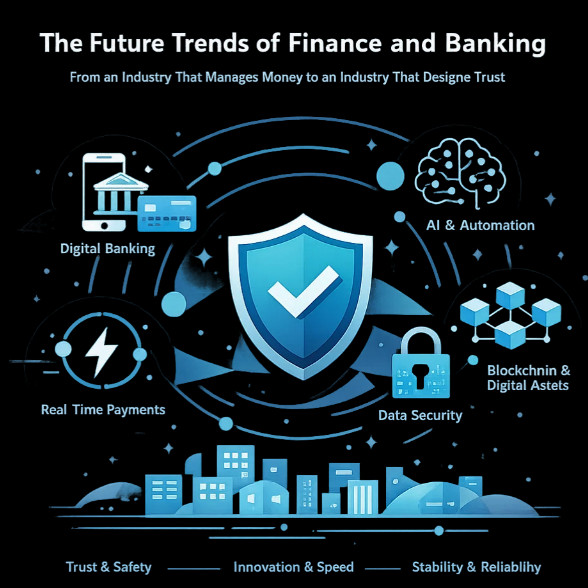
* 미래의 은행은 사라지는 것이 아니라, 돈을 보관하는 기관에서 신뢰를 설계하는 인프라로 다시 정의될 가능성이 크다.
* 금융의 경쟁 무대는 점포에서 플랫폼과 일상 속 접점으로 이동하고 있으며, 누가 고객의 생활 안에 더 자연스럽게 들어가느냐가 중요해지고 있다.
* 인공지능은 금융의 겉모습보다 뒤편 운영을 먼저 바꾸고 있으며, 앞으로의 승부는 AI를 많이 쓰는가보다 얼마나 안전하고 책임 있게 쓰는가에 달려 있다.
* 결제 혁신, 디지털 자산, 토큰화의 확산은 돈의 형태를 바꾸고 있지만, 금융의 본질인 신뢰와 책임 구조는 여전히 가장 중요한 기준으로 남는다.
* 한국 금융의 미래 경쟁력은 빠른 디지털화 자체보다, 가계부채·플랫폼 의존·금융소외·보안 위협 속에서도 얼마나 안정적이고 믿을 수 있는 구조를 만들 수 있느냐에 달려 있다.
***
금융과 은행의 미래를 이야기할 때 사람들은 대개 모바일 앱, 무인 점포, 인공지능 상담 같은 장면부터 떠올린다. 하지만 더 큰 변화는 화면 바깥에서 진행되고 있다. 돈이 움직이는 방식이 달라지고, 금융회사가 위험을 판단하는 기준이 바뀌며, 고객이 금융을 믿는 근거도 새롭게 짜이고 있기 때문이다. 이제 금융의 경쟁은 단순히 누가 더 편리한 서비스를 내놓느냐의 문제가 아니다. 누가 더 빠르고 안전하게 돈을 움직이게 하고, 누가 더 정교하게 위험을 읽으며, 누가 더 오래 신뢰를 유지하느냐의 문제로 바뀌고 있다.
이 변화는 어느 한 나라만의 일이 아니다. 세계 금융은 이미 인공지능, 실시간 결제, 디지털 자산, 데이터 개방, 사이버 보안이라는 다섯 축을 중심으로 다시 움직이고 있다. 그런데 한국은 이 변화가 더 빠르고 더 직접적으로 드러나는 시장 가운데 하나다. 모바일 금융 이용률이 높고, 인터넷전문은행이 빠르게 성장했으며, 간편결제와 플랫폼 금융이 일상 깊숙이 들어와 있기 때문이다. 그만큼 한국 금융은 미래를 가장 빨리 시험받는 공간이기도 하다. 앞으로 은행은 점포 수나 전통적 규모보다, 얼마나 자연스럽게 생활 속에 스며들고 얼마나 튼튼하게 신뢰를 지켜내느냐로 평가받게 될 가능성이 크다.
보이지 않는 은행이 더 강해진다
한동안 금융의 미래를 설명하는 말 가운데 가장 자주 등장한 표현은 “은행 없는 금융”이었다. 핀테크와 빅테크가 금융을 빠르게 잠식하고, 사람들은 더 이상 은행 점포를 찾지 않으며, 예금과 대출조차 전통적 은행의 바깥에서 이뤄지는 세상이 올 것이라는 전망이었다. 실제로 고객이 체감하는 금융의 첫 화면은 더 이상 은행 창구가 아니다. 사람들은 스마트폰 안에서 송금하고, 결제하고, 투자하며, 신용점수를 확인하고, 돈을 빌린다. 겉으로 보기에는 금융의 중심이 은행에서 플랫폼으로 넘어간 것처럼 보인다.
하지만 여기서 곧바로 은행의 퇴장을 말하는 것은 현실을 절반만 보는 해석이다. 기술이 아무리 발달해도 금융은 결국 신뢰를 다루는 산업이기 때문이다. 사람들은 단지 돈을 옮기는 기능만 원하는 것이 아니다. 내 돈이 안전한지, 거래가 확정되는지, 문제가 생기면 누가 책임지는지, 위기 상황에서 누가 마지막으로 버팀목이 되는지를 함께 묻는다. 이 질문 앞에서 은행은 여전히 중요한 자리를 차지하고 있다. 은행은 단순히 예금을 받아 대출을 내주는 기관이 아니라, 사회 전체가 자금과 위험, 결제와 신용을 연결하는 핵심 구조물이기 때문이다.
그래서 미래의 은행은 사라지는 것이 아니라 재정의될 가능성이 크다. 과거에는 많은 지점과 오랜 역사, 큰 자산 규모가 은행의 힘을 보여줬다면, 앞으로는 자금조달 능력, 결제 인프라 접근성, 규제 대응력, 데이터 활용 역량, 사이버 복원력, 고객 신뢰를 얼마나 하나의 구조로 묶어내느냐가 더 중요해질 것이다. 은행은 건물에서 기능으로, 간판에서 구조로 이동하고 있다. 눈앞에 보이는 지점은 줄어들 수 있지만, 사회 전체의 돈의 흐름을 떠받치는 은행의 역할은 오히려 더 중요해질 수 있다. 미래의 은행은 덜 보이지만 더 깊게 작동하는 존재가 될 가능성이 크다.
화면 속 첫 접점을 누가 차지할 것인가
오늘날 사람들은 은행을 직접 찾는 횟수보다 금융을 접하는 횟수가 훨씬 많다. 아침에는 커피를 사며 결제하고, 점심에는 메신저로 돈을 보내고, 오후에는 쇼핑앱에서 할부를 고르며, 저녁에는 카드 사용 알림을 확인한다. 이 모든 것이 금융이지만, 사람들은 매번 그것을 “은행 업무”라고 느끼지 않는다. 바로 여기에 미래 금융의 중요한 특징이 있다. 금융은 점점 더 생활 속으로 숨어들고 있다. 이제 금융은 독립된 공간이 아니라 일상 서비스 안에 자연스럽게 붙어 움직이는 기능이 되고 있다.
이 변화는 금융회사에 매우 근본적인 질문을 던진다. 고객이 금융을 이용하는 첫 화면을 누가 차지하느냐는 질문이다. 고객이 가장 먼저 들어가는 곳이 은행 앱이 아니라 쇼핑 플랫폼, 메신저, 배달앱, 교통앱, 업무 도구라면, 은행은 뒤편 인프라 사업자로 밀려날 수도 있다. 반대로 은행이 일상 속 접점을 더 정교하게 연결해낸다면, 고객과의 관계를 더 넓게 확장할 수도 있다. 결국 경쟁력 있는 금융회사는 앱을 보기 좋게 만드는 곳이 아니라, 고객의 하루 안에 금융을 얼마나 자연스럽게 녹여 넣느냐를 고민하는 곳이 될 것이다.
예를 들어 집을 사려는 사람에게는 대출만이 아니라 세금, 보험, 상환 계획, 자산 흐름이 함께 제시될 수 있어야 한다. 자영업자에게는 매출 정산과 운전자금, 카드매출 관리, 회계 지원이 하나의 흐름으로 이어져야 한다. 직장인에게는 월급이 들어오는 순간 예산 관리, 저축, 투자, 소비 분석이 함께 연결돼야 한다. 앞으로 금융은 개별 상품이 아니라 생활의 맥락 안에서 작동하는 서비스가 될 가능성이 크다. 이렇게 보면 미래 금융의 핵심은 “어떤 상품을 파느냐”보다 “어떤 순간에 어떤 방식으로 고객과 연결되느냐”에 가깝다.
그렇다고 오프라인 접점이 완전히 사라지는 것은 아니다. 오히려 점포의 의미는 더 분명해질 수 있다. 단순 이체와 조회, 송금 같은 반복 업무는 거의 모두 화면으로 이동하겠지만, 복잡한 대출 상담, 상속과 증여, 은퇴 설계, 기업금융, 고액 자산관리처럼 설명과 판단, 심리적 안심이 필요한 영역에서는 여전히 사람의 역할이 중요하다. 미래의 지점은 거래를 처리하는 공간이 아니라, 불안을 줄이고 결정을 돕는 공간으로 바뀔 가능성이 크다. 클릭 몇 번으로 해결할 수 있는 일을 위해 굳이 지점을 찾을 이유는 줄어들겠지만, 한 번의 선택이 큰 손실이나 긴 책임으로 이어질 수 있는 문제에서는 오히려 사람을 만나는 금융의 가치가 다시 커질 수 있다.
인공지능은 금융의 앞보다 뒤를 먼저 바꾼다
AI가 금융을 바꾼다는 말은 이제 너무 흔해서 새삼스럽지 않게 들릴 수 있다. 그러나 진짜 중요한 변화는 AI가 화려한 시연용 기능이 아니라 금융의 핵심 운영 안으로 깊이 들어가고 있다는 점이다. 사람들은 흔히 AI를 챗봇이나 상담 자동화 정도로 떠올리지만, 실제로는 대출 심사, 사기 탐지, 이상 거래 탐지, 문서 검토, 고객 맞춤 추천, 자산관리, 규제 준수 점검, 내부 보고서 작성 같은 영역까지 넓게 침투하고 있다. 금융에서 AI는 점점 “보여주는 기술”이 아니라 “뒤에서 돌아가는 운영체제”가 되고 있다.
이 변화는 매우 크다. 예전에는 사람이 규칙을 만들고 시스템이 그 규칙을 따랐다면, 이제는 시스템이 패턴을 찾아내고 사람이 그 결과를 검토하는 구조가 커지고 있다. 고객은 더 빠른 응답과 더 개인화된 서비스를 기대하게 되고, 금융회사는 더 낮은 비용으로 더 많은 업무를 처리하려 한다. 특히 데이터가 풍부한 금융산업에서는 AI가 가진 효율의 유혹이 크다. 방대한 거래 내역, 상환 기록, 소비 패턴, 이상 징후를 분석하는 데 AI는 분명 강력한 도구다.
하지만 AI가 깊숙이 들어올수록 효율만 커지는 것은 아니다. 위험도 함께 커진다. 여러 금융회사가 비슷한 데이터를 바탕으로 비슷한 모델을 돌리게 되면, 잘못된 판단도 동시에 확산될 수 있다. 평소에는 효율처럼 보이는 구조가 위기 상황에서는 쏠림과 동시 반응으로 바뀔 가능성이 있다는 뜻이다. 또한 특정 클라우드 기업, 특정 반도체, 특정 솔루션 공급업체에 대한 의존이 커질수록 금융의 취약성도 함께 커진다. 눈에 띄지 않던 작은 기술적 문제 하나가 금융시스템 전체의 위험으로 번질 수 있는 것이다.
그래서 미래의 은행은 AI를 가장 많이 쓰는 곳보다, AI를 가장 안전하게 쓰는 곳이 강해질 가능성이 크다. 모델이 어떤 데이터를 보고 어떤 결론을 냈는지 설명할 수 있어야 하고, 잘못된 판단을 사람이 중간에서 제어할 수 있어야 하며, 특정 공급업체에 과도하게 의존하지 않도록 구조를 분산시킬 수 있어야 한다. 이때 중요한 것은 기술의 화려함이 아니라 데이터의 질이다. 오래되었거나 편향된 데이터, 서로 연결되지 않은 데이터 위에서 돌아가는 AI는 아무리 첨단처럼 보여도 엉뚱한 결론을 내기 쉽다. 결국 AI 시대의 금융 경쟁은 누가 더 먼저 도입하느냐보다, 누가 더 믿을 수 있게 운영하느냐의 경쟁이 될 것이다.
결제의 전쟁이 은행의 미래를 다시 쓴다
사람들이 가장 자주 사용하는 금융은 대출이나 투자가 아니라 결제다. 그래서 결제는 늘 금융의 가장 치열한 전장이다. 사람들은 더 빠르고, 더 간단하고, 더 눈에 띄지 않는 결제를 원한다. 카드를 꺼내지 않아도 되고, 비밀번호를 길게 입력하지 않아도 되며, 돈을 보냈는지 기다리지 않아도 되는 결제가 점점 기본값이 되고 있다. 앞으로 결제는 “가능한가”의 문제가 아니라 “얼마나 즉시적이고 얼마나 마찰이 없는가”의 문제가 될 가능성이 크다.
이 변화는 은행의 위상을 크게 흔든다. 과거에는 은행계좌가 금융의 중심이고 카드나 간편결제가 그 주변 기능처럼 보였다. 하지만 이제는 고객이 결제하는 첫 화면을 누가 차지하느냐가 전체 금융관계를 좌우하게 된다. 결제를 장악하면 소비 데이터를 얻고, 소비 데이터를 얻으면 신용평가와 마케팅, 자산관리와 대출 확장으로 이어질 수 있기 때문이다. 결제는 단순한 수수료 사업이 아니라, 고객 접점 사업이고 데이터 사업이며 관계를 붙잡는 사업이다.
그래서 미래의 은행은 단순한 계좌 제공자를 넘어 결제 경험의 설계자가 되어야 한다. 송금이 느리고, 정산이 복잡하고, 해외결제가 비싸고, 온라인 인증 절차가 번거로운 은행은 앞으로 고객을 오래 붙잡기 어려워진다. 반대로 결제 과정이 자연스럽고 안전하며, 다른 금융 기능과 매끄럽게 연결되는 곳은 고객의 생활 속에서 더 강한 위치를 차지할 수 있다. 특히 한국처럼 모바일 이용이 생활 전반에 깊이 스며든 시장에서는 결제 경쟁이 곧 금융 경쟁의 핵심으로 이어질 가능성이 크다. 누가 더 많은 점포를 가졌느냐보다, 누가 더 자주 고객의 하루 안에 들어오느냐가 중요해지는 것이다.
돈의 모양은 바뀌지만, 돈의 본질은 쉽게 바뀌지 않는다
결제 혁신과 함께 디지털 자산, 스테이블코인, 토큰화, 중앙은행 디지털화폐 같은 논의도 금융의 미래를 둘러싼 큰 화두가 되고 있다. 이 흐름은 단순히 새로운 기술의 등장을 뜻하는 것이 아니다. 돈이란 무엇인가, 어떤 돈이 안전한가, 누가 발행한 돈을 사회가 신뢰할 것인가를 다시 묻는 과정에 가깝다. 겉으로 보면 다양한 디지털 자산이 등장하면서 기존 은행과 화폐 체계가 빠르게 흔들릴 것처럼 보이기도 한다. 그러나 실제 변화는 생각보다 더 복합적이다.
중요한 것은 무엇이 가장 새롭냐가 아니다. 무엇이 안정적으로 가치가 유지되고, 널리 받아들여지며, 문제 발생 시 책임 구조를 갖고 있느냐가 더 중요하다. 사람들은 새로운 기술을 호기심 있게 바라보지만, 자기 월급과 예금, 생활비와 대출 상환이 걸린 문제에서는 여전히 안전성과 신뢰를 먼저 따진다. 그래서 미래의 돈은 완전히 새로운 어떤 한 형태가 기존 돈을 단숨에 대체하는 방식으로 오기보다, 공적 신뢰와 민간 혁신이 섞인 혼합 구조로 발전할 가능성이 크다.
이 과정에서 은행의 위치도 다시 정리될 것이다. 어떤 은행은 변화에 늦게 반응해 주변 인프라 역할로 밀려날 수도 있다. 반대로 어떤 은행은 디지털 자산 보관, 토큰화된 자산 거래 지원, 차세대 결제 인프라 연결 같은 새로운 역할을 맡으며 미래 화폐 시스템의 핵심 플레이어로 남을 수도 있다. 결국 디지털 화폐와 토큰화 시대에도 중요한 것은 기술 그 자체가 아니라, 그 기술 위에 어떤 신뢰 구조를 세우느냐이다. 돈의 모양은 빠르게 바뀔 수 있어도, 돈의 본질인 신뢰는 그렇게 쉽게 대체되지 않는다.
혁신의 속도보다 더 중요한 것
기술이 금융을 바꾼다고 할 때 사람들은 대개 편리함부터 떠올린다. 그러나 금융은 편리함만으로 굴러가지 않는다. 오히려 금융은 편리해질수록 보안과 규제가 더 중요해진다. 계좌를 여는 시간이 짧아지고, 송금이 즉시 처리되고, AI가 상담과 심사를 대신할수록 공격자도 같은 속도로 움직인다. 최근 금융범죄는 더 정교해지고 있다. 피싱은 더 자연스러워졌고, 가짜 앱과 위조 사이트는 더 정교해졌으며, 음성과 얼굴을 흉내 내는 기술까지 등장하면서 금융사기의 심리적 설득력도 커지고 있다.
이런 환경에서 중요한 것은 단순한 보안 강화가 아니라 복원력이다. 공격을 완벽히 막는 것은 사실상 불가능하다. 대신 침해를 얼마나 빨리 알아차리고, 피해를 얼마나 작게 묶고, 핵심 서비스를 얼마나 유지하며, 회복을 얼마나 빠르게 해내느냐가 중요해진다. 앞으로 고객은 앱의 디자인만 보고 은행을 고르지 않을 것이다. 문제가 생겼을 때 얼마나 안정적으로 대응하는지, 서비스가 얼마나 끊기지 않는지, 사고 이후의 설명과 보상이 얼마나 신속하고 명확한지를 더 중요하게 보게 될 가능성이 크다.
또 하나의 변화는 규제가 더 이상 혁신을 뒤쫓는 존재만이 아니라는 점이다. 이제는 규제가 기술의 방향 자체를 바꾸는 시대가 되고 있다. AI를 어디까지 허용할지, 데이터 이동과 개인정보 보호의 경계를 어떻게 정할지, 디지털 자산을 어떤 기준으로 감독할지, 결제 인프라를 얼마나 개방할지에 따라 금융회사의 사업 모델은 크게 달라질 수 있다. 예전에는 규제를 넘어서면 성장할 수 있다는 사고가 강했다면, 앞으로는 처음부터 규제와 보안을 설계 안에 넣지 않으면 지속 가능한 성장 자체가 어려워질 가능성이 크다. 미래 금융에서 규제는 혁신의 족쇄라기보다, 신뢰를 잃지 않고 오래 달리게 해주는 구조물에 더 가까워질 것이다.
한국 금융이 맞닥뜨린 현실
한국 금융은 세계적으로 봐도 디지털 전환 속도가 빠른 편에 속한다. 모바일뱅킹과 간편결제의 이용이 일상화되어 있고, 인터넷전문은행은 단기간에 강한 존재감을 확보했으며, 소비자들은 금융 서비스를 더 빠르고 더 편하게 이용하는 데 익숙하다. 겉으로 보기에는 매우 앞서 있는 시장처럼 보인다. 실제로 한국은 금융의 디지털 이용 경험이라는 측면에서 상당히 높은 수준에 올라 있다. 하지만 조금 더 안쪽을 들여다보면, 이 빠른 디지털화가 한국 금융에 새로운 과제를 함께 안기고 있음을 알 수 있다.
첫째는 가계부채와 부동산 의존의 문제다. 한국 금융은 오랫동안 부동산과 가계대출 중심의 구조에 크게 기대어 성장해 왔다. 이 구조는 자산 가격이 오르고 금리가 낮을 때는 비교적 안정적으로 돌아가지만, 금리 변화와 경기 둔화, 부동산 조정이 겹칠 경우 금융 전반의 긴장도를 높이기 쉽다. 디지털 금융이 아무리 빠르게 발전해도, 금융 시스템의 기초 체력이 부동산과 가계부채에 지나치게 묶여 있다면 미래 경쟁력을 낙관하기 어렵다. 기술 혁신은 구조 문제를 가릴 수는 있어도 없애주지는 못한다.
둘째는 플랫폼 의존의 문제다. 한국에서는 은행 앱뿐 아니라 메신저, 쇼핑, 배달, 포털, 통신 서비스가 금융 접점과 빠르게 결합하고 있다. 이는 매우 편리한 경험을 만들지만, 동시에 금융의 첫 화면이 은행 밖으로 넘어갈 가능성도 높인다. 고객은 더 편리해지지만, 은행은 점점 더 보이지 않는 인프라 사업자로 밀려날 위험을 안게 된다. 앞으로 한국 은행들은 단순히 금융기능을 잘 제공하는 것만으로는 부족할 수 있다. 고객 접점을 어떻게 되찾거나 새롭게 설계할 것인지가 더 중요해질 것이다.
셋째는 고령층과 디지털 취약계층의 문제다. 한국은 빠른 디지털화 덕분에 효율을 높였지만, 동시에 점포 축소와 비대면 전환이 금융 소외를 만들 수 있다는 문제도 안고 있다. 젊은 세대에게는 자연스러운 모바일 금융이, 누군가에게는 여전히 높은 장벽일 수 있다. 미래 금융은 단순히 가장 빠른 사용자 경험을 제공하는 경쟁이 아니라, 누구도 과하게 배제하지 않는 포용의 구조를 만드는 경쟁이기도 하다. 한국 금융이 진짜로 성숙해지려면 기술 선도와 함께 접근성의 균형도 함께 고민해야 한다.
넷째는 보안과 신뢰의 문제다. 한국은 디지털 금융 이용이 활발한 만큼 피싱, 스미싱, 계정 탈취, 인증 우회 같은 위험에도 매우 민감한 시장이다. 서비스가 빠르게 퍼질수록 사기와 범죄도 빠르게 진화한다. 따라서 한국 금융의 미래는 단순히 더 혁신적인 기능을 붙이는 데 있는 것이 아니라, 그 기능을 얼마나 안전하게 작동시키고 문제 발생 시 얼마나 신속하게 대응하느냐에 달려 있다. 한국 시장은 속도 면에서는 이미 높은 수준에 올라 있지만, 앞으로의 승부는 신뢰의 질에서 갈릴 가능성이 크다.
앞으로 한국 금융은 어디로 갈 것인가
앞으로 한국 금융은 몇 가지 방향으로 더 분명하게 움직일 가능성이 크다. 첫째, 금융은 더 생활밀착형 서비스로 들어갈 것이다. 은행 앱 안에서만 이뤄지던 금융이 아니라, 쇼핑과 이동, 의료와 교육, 업무와 자영업 운영 같은 일상의 장면 속으로 금융이 더 자연스럽게 붙어 들어갈 가능성이 크다. 고객은 그것을 “금융”이라고 따로 인식하지 않을 수도 있다. 하지만 바로 그런 방식으로 금융은 일상 속에서 더 자주, 더 깊게 사용될 것이다.
둘째, AI는 보여주는 기술이 아니라 보이지 않는 경쟁력이 될 것이다. 앞으로는 누가 더 멋진 챗봇을 보여주느냐보다, 누가 더 정교하게 사기를 막고, 누가 더 정확하게 위험을 예측하며, 누가 더 개인화된 관리 기능을 제공하느냐가 중요해질 것이다. 한국 금융은 디지털 이용 기반이 강하기 때문에 AI 적용 속도도 빠를 수 있다. 다만 그만큼 설명 가능성, 책임성, 데이터 편향, 공급망 의존 문제를 더 빨리 고민해야 할 것이다.
셋째, 결제와 송금의 속도는 계속 빨라지고, 은행과 비은행의 경계는 더 흐려질 것이다. 실시간 결제, 플랫폼 결제, 계좌 기반 이체, 디지털 자산 연계 서비스는 점점 더 자연스러운 표준이 될 가능성이 크다. 이 과정에서 은행은 단순한 계좌 제공자에 머무를 것인지, 아니면 차세대 결제 경험을 설계하는 주체로 남을 것인지 선택해야 한다. 한국처럼 모바일 결제 인프라가 발달한 시장에서는 이 변화가 특히 빠르게 나타날 수 있다.
넷째, 금융의 핵심 평가는 더 이상 “얼마나 혁신적인가”에만 머물지 않을 것이다. “얼마나 안전한가”, “얼마나 끊기지 않는가”, “얼마나 설명 가능한가”, “얼마나 책임지는가”가 더 중요한 기준이 될 가능성이 크다. 이것은 기술의 시대가 끝난다는 뜻이 아니라, 기술만으로는 충분하지 않다는 뜻이다. 앞으로의 금융은 더 기술적이면서도 더 제도적이어야 하고, 더 자동화되면서도 더 설명 가능해야 하며, 더 플랫폼화되면서도 더 신뢰 중심적이어야 한다.
마지막에 남는 질문은 하나다
앞으로 금융산업의 경쟁자는 더 다양해질 것이다. 전통 대형은행은 여전히 자금력과 브랜드 신뢰, 규제 대응력에서 강점을 갖고 있다. 인터넷전문은행은 속도와 사용자 경험에서 경쟁력이 있고, 핀테크는 특정 고객층과 특정 기능에 집중하는 유연성을 갖고 있다. 빅테크는 강력한 이용자 접점과 데이터, 생태계 결합력을 앞세워 금융을 계속 잠식하려 할 것이다. 겉으로 보면 누가 더 기술을 잘 다루느냐의 경쟁처럼 보이지만, 시간이 갈수록 더 중요한 것은 누가 더 큰 신뢰 시스템을 만들 수 있느냐가 될 가능성이 크다.
금융은 한 번 팔고 끝나는 제품이 아니다. 월급이 들어오고, 공과금이 빠져나가고, 대출이 상환되고, 자산이 쌓이고, 위기 때 도움을 요청하는 긴 관계의 산업이다. 그래서 고객은 언제나 편리함과 함께 안전함을 묻는다. 앞으로의 은행은 기술기업처럼 움직여야 하지만, 기술기업으로만 남아서는 안 된다. 설명 가능한 AI, 끊기지 않는 결제, 믿을 수 있는 인증, 빠른 사고 대응, 이해하기 쉬운 상품, 과도한 수수료와 불투명한 구조를 줄이는 태도까지 모두 신뢰를 만드는 요소가 된다.
결국 금융과 은행의 미래는 “은행이 사라질까”를 묻는 이야기가 아니다. “은행이 어떤 모습으로 남을까”를 묻는 이야기다. 그 답은 점점 분명해지고 있다. 은행은 지점을 줄일 수는 있어도 기능을 버리지는 못한다. AI를 도입할 수는 있어도 감독과 통제를 포기할 수는 없다. 디지털 화폐와 새로운 결제수단을 받아들일 수는 있어도 신뢰의 중심을 비워둘 수는 없다. 그래서 미래의 은행은 더 기술적이면서도 더 제도적이고, 더 자동화되면서도 더 인간의 판단을 필요로 하며, 더 플랫폼화되면서도 더 신뢰 지향적인 존재가 될 것이다. 그 은행은 더 이상 단순한 금융회사가 아니라, 사회가 안심하고 돈을 맡기고 움직이게 하는 신뢰 인프라에 가까워질 것이다. 한국 금융 역시 그 방향으로 갈 수밖에 없다. 속도의 경쟁을 넘어, 신뢰의 경쟁으로 들어가는 것. 그것이 앞으로 금융과 은행이 맞이할 가장 중요한 미래다.
Reference
Bank for International Settlements. 2025. III. The Next-Generation Monetary and Financial System. Annual Economic Report. June 24, 2025.
Bank of Korea. 2025. Payment and Settlement Report 2025. December 2025.
Bank of Korea. 2025. Financial Stability Report. December 2025.
European Central Bank. 2026. Payments Statistics: First Half of 2025. January 29, 2026.
Financial Services Commission. 2025. FSC Business Plan 2025. January 2025.
Financial Services Commission. 2025. Measures to Improve Financial Access for Vulnerable Consumers. March 2025.
Financial Stability Board. 2025. Monitoring Adoption of Artificial Intelligence and Related Vulnerabilities in the Financial Sector. October 10, 2025.
International Monetary Fund. 2026. Global Economic and Financial Implications of Artificial Intelligence: Lessons from a Fast-Evolving Technology. April 3, 2026.
Finance and Banking, From an Industry That Manages Money to an Industry That Designs Trust
[Key Message]
* The bank of the future is unlikely to disappear; instead, it is more likely to be redefined from an institution that stores money into an infrastructure that designs trust.
* The competitive arena of finance is shifting from branches to platforms and everyday points of contact, and what matters increasingly is who can enter most naturally into the customer’s daily life.
* Artificial intelligence is transforming the back-end operations of finance before its outward appearance, and the real competition ahead will depend less on who uses more AI than on who uses it more safely and responsibly.
* Payment innovation, digital assets, and the spread of tokenization are changing the form of money, but trust and accountability, which remain the essence of finance, are still the most important standards.
* The future competitiveness of Korean finance will depend less on rapid digitalization itself than on whether it can build a stable and trustworthy system despite household debt, platform dependence, financial exclusion, and growing security threats.
***
When people talk about the future of finance and banking, they usually picture mobile apps, unmanned branches, and AI-powered customer service first. But the bigger changes are unfolding outside the screen. The way money moves is changing, the standards by which financial institutions assess risk are shifting, and the very basis on which customers trust finance is being rewritten. Competition in finance is no longer simply about who can offer the most convenient service. It is becoming a question of who can move money more quickly and safely, who can read risk more precisely, and who can sustain trust for longer.
This is not something happening in just one country. Global finance is already being reorganized around five major axes: artificial intelligence, real-time payments, digital assets, data openness, and cybersecurity. Korea, however, is one of the markets where these changes are appearing more quickly and more directly. Mobile financial usage is high, internet-only banks have grown rapidly, and easy payment services and platform-based finance have penetrated deeply into everyday life. For that very reason, Korean finance is also one of the first places where the future is being tested. In the years ahead, banks are likely to be evaluated less by the number of their branches or their traditional scale, and more by how naturally they can blend into everyday life and how solidly they can protect trust.
Invisible Banks Will Become Stronger
For a while, one of the most common phrases used to describe the future of finance was “bankless finance.” The prediction was that fintechs and big tech firms would rapidly encroach on finance, people would no longer visit bank branches, and even deposits and loans would take place outside traditional banks. There is certainly some truth in that view. The first screen through which customers experience finance is no longer a bank counter. People send money, make payments, invest, check their credit scores, and borrow money on their smartphones. On the surface, it may seem as though the center of finance has shifted from banks to platforms.
But to conclude from this that banks are disappearing is to read only half the picture. No matter how advanced technology becomes, finance ultimately remains an industry that deals in trust. People do not merely want the functional ability to move money. They also want to know whether their money is safe, whether a transaction is final, who takes responsibility if something goes wrong, and who becomes the last line of support in a crisis. Faced with those questions, banks still occupy an important place. A bank is not merely an institution that takes deposits and makes loans. It is a core structure that connects funds and risk, payments and credit, across society as a whole.
That is why the bank of the future is more likely to be redefined than to disappear. In the past, a large branch network, a long history, and a large balance sheet were seen as signs of a bank’s strength. In the future, what will matter more is how well a bank can integrate funding capacity, access to payment infrastructure, regulatory responsiveness, data capabilities, cyber resilience, and customer trust into a single structure. Banks are moving from buildings to functions, from signboards to systems. The branches people see in front of them may shrink, but the role of banks in supporting the overall flow of money in society may actually become more important. The bank of the future will likely be less visible, yet operate more deeply.
Who Will Capture the First Point of Contact on the Screen
Today, people encounter finance far more often than they physically visit a bank. In the morning, they pay for coffee. At lunch, they send money through a messenger app. In the afternoon, they choose installment payments in a shopping app. In the evening, they check their card-use alerts. All of this is finance, yet people do not think of it every time as “banking.” That is precisely where one of the most important characteristics of future finance lies. Finance is increasingly disappearing into everyday life. It is becoming less a standalone space and more a function that naturally attaches itself to daily services.
This change poses a very fundamental question to financial companies: who will capture the first screen through which customers access finance? If the place customers enter first is not a banking app but a shopping platform, messenger, delivery app, mobility app, or work tool, then banks may be pushed back into the role of backend infrastructure providers. On the other hand, if banks can connect points of contact in daily life more precisely, they may be able to expand their relationship with customers much further. In the end, competitive financial institutions will not be the ones that merely make better-looking apps, but the ones that think about how to embed finance as naturally as possible into the customer’s everyday routine.
For example, someone buying a home should be presented not only with a loan, but also with taxes, insurance, repayment planning, and asset-flow management together. For small business owners, sales settlement, working capital, card sales management, and accounting support should flow together as one connected experience. For salaried workers, the moment their pay comes in, budgeting, saving, investing, and spending analysis should all be linked. In the future, finance is likely to become less about individual products and more about services that operate within the context of everyday life. Seen from this angle, the core of future finance is not “what product do you sell?” but rather “at what moment and in what way do you connect with the customer?”
That does not mean offline contact points will disappear entirely. On the contrary, the meaning of the branch may become clearer. Repetitive tasks such as simple transfers, account inquiries, and remittances will move almost entirely onto screens, but in areas such as complex loan consultations, inheritance and gifting, retirement planning, corporate finance, and high-net-worth asset management—areas where explanation, judgment, and psychological reassurance are needed—the human role will still matter. The branch of the future is likely to become a place not for processing transactions, but for reducing anxiety and helping people make decisions. There will be less reason to visit a branch for tasks that can be resolved with a few clicks, but in matters where one decision can lead to major losses or long-term obligations, the value of meeting a person face-to-face may actually grow again.
Artificial Intelligence Will Transform the Back End of Finance Before the Front End
The phrase “AI is transforming finance” has become so common that it can sound almost unremarkable. But the truly important change is that AI is no longer just a flashy demonstration tool; it is moving deep into the core operations of finance. People often think of AI as little more than chatbots or customer-service automation, but in reality it is spreading widely into areas such as loan underwriting, fraud detection, abnormal transaction monitoring, document review, personalized recommendations, wealth management, compliance checks, and internal report writing. In finance, AI is gradually becoming not a technology that is shown off, but an operating system that runs quietly in the background.
This shift is enormous. In the past, people created rules and systems followed them. Now, systems are increasingly finding patterns, while people review the results. Customers will come to expect faster responses and more personalized services, while financial institutions will want to process more work at lower cost. In a data-rich industry such as finance, the lure of AI efficiency is especially strong. AI is undoubtedly a powerful tool for analyzing vast amounts of transaction records, repayment histories, spending patterns, and signs of suspicious activity.
But the deeper AI enters, the greater the risks become alongside the efficiency. If many financial institutions rely on similar models built on similar data, mistaken judgments may spread simultaneously. A structure that looks like efficiency in normal times may turn into herding and synchronized reactions in times of crisis. In addition, as dependence on specific cloud providers, semiconductor makers, and software vendors increases, financial vulnerability can also increase. A small technical problem that normally goes unnoticed can end up spilling over into a risk for the entire financial system.
That is why the strongest banks of the future are likely to be not the ones that use the most AI, but the ones that use AI most safely. They must be able to explain what data a model has seen and how it reached its conclusions. They must be able to ensure that human beings can intervene and control incorrect judgments. They must be able to distribute their structure so they do not become overly dependent on a single vendor. Here, what matters is not the glamour of the technology, but the quality of the data. AI running on outdated, biased, or poorly connected data can produce absurd conclusions no matter how advanced it appears. In the end, competition in AI-era finance will be less about who adopts it first and more about who operates it most reliably.
The Battle Over Payments Will Rewrite the Future of Banking
The financial service people use most often is not lending or investing, but payments. That is why payments have always been the fiercest battlefield in finance. People want payments that are faster, simpler, and less visible. A payment experience in which there is no need to take out a card, no need to enter a long password, and no need to wait to see whether the money has been sent is increasingly becoming the default. In the future, payments are likely to be judged not by whether they are possible, but by how immediate and frictionless they are.
This shift significantly shakes the position of banks. In the past, the bank account appeared to be at the center of finance, while cards or easy-payment services seemed like surrounding functions. But now, who controls the first screen where the customer makes a payment can determine the broader financial relationship. Control payments, and you gain consumer data. Gain consumer data, and you can extend into credit evaluation, marketing, wealth management, and lending. Payments are not just a fee business; they are a customer-contact business, a data business, and a relationship-holding business.
That is why the banks of the future must move beyond being simple account providers and become designers of the payment experience. Banks whose transfers are slow, settlements are complicated, cross-border payments are expensive, and online authentication procedures are cumbersome will find it difficult to hold on to customers. By contrast, institutions whose payment process feels natural and safe, and connects smoothly with other financial functions, will be able to claim a stronger place in customers’ daily lives. In markets like Korea, where mobile usage is deeply embedded throughout daily life, competition over payments is likely to become the very core of competition in finance. The question will matter less who has more branches, and more who can enter the customer’s day more often.
The Shape of Money Changes, but the Essence of Money Does Not Change Easily
Alongside payment innovation, debates over digital assets, stablecoins, tokenization, and central bank digital currencies have become major themes surrounding the future of finance. This is not merely about the emergence of new technologies. It is closer to a process of asking again: what is money, what kind of money is safe, and what kind of issuer’s money will society trust? On the surface, the rise of various digital assets can make it seem as though the existing banking and monetary system will be rapidly overturned. But the actual change is more complex than that.
What matters is not what is newest. What matters more is what can maintain stable value, what is broadly accepted, and what has a clear structure of accountability when problems arise. People may look at new technologies with curiosity, but when it comes to their salaries, savings, living expenses, and loan repayments, they still care first about safety and trust. That is why the money of the future is likely to evolve not through a single entirely new form abruptly replacing existing money, but through a hybrid structure in which public trust and private innovation are mixed together.
In that process, the place of banks will also be rearranged. Some banks may respond slowly and be pushed toward a peripheral infrastructure role. Others may take on new functions such as safeguarding digital assets, supporting the trading of tokenized assets, and connecting next-generation payment infrastructure, thereby remaining core players in the future monetary system. In the end, even in the age of digital currency and tokenization, what matters is not the technology itself, but what kind of trust structure is built on top of it. The shape of money may change quickly, but trust—the essence of money—is not so easily replaced.
What Matters More Than the Speed of Innovation
When people say technology is changing finance, they usually think first of convenience. But finance does not run on convenience alone. In fact, the more convenient finance becomes, the more important security and regulation become. The shorter the time it takes to open an account, the more instantly remittances are processed, and the more AI takes over consultations and screenings, the more quickly attackers move as well. Financial crime has become increasingly sophisticated. Phishing has become more natural, fake apps and forged websites more elaborate, and even technologies that imitate voices and faces have emerged, increasing the psychological persuasiveness of financial fraud.
In this environment, what matters is not simply stronger security but resilience. It is virtually impossible to block all attacks completely. What matters instead is how quickly breaches are detected, how narrowly damage can be contained, how well core services can be maintained, and how quickly recovery can be achieved. In the future, customers will not choose banks based on app design alone. They are likely to care more about how stably an institution responds when problems occur, how uninterrupted its services remain, and how quickly and clearly it explains and compensates after an incident.
Another important shift is that regulation is no longer merely chasing behind innovation. We are entering an era in which regulation shapes the direction of technology itself. How far AI will be allowed to go, where the boundary will be drawn between data mobility and privacy protection, by what standards digital assets will be supervised, and how open payment infrastructure will be—these factors can all greatly alter the business models of financial institutions. In the past, the dominant mindset was that once you got past regulation, you could grow. In the future, sustainable growth itself may become difficult unless regulation and security are built into the design from the start. In future finance, regulation is likely to become less like a shackle on innovation and more like a structure that allows institutions to run for a long time without losing trust.
The Reality Facing Korean Finance
By global standards, Korean finance is among the faster movers in digital transformation. Mobile banking and easy payments have become part of everyday life, internet-only banks have established a strong presence in a short period of time, and consumers are used to accessing financial services more quickly and more conveniently. On the surface, it looks like a very advanced market. Indeed, in terms of the experience of using digital finance, Korea has reached a fairly high level. But a closer look reveals that this rapid digitalization has also brought new challenges to Korean finance.
The first is the problem of household debt and dependence on real estate. For a long time, Korean finance has relied heavily on a structure centered on real estate and household lending. When asset prices are rising and interest rates are low, this structure can appear relatively stable. But when changes in interest rates, economic slowdown, and property-market adjustment overlap, it can easily raise tension across the financial system. No matter how quickly digital finance develops, it is difficult to be optimistic about long-term competitiveness if the basic strength of the financial system remains too tightly tied to real estate and household debt. Technological innovation can conceal structural problems, but it cannot eliminate them.
The second is dependence on platforms. In Korea, not only banking apps but also messenger services, shopping, delivery, portal sites, and telecommunications services are rapidly integrating with financial contact points. This creates a highly convenient experience, but it also raises the possibility that the first screen of finance will move outside the bank. Customers become more comfortable, but banks risk being pushed toward the role of invisible infrastructure providers. In the future, Korean banks may not be able to rely solely on providing financial functions well. It will become more important to think about how to reclaim or redesign customer contact points.
The third is the issue of the elderly and other digitally vulnerable groups. Korea has improved efficiency through rapid digitalization, but at the same time it faces the problem that branch closures and non-face-to-face transitions can create financial exclusion. Mobile finance may feel natural to younger generations, but for others it may still be a high barrier. Future finance is not just a competition to offer the fastest user experience. It is also a competition to build a structure that does not exclude anyone too severely. For Korean finance to mature in a real sense, it will need to think about the balance between technological leadership and accessibility.
The fourth is security and trust. Because digital financial usage is so active in Korea, it is also a market highly sensitive to threats such as phishing, smishing, account theft, and authentication bypass. The faster a service spreads, the faster fraud and crime evolve as well. Therefore, the future of Korean finance lies not simply in adding more innovative features, but in how safely those features are operated and how quickly institutions respond when problems occur. The Korean market has already reached a high level in terms of speed, but future competition is likely to be decided by the quality of trust.
Where Korean Finance Is Likely to Go
Korean finance is likely to move more clearly in several directions in the years ahead. First, finance will become more deeply embedded in everyday life. Instead of taking place only within banking apps, finance is likely to attach itself more naturally to daily scenes involving shopping, mobility, healthcare, education, work, and running small businesses. Customers may not even consciously recognize it as “finance.” But in precisely that way, finance will be used more often and more deeply in everyday life.
Second, AI will become not a showpiece technology but an invisible source of competitiveness. In the future, what matters will be not who shows off the most impressive chatbot, but who can block fraud more precisely, predict risk more accurately, and provide more personalized management functions. Because Korea has a strong base of digital usage, the pace of AI adoption in finance may also be fast. But that means issues such as explainability, accountability, data bias, and supply-chain dependence will also need to be considered sooner.
Third, the speed of payments and remittances will continue to increase, and the boundary between banks and non-banks will become blurrier. Real-time payments, platform payments, account-based transfers, and digital-asset-linked services are likely to become increasingly natural standards. In this process, banks will need to choose whether they will remain simple account providers or continue as the entities that design next-generation payment experiences. In a market like Korea, where mobile payment infrastructure is highly developed, this change may appear especially quickly.
Fourth, the key standard by which finance is evaluated will no longer stop at “how innovative is it?” Instead, “how safe is it?”, “how uninterrupted is it?”, “how explainable is it?”, and “how accountable is it?” are likely to become more important criteria. This does not mean the age of technology is ending. It means technology alone is not enough. The finance of the future will need to be more technological and at the same time more institutional, more automated and at the same time more explainable, more platform-based and at the same time more trust-centered.
In the End, One Question Remains
The competitors in the financial industry will become more diverse. Traditional large banks still have strengths in funding capacity, brand trust, and regulatory responsiveness. Internet-only banks are competitive in speed and user experience. Fintech firms have the flexibility to focus on particular customer groups and specific functions. Big tech companies will continue to try to encroach on finance by leveraging strong user contact points, data, and ecosystem integration. On the surface, this may look like a competition over who handles technology better. But over time, what is likely to matter more is who can build the larger and stronger trust system.
Finance is not a product you sell once and then forget. It is an industry of long relationships—salaries come in, utility bills go out, loans are repaid, assets accumulate, and people ask for help in times of crisis. That is why customers always ask about safety along with convenience. The bank of the future will have to move like a technology company, but it cannot remain merely a technology company. Explainable AI, uninterrupted payments, trustworthy authentication, rapid incident response, understandable products, and an attitude that reduces excessive fees and opaque structures—all of these are elements that build trust.
In the end, the future of finance and banking is not a story about whether banks will disappear. It is a story about what form banks will remain in. The answer is becoming increasingly clear. Banks may reduce branches, but they cannot abandon their functions. They may adopt AI, but they cannot give up oversight and control. They may embrace digital currencies and new payment methods, but they cannot leave the center of trust empty. That is why the bank of the future will be more technological yet also more institutional, more automated yet still in need of human judgment, more platform-based yet more trust-oriented. It will no longer be merely a financial company, but something closer to a trust infrastructure that allows society to entrust and move money with peace of mind. Korean finance, too, will have no choice but to move in that direction. Beyond competition over speed, it will be entering competition over trust. That is the most important future awaiting finance and banking.
Reference
Bank for International Settlements. 2025. III. The Next-Generation Monetary and Financial System. Annual Economic Report. June 24, 2025.
Bank of Korea. 2025. Payment and Settlement Report 2025. December 2025.
Bank of Korea. 2025. Financial Stability Report. December 2025.
European Central Bank. 2026. Payments Statistics: First Half of 2025. January 29, 2026.
Financial Services Commission. 2025. FSC Business Plan 2025. January 2025.
Financial Services Commission. 2025. Measures to Improve Financial Access for Vulnerable Consumers. March 2025.
Financial Stability Board. 2025. Monitoring Adoption of Artificial Intelligence and Related Vulnerabilities in the Financial Sector. October 10, 2025.
International Monetary Fund. 2026. Global Economic and Financial Implications of Artificial Intelligence: Lessons from a Fast-Evolving Technology. April 3, 2026.