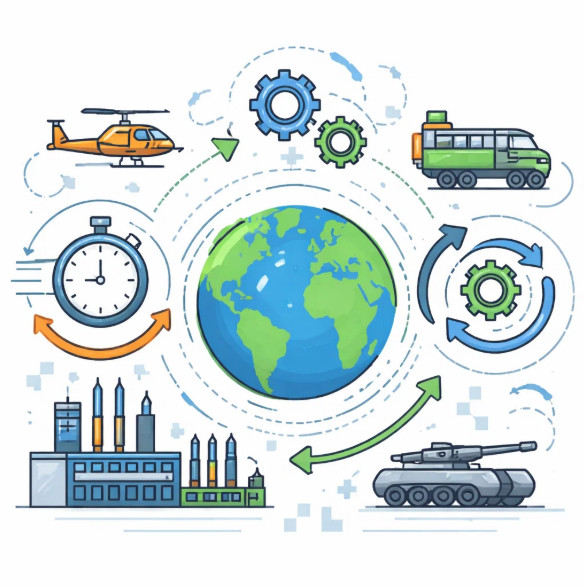
세계 방산시장은 이제 “성능 경쟁”만으로 설명되지 않는다. 전장은 소모가 빠르고 위협은 다층화되었으며, 각국은 무기를 사는 동시에 생산과 정비의 통제권까지 요구한다. 이 흐름 속에서 시장을 가르는 기준은 점점 단순해진다. 얼마나 빨리 공급할 수 있는가, 얼마나 오래 운영할 수 있는가, 얼마나 깊게 현지화할 수 있는가.
전쟁이 바꾼 수요의 공식, 첨단보다 재고와 납기
전쟁이 길어질수록 무기는 ‘결정적 한 방’이 아니라 ‘지속 가능한 소비재’처럼 취급된다. 그래서 시장의 관심은 전투기나 전차 같은 상징적 플랫폼만이 아니라, 전장에 매일 투입되고 매일 소모되는 품목으로 이동한다. 포탄과 로켓, 유도탄과 드론, 예비부품과 정비 장비, 통신 장비와 소프트웨어 업데이트가 전력의 뼈대를 이룬다. 이때 조달의 질문은 바뀐다. 더 강한 무기가 있느냐가 아니라, 지금 당장 필요한 물량을 약속한 날짜에 가져올 수 있느냐가 먼저다. 성능은 입장권이 되고, 납기와 반복 공급이 승패를 가른다.
이 변화는 방산기업의 경쟁력을 새로 정의한다. 연구개발이 강한 기업이 반드시 시장을 가져가는 것이 아니라, 생산능력을 증명하는 기업이 주문을 끌어온다. 생산능력은 단순히 공장 규모가 아니라, 협력사와 소재 조달, 전자부품 수급, 품질 관리, 숙련 인력, 검사와 인증까지 묶인 종합 체력이다. 특히 탄약과 미사일처럼 부품과 재료의 대체가 어렵고, 안전성과 신뢰성이 절대적인 품목은 라인 증설 자체가 곧 전략이 된다. 전쟁이 생산의 속도를 요구하는 순간, 방산은 기술의 산업이면서 동시에 제조업의 산업이 된다.
유럽 수요가 급증한 이유도 여기서 설명된다. 유럽은 전력 공백을 빠르게 채워야 하고, 동시에 장기전을 대비해 재고를 쌓아야 한다. 그래서 단발 도입보다 재고 보충과 후속 물량의 반복 발주가 늘어난다. 시장은 그때마다 “빨리 납품해 본 공급자”에게 추가 주문을 붙인다. 결국 납기는 가격만큼 중요한 변수가 되고, 납기가 신뢰가 되며, 신뢰가 다음 계약을 끌어오는 구조가 형성된다.
유럽의 재무장과 산업주권, 구매가 산업정책이 되다
유럽이 예산을 늘리는 방식은 단순히 더 많이 사는 것이 아니다. 유럽은 무기를 사면서 동시에 무기를 “만드는 능력”을 되찾으려 한다. 이것이 산업주권이다. 산업주권은 전쟁이 터졌을 때 외부 공급이 막혀도 스스로 유지할 수 있어야 한다는 의미이고, 동맹이라 해도 핵심 부품과 소프트웨어 통제권을 완전히 밖에 맡기지 않겠다는 선언이기도 하다. 그래서 유럽의 조달은 가격과 성능뿐 아니라 현지 생산, 기술이전, 부품 현지 조달, 정비 허브 구축, 교육훈련 체계까지 요구하는 방향으로 움직인다.
이 요구는 시장 구조를 바꾼다. 과거에는 완제품을 납품하고 나면 계약이 끝났지만, 이제는 도입 이후의 운영까지 포함하는 장기 프로젝트가 된다. 현지에서 생산과 정비가 돌아가면, 후속 물량과 개량형, 부품 공급과 유지보수 계약이 자연스럽게 이어진다. 즉, 진입 장벽은 높아지지만, 한 번 자리 잡으면 오래 남을 수 있는 시장으로 변한다. 그래서 유럽 시장은 지금 ‘판매 경쟁’이 아니라 ‘파트너 경쟁’이 되고 있다.
공급자 입장에서는 두 가지 능력이 동시에 요구된다. 하나는 납기와 생산의 속도다. 다른 하나는 현지화의 실행력이다. 현지화는 계약서의 문장으로 끝나지 않는다. 공장 설비를 깔고, 품질 관리 기준을 맞추고, 인증 절차를 통과하며, 부품망을 구축하고, 인력을 교육하는 시간이 필요하다. 이 과정에서 납기가 흔들리면 신뢰가 깨지고, 정치적 비판이 커지며, 산업주권이라는 명분 자체가 흔들린다. 결국 유럽에서의 성패는 ‘현지화 약속을 얼마나 현실로 만들 수 있는가’에 달려 있다.
한국 방산의 상승 곡선, 납기와 가격, 현지화 패키지의 결합
한국 방산이 최근 존재감을 키운 이유는 무기 1개를 파는 방식이 아니라, 전력화를 가능하게 만드는 패키지를 제안할 수 있기 때문이다. 전차를 팔면 전차만 파는 것이 아니라, 지원 차량과 부품, 훈련과 정비, 후속 물량 계획까지 함께 묶는다. 자주포를 팔면 탄약 보급과 정비 교육, 운용 노하우까지 포함한다. 항공기를 팔면 조종사 양성과 정비 인프라, 훈련 체계를 결합한다. 수요국이 원하는 것은 전시용 무기가 아니라 “사자마자 굴러가는 전력”이기 때문에, 이 묶음이 설득력을 갖는다.
여기에 한국의 강점이 더해진다. 한국은 짧은 시간 내 대량 생산을 수행해온 제조 경험이 있고, 납기 경쟁력에 대한 시장의 기대가 형성되어 있다. 가격 대비 성능에서도 설득력을 만들 수 있으며, 기술이전과 현지화 협상에서 유연한 방식을 제시할 수 있다. 유럽이 원하는 산업주권 요구와도 맞물린다. 완제품을 들여오는 모델보다, 현지 생산과 정비 생태계를 같이 설계해주는 파트너가 더 매력적이기 때문이다. 한국 방산이 “빠르다”는 평가를 받는 순간, 그 속도는 단순한 일정이 아니라 전략적 가치가 된다.
그러나 패키지 전략은 성공의 이유이면서 동시에 위험의 근원이다. 패키지의 본질은 ‘약속의 이행’이다. 납기 약속이 흔들리면 신뢰가 무너지고, 현지화 약속이 늦어지면 정치적 비판이 커지며, 정비와 부품 공급이 끊기면 도입국의 불만이 누적된다. 즉, 패키지는 단순 계약이 아니라 운영 프로젝트다. 운영 프로젝트는 단일 기업이 혼자 완주하기 어렵다. 협력사와 부품망, 금융과 보험, 교육훈련 기관, 정부 간 협력까지 한 몸처럼 움직여야 한다. 한국 방산이 한 단계 더 커지려면, ‘수주를 잘하는 산업’에서 ‘운영을 잘하는 산업’으로 성숙해야 한다.
드론의 일상화와 대드론의 보편화, 방공의 규칙이 바뀌다
드론은 전장의 예외가 아니라 기본값이 되었다. 드론이 늘어나면 전장의 시야가 바뀌고, 타격 방식이 바뀌며, 방공의 논리가 바뀐다. 과거에는 정찰 자산이 제한되어 정보 공백이 생기곤 했지만, 드론은 공백을 줄인다. 동시에 값싼 드론이 표적을 찾고, 때로는 직접 타격하며, 때로는 미끼가 되어 상대 방공망을 소모시킨다. 이렇게 되면 고가 플랫폼의 생존이 더 큰 문제가 된다. 그래서 대드론은 선택이 아니라 필수가 된다.
대드론이 까다로운 이유는 기술이 복합적이기 때문이다. 탐지는 레이더와 광학 장비, 전파 탐지 등 여러 방식이 필요하고, 대응은 재밍과 스푸핑, 요격 탄과 기관포, 레이저 같은 수단이 혼합된다. 더 어려운 것은 지휘통제다. 어느 표적을 먼저 처리할지, 오인식을 줄일지, 아군 드론과 적 드론을 어떻게 구분할지, 재밍이 아군 통신을 방해하지 않게 어떻게 조절할지 같은 운영 문제가 시스템 전체의 성능을 결정한다. 결국 대드론은 장비가 아니라 방어망이고, 방어망은 통합 능력에서 성패가 갈린다.
이 분야는 변화가 너무 빠르기 때문에 조달 방식도 달라진다. 몇 년짜리 개발 계획으로는 현장을 따라가기 어렵고, 신속 도입과 반복 업그레이드가 필요하다. 그래서 대드론 시장은 하드웨어보다 소프트웨어와 통합 역량이 더 큰 가치를 가진다. 탐지 알고리즘, 표적 식별, 전자전 환경에서의 내성, 업데이트 속도, 그리고 여러 장비를 엮어 하나의 방어망으로 만드는 통합 능력이 핵심이다. 한국 방산이 이 흐름에서 기회를 얻으려면, 드론 자체의 성능 경쟁을 넘어, 대드론 방어망을 설계하고 현지 환경에 맞게 통합하는 “프로젝트형 공급자”로 접근해야 한다.
전자전과 소프트웨어의 시대, 무기 성능에서 운용 체계로
드론이 늘면 전자전은 전장의 배경이 아니라 중심이 된다. 통신이 끊기면 드론은 눈과 손을 잃고, 위치정보가 흔들리면 길을 잃는다. 전자전은 상대의 장비를 못 쓰게 만드는 공격이기도 하고, 아군이 교란 속에서도 계속 운용할 수 있게 만드는 방어이기도 하다. 이 환경에서는 단순한 하드웨어 성능만으로 전력을 설명할 수 없다. 시스템은 연결되어야 하고, 교란 속에서도 복구되어야 하며, 업데이트로 진화해야 한다.
그래서 방산 경쟁은 무기 성능에서 운용 체계로 옮겨간다. 같은 플랫폼이라도 데이터 링크가 안정적이면 전력은 커지고, 지휘통제가 빠르면 타격 사이클이 짧아진다. 소프트웨어 업데이트가 민첩하면 새로운 위협에 빨리 대응할 수 있고, 전자전 환경에서의 내성이 강하면 손실을 줄일 수 있다. 이때 계약서의 핵심은 성능 수치뿐 아니라, 소프트웨어 업데이트 범위와 권한, 사이버 보안 책임, 데이터 저장과 활용의 통제권, 공급망 보안 같은 조항으로 확장된다. 방산이 통신, 위성, 반도체, 인공지능과 더 깊게 얽히는 이유다.
이 변화는 수익 모델도 바꾼다. 초기 판매 수익보다 업그레이드와 유지보수, 소프트웨어 기능 추가, 훈련과 시뮬레이션 같은 장기 운영 수익이 더 중요해진다. 즉, 방산은 제품이 아니라 플랫폼이 되고, 플랫폼은 생태계가 된다. 생태계를 가진 쪽이 장기 우위를 점한다. 한국 방산이 장기적으로 더 큰 시장을 가져가려면, 하드웨어 중심의 제조 경쟁력에 더해 소프트웨어와 전자전, 통합 아키텍처에서의 경쟁력을 강화해야 한다. “잘 만드는 산업”에서 “잘 굴리는 산업”으로의 전환이 여기서 결정된다.
동맹과 제재, 공급망의 블록화, 시장은 정치로 다시 설계된다
방산 시장은 원래도 정치적이었다. 그러나 지금은 그 정치성이 더 노골적으로 강화되고 있다. 수요국은 무기를 사는 동시에, 누구와 묶일지, 어떤 공급망에 편입될지, 기술 통제권을 어디까지 공유할지 결정한다. 제재와 수출 통제, 기술 보호 규정이 강화될수록 거래는 더 복잡해지고, 거래의 성공은 성능이나 가격보다 정치적 적합성에 의해 좌우될 때가 늘어난다. 이 흐름은 시장의 블록화를 촉진한다. 동맹권역별로 공급망이 재편되고, 조달 표준이 강화되며, 특정 기술은 공유가 제한된다.
블록화가 심해질수록 시장은 두 가지 얼굴을 갖는다. 하나는 기회다. 블록 내부에서 신뢰받는 공급자가 되면 장기 발주가 이어진다. 다른 하나는 리스크다. 정치적 변화가 계약과 공급을 흔들 수 있고, 기술 이전과 현지화는 국내외 여론과 규정의 영향을 받는다. 특히 유럽에서 표준화와 신속 조달이 중요한 화두가 되면, 누가 표준을 쥐느냐가 기업의 운명을 좌우할 가능성이 크다. 표준은 단순한 문서가 아니라 생태계를 잠그는 자물쇠다. 일단 특정 아키텍처와 데이터 링크, 지휘통제 방식이 표준이 되면, 그 표준에 맞춘 업체가 계속 확장 공급을 하게 된다.
한국 방산이 유럽에서 지속적으로 성장하려면, 이 정치와 표준의 언어를 이해하고, 현지 파트너십을 통해 블록 내부의 공급자로 자리 잡는 전략이 필요하다. 단순한 수출 확대가 아니라, 현지 생산과 정비 허브, 교육훈련 체계, 공급망 보안, 소프트웨어 업데이트 체계를 포함한 신뢰의 구조를 만들어야 한다. 납기와 가격, 성능을 넘어 “정치적으로도 산업적으로도 받아들여질 수 있는 파트너”가 되는 길이다.
향후 2년의 변곡점, 생산 전환과 운영 생태계의 승부
앞으로 2년은 세계 방산시장이 전쟁의 긴장을 넘어 재무장의 구조로 굳어지는지 확인되는 시기가 될 가능성이 크다. 이 구간에서 첫 번째 관전 포인트는 생산능력 경쟁이 얼마나 본격화되는가다. 생산라인 증설은 생각보다 느리다. 설비와 인력, 공급망을 동시에 키워야 하고, 품질을 유지해야 하며, 원재료와 부품 수급이 따라줘야 한다. 그래서 생산능력 경쟁은 단기 이벤트가 아니라 체력전이다. 공급자들은 단순히 더 많이 만드는 것이 아니라, 더 안정적으로 만드는 체계를 증명해야 한다.
두 번째 관전 포인트는 현지화의 실전이다. 유럽의 산업주권 요구가 강해질수록 현지 생산과 기술이전은 기본 조건이 된다. 문제는 현지화가 계약서에서 공장으로 옮겨가는 과정이 늘 어렵다는 점이다. 계획이 현실이 되려면 공정 설계와 품질 관리, 인증 체계, 부품망 구축, 인력 훈련, 그리고 생산 일정의 관리가 필요하다. 이 모든 요소가 연결되어야 납기가 유지된다. 한국 방산의 향후 승부는 이 전환 구간을 얼마나 매끄럽게 넘는지에 달려 있다. 전환 구간을 잘 넘으면 한국은 외부 공급자에서 현지 산업 파트너로 위상이 바뀌며, 후속 물량과 개량형, 장기 유지보수 계약으로 확장될 가능성이 커진다. 전환 구간에서 삐끗하면 납기 경쟁력이 약해지고, 정치적 비판이 커지며, 시장 창이 좁아질 수 있다.
세 번째 관전 포인트는 운용 체계의 패권이다. 드론과 전자전 환경이 표준이 되면, 하드웨어 단품보다 통합 아키텍처가 경쟁력이 된다. 어떤 장비를 쓰느냐보다 어떻게 연결하고, 어떻게 업데이트하며, 교란 속에서도 어떻게 복구하느냐가 중요해진다. 이때 승부는 소프트웨어 업데이트 능력, 전자전 내성, 지휘통제 통합, 그리고 데이터 주권을 둘러싼 계약 구조에서 난다. 방산이 IT 산업처럼 변한다는 말은 과장이 아니다. 제품이 아니라 플랫폼이 되고, 플랫폼은 생태계가 된다. 생태계를 가진 쪽이 장기적으로 우위를 점한다.
결론적으로 지금의 세계 방산 트렌드는 분명하다. 재무장이 일상이 된 세계에서 방산은 더 이상 완제품을 파는 산업이 아니라 생산과 운영을 함께 제공하는 산업이 되고 있다. 그리고 시장을 가르는 질문은 단순해진다. 즉시 납품이 가능한가. 대량생산을 지속할 수 있는가. 현지화와 기술이전을 통해 파트너의 산업주권 요구에 부합하는가. 드론과 전자전, 소프트웨어 업데이트가 기본값이 된 전장에서 운용 체계를 제공할 수 있는가. 한국 방산이 더 큰 시장으로 가려면, 지금의 강점인 납기와 패키지 제안을 넘어, 현지 생산 전환과 운영 생태계를 안정적으로 구축하는 단계로 올라서야 한다. 그 전환을 누가 먼저 완주하느냐가, 앞으로 2년의 시장 재편에서 중심이 될 것이다.
Reference
Stockholm International Peace Research Institute (SIPRI). Trends in World Military Expenditure, 2024. (Apr 28, 2025).
SIPRI. Trends in International Arms Transfers, 2024. (Mar 10, 2025).
European Commission. The Commission allocates €500 million to ramp up ammunition production, out of a total of €2 billion to strengthen EU's defence industry. (Mar 15, 2024).
NATO. US troops test counter-drone technologies in Germany to boost NATO’s air defences. (Dec 1, 2025).
Reuters. Poland signs contract to buy more South Korean battle tanks. (Aug 1, 2025).
Reuters. South Korea’s Hanwha Aerospace to produce missiles in Poland. (Apr 15, 2025).
Center for Strategic and International Studies (CSIS). Lessons from the Ukraine Conflict: Modern Warfare in the Age of Autonomy, Information, and Resilience. (May 2, 2025).
Reuters. Ukraine working with SpaceX to stop Russia from using Starlink to guide drones, Kyiv says. (Jan 29, 2026).
Rearmament as a daily reality
- Immediate delivery, mass production, and technology transfer now decide who wins in defense
The global defense market can no longer be explained by “performance competition” alone. On the battlefield, consumption is fast, threats have become multi-layered, and countries are demanding not only weapons but also control over production and maintenance. Within this flow, the criteria that divide the market are becoming clearer and simpler. How quickly can you supply. How long can you sustain operations. How deeply can you localize.
A demand formula reshaped by war: inventory and delivery schedules over cutting-edge
The longer a war lasts, the more weapons are treated not as a “decisive single blow,” but as “sustainable consumables.” So market attention shifts away from only symbolic platforms like fighter jets and tanks, toward items that are deployed every day and consumed every day on the battlefield. Artillery shells and rockets, guided munitions and drones, spare parts and maintenance equipment, communications gear and software updates become the backbone of combat power. At that point, the procurement question changes. It is no longer “Is there a stronger weapon,” but “Can you bring the quantities we need right now, by the promised date.” Performance becomes the entry ticket, while delivery schedules and repeat supply determine victory or defeat.
This change redefines what makes a defense contractor competitive. A company strong in R&D does not automatically win the market; the orders flow to those that can prove manufacturing capacity. Capacity is not merely the size of a factory. It is comprehensive stamina that bundles suppliers and materials, sourcing of electronic components, quality control, skilled labor, inspection, and certification. Especially for items like ammunition and missiles, where parts and materials are difficult to substitute and safety and reliability are absolute, expanding production lines itself becomes strategy. The moment war demands speed of production, defense becomes both a technology industry and a manufacturing industry.
This is also how Europe’s demand surge is explained. Europe must fill capability gaps quickly and, at the same time, build stockpiles for a long war. So repeat procurement for replenishment and follow-on quantities increases, rather than one-time acquisitions. Each time, the market attaches additional orders to suppliers that have already demonstrated “fast delivery.” In the end, delivery schedules become a variable as important as price. Delivery schedules become trust. Trust pulls the next contract.
Europe’s rearmament and industrial sovereignty: procurement becomes industrial policy
What Europe is doing is not simply increasing budgets to buy more. More precisely, Europe is trying to regain, while buying weapons, the ability to “make weapons.” That is industrial sovereignty. Industrial sovereignty means being able to sustain yourself even if external supply is cut off when war breaks out, and it is also a declaration that even among allies, Europe will not fully outsource control over core components and software. As a result, European procurement is moving in a direction that demands not only price and performance, but also local production, technology transfer, local sourcing of parts, the construction of maintenance hubs, and training systems.
This demand changes the market structure. In the past, the contract ended once the finished product was delivered. Now it becomes a long-term project that includes operations after introduction. If production and maintenance run locally, follow-on quantities, upgraded variants, parts supply, and sustainment contracts naturally follow. In other words, barriers to entry rise, but once you take root, it becomes a market where you can remain for a long time. That is why Europe is no longer in a “sales competition,” but in a “partner competition.”
From the supplier’s perspective, two capabilities are required at once. One is delivery speed and manufacturing throughput. The other is execution power for localization. Localization does not end as a line in a contract. Time is needed to install factory equipment, meet quality-control standards, pass certification procedures, build supply networks, and train personnel. If delivery schedules wobble during this process, trust breaks. Political criticism grows. The very rationale of industrial sovereignty is shaken. In the end, success or failure in Europe depends on “how realistically you can make localization promises real.”
The rising curve of Korea’s defense industry: combining delivery schedules, price, and localization packages
Korea’s defense industry has recently expanded its presence because it can propose not a way to sell “one weapon,” but packages that make rapid fielding possible. When it sells tanks, it does not sell only tanks; it bundles support vehicles and parts, training and maintenance, and even follow-on quantity plans. When it sells self-propelled artillery, it includes ammunition supply, maintenance training, and operational know-how. When it sells aircraft, it combines pilot training, maintenance infrastructure, and training systems. Because what customer countries want is not a display weapon, but “combat power that runs the moment you buy it,” these bundles become persuasive.
Korea’s strengths add to this. Korea has manufacturing experience that has enabled mass production within short periods, and market expectations of delivery competitiveness have formed. It can create persuasion on cost-effective performance, and it can propose flexible approaches in negotiations over technology transfer and localization. This also aligns with Europe’s industrial sovereignty demands. Rather than a model that imports finished products, a partner that designs local production and a maintenance ecosystem together is more attractive. The moment Korea earns the evaluation that it is “fast,” that speed becomes not merely a schedule, but strategic value.
However, the package strategy is both the reason for success and the source of risk. The essence of a package is “fulfilling promises.” If delivery promises wobble, trust collapses. If localization promises are delayed, political criticism grows. If maintenance and spare-parts supply are interrupted, dissatisfaction in the importing country accumulates. In other words, a package is not a simple contract; it is an operations project. An operations project is difficult for a single company to complete alone. Suppliers and parts networks, finance and insurance, training institutions, and intergovernmental cooperation must move like one body. For Korea’s defense industry to grow to the next level, it must mature from “an industry that wins orders well” into “an industry that runs operations well.”
The rules of air defense change: drones become everyday, counter-drone becomes universal
Drones have become the default, not the exception, on the battlefield. As drones increase, the battlefield’s sightlines change, strike methods change, and the logic of air defense changes. In the past, reconnaissance assets were limited and information gaps often emerged, but drones reduce those gaps. At the same time, cheap drones find targets, sometimes strike directly, and sometimes act as decoys that consume the enemy’s air-defense network. In such a battlefield, the survival of expensive platforms becomes a bigger issue. Therefore, counter-drone is not a choice, but a necessity.
Counter-drone is difficult because the technology is complex. Detection requires multiple methods such as radar, optical equipment, and RF detection, and responses combine means such as jamming and spoofing, intercept munitions and cannons, and lasers. What is even harder is command and control. Operational issues—such as which target to handle first, how to reduce false identification, how to distinguish friendly drones from enemy drones, and how to adjust jamming so it does not disrupt friendly communications—determine the performance of the whole system. Ultimately, counter-drone is not a piece of equipment but a defensive network, and the outcome of a defensive network depends on integration capability.
Because this field changes so quickly, procurement methods also change. Multi-year development plans cannot keep up with the field; rapid adoption and iterative upgrades are needed. Therefore, the counter-drone market derives more value from software and integration than from hardware. Detection algorithms, target identification, resilience in electronic-warfare environments, update speed, and the integration capability to tie multiple pieces of equipment into a single defensive network are the core. For Korea’s defense industry to seize opportunity in this trend, it must go beyond competing on drone performance itself and approach as a “project-type supplier” that designs and integrates a counter-drone defensive network tailored to the local environment.
The age of electronic warfare and software: from weapon performance to operating systems
As drones increase, electronic warfare moves from the background to the center of the battlefield. If communications are cut, drones lose their eyes and hands. If positioning information is disrupted, they lose their way. Electronic warfare is an offense that prevents the enemy from using its equipment, and it is also a defense that enables friendly forces to keep operating amid disruption. In this environment, combat power cannot be explained by hardware performance alone. Systems must be connected, must recover under jamming, and must evolve through updates.
So defense competition shifts from weapon performance to operating systems. Even with the same platform, combat power grows if data links are stable, and the kill chain shortens if command and control is fast. If software updates are agile, forces can respond quickly to new threats, and if resilience in electronic-warfare environments is strong, losses can be reduced. At this point, the core of the contract expands beyond performance specifications into clauses about the scope and authority of software updates, cybersecurity responsibilities, control rights over the storage and use of data, and supply-chain security. That is why defense becomes more deeply entangled with communications, satellites, semiconductors, and AI.
This change also transforms the revenue model. Long-term operating revenue—upgrades and sustainment, software feature additions, training and simulation—becomes more important than initial sales revenue. In other words, defense becomes a platform rather than a product, and a platform becomes an ecosystem. Those who have ecosystems gain long-term advantage. For Korea’s defense industry to take a larger share of the long-term market, it must strengthen competitiveness in software, electronic warfare, and integrated architectures in addition to its manufacturing-centered hardware competitiveness. The transition from “an industry that builds well” to “an industry that runs well” is decided here.
Alliances, sanctions, and the bloc-ification of supply chains: the market is redesigned by politics
The defense market has always been political. But now that political nature is being strengthened more openly. Buyer countries, while purchasing weapons, decide whom they will align with, which supply chain they will be integrated into, and how far they will share control rights over technology. As sanctions, export controls, and technology-protection rules tighten, transactions become more complex, and success is increasingly determined by political fit rather than performance or price. This trend accelerates the bloc-ification of the market. Supply chains are reorganized by alliance blocs, procurement standards are strengthened, and the sharing of certain technologies is restricted.
As bloc-ification deepens, the market takes on two faces. One is opportunity. If you become a trusted supplier within a bloc, long-term procurement follows. The other is risk. Political change can shake contracts and supply, and technology transfer and localization are influenced by domestic and international public opinion and regulations. Especially if standardization and rapid procurement become major themes in Europe, who controls standards may determine corporate fate. Standards are not just documents; they are locks that secure ecosystems. Once certain architectures, data links, and command-and-control methods become standards, companies aligned with those standards continue to expand supply.
For Korea’s defense industry to grow continuously in Europe, it needs a strategy that understands the language of politics and standards and, through local partnerships, positions itself as a supplier inside the bloc. This is not simply export expansion. It must build a structure of trust that includes local production and maintenance hubs, training systems, supply-chain security, and software update systems. It is the path to becoming a partner that is acceptable both politically and industrially, beyond delivery schedules, price, and performance.
The turning point over the next two years: the contest of production transition and operating ecosystems
The next two years are likely to be the period in which it becomes clear whether the global defense market solidifies into a structure of rearmament beyond the tensions of war. The first point to watch is how fully the competition for manufacturing capacity becomes institutionalized. Expanding production lines is slower than many think. Facilities, labor, and supply chains must be scaled at the same time, quality must be maintained, and raw materials and parts supply must keep pace. Therefore, capacity competition is not a short event but an endurance match. Suppliers must prove not merely that they can make more, but that they can make more stably.
The second point to watch is the reality test of localization. As Europe’s industrial sovereignty demands strengthen, local production and technology transfer become baseline conditions. The problem is that the process of moving localization from contract text to factory floors is always difficult. For plans to become reality, process design and quality control, certification systems, supply-chain construction, workforce training, and production schedule management are required. All these elements must connect for delivery schedules to hold. The future contest for Korea’s defense industry depends on how smoothly it crosses this transition section. If it crosses it well, Korea’s position shifts from an external supplier to a local industrial partner, and it is more likely to expand into follow-on quantities, upgraded variants, and long-term sustainment contracts. If it stumbles during the transition, delivery competitiveness weakens, political criticism grows, and the window of the market can narrow.
The third point to watch is dominance in operating systems. Once drone and electronic-warfare environments become the standard, integrated architectures become more competitive than standalone hardware. What matters is not which equipment you use, but how you connect it, how you update it, and how you recover under disruption. At that point, victory is decided by software update capability, resilience to electronic warfare, command-and-control integration, and contract structures around data sovereignty. It is no exaggeration to say that defense is becoming like the IT industry. It becomes a platform rather than a product, and a platform becomes an ecosystem. Those who have ecosystems gain long-term advantage.
In conclusion, today’s global defense trends are clear. In a world where rearmament is daily reality, defense is no longer an industry that sells finished products; it is becoming an industry that provides production and operations together. And the questions that divide the market have become simple. Can you deliver immediately. Can you sustain mass production. Can you meet a partner’s industrial sovereignty demands through localization and technology transfer. Can you provide operating systems in a battlefield where drones, electronic warfare, and software updates are the default. For Korea’s defense industry to move into a larger market, it must go beyond its current strengths of delivery schedules and package proposals and rise to the stage of building stable production transitions and operating ecosystems. Who completes that transition first will stand at the center of the market reshuffle over the next two years.
Reference
Stockholm International Peace Research Institute (SIPRI). Trends in World Military Expenditure, 2024. (Apr 28, 2025).
SIPRI. Trends in International Arms Transfers, 2024. (Mar 10, 2025).
European Commission. The Commission allocates €500 million to ramp up ammunition production, out of a total of €2 billion to strengthen EU's defence industry. (Mar 15, 2024).
NATO. US troops test counter-drone technologies in Germany to boost NATO’s air defences. (Dec 1, 2025).
Reuters. Poland signs contract to buy more South Korean battle tanks. (Aug 1, 2025).
Reuters. South Korea’s Hanwha Aerospace to produce missiles in Poland. (Apr 15, 2025).
Center for Strategic and International Studies (CSIS). Lessons from the Ukraine Conflict: Modern Warfare in the Age of Autonomy, Information, and Resilience. (May 2, 2025).
Reuters. Ukraine working with SpaceX to stop Russia from using Starlink to guide drones, Kyiv says. (Jan 29, 2026).