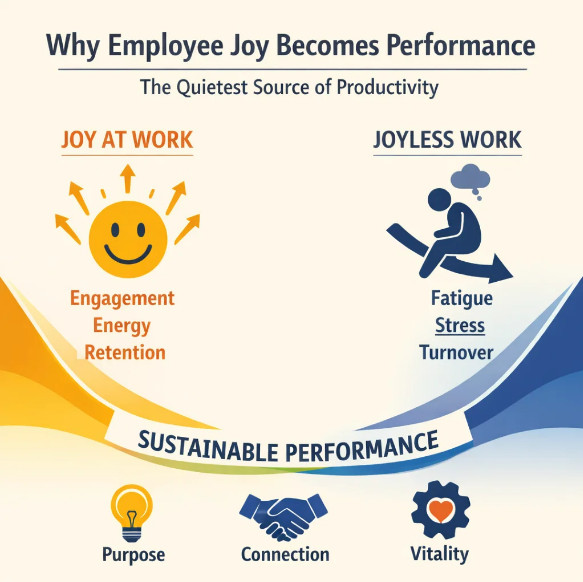
* 직원의 즐거움은 복지나 분위기 차원의 부수 요소가 아니라, 몰입·생산성·유지율을 움직이는 핵심 경영 변수다.
* 많은 리더는 직원의 감정을 경영의 주변부에 두지만, 실제로 조직의 성과는 일상에서 느끼는 정서적 에너지와 마찰 비용에 크게 좌우된다.
* 즐거움은 단순한 기분이 아니라, 일이 헛돌지 않는다는 감각, 의미 있는 진전, 덜 소모적인 관계에서 비롯되는 ‘일할 힘’에 가깝다.
* 직원의 즐거움이 사라진 조직에서는 불행보다 먼저 무감각이 퍼지고, 그 결과 협업 저하, 피로 누적, 실수 증가, 인재 유출이 조용히 진행된다.
* 앞으로 강한 조직은 사람을 더 세게 밀어붙이는 곳이 아니라, 사람의 에너지가 마르지 않도록 일과 관계와 운영 방식을 설계하는 곳이 될 가능성이 크다.
***
2026년 3월 24일, 하버드 비즈니스 리뷰는 직원의 즐거움이 단순한 기분 문제가 아니라 몰입과 생산성, 이직 의향까지 좌우하는 중요한 경영 변수라고 짚었다. 많은 리더는 직원의 즐거움을 분위기나 복지의 문제로 여기지만, 실제 조직에서는 이 감정이 성과의 지속성과 회복력을 가르는 힘으로 작용한다. 성과 압박이 커질수록 사람을 오래 움직이게 하는 힘은 통제보다 활력에 있다는 사실이 점점 더 분명해지고 있다.
성과를 갉아먹는 조용한 오해
2026년 3월 24일 하버드 비즈니스 리뷰에는 직원의 즐거움을 경영의 중심 변수로 다시 보아야 한다는 문제의식을 담은 글이 실렸다. 핵심은 분명하다. 많은 리더가 직원의 즐거움을 과소평가하고 있으며, 그 결과 조직은 몰입과 생산성, 유지율을 움직이는 중요한 힘을 스스로 놓치고 있다는 것이다. 직원이 일터에서 느끼는 긍정적 정서는 분위기를 조금 부드럽게 만드는 부수적 요소가 아니라, 조직의 실행력과 지속 가능성을 떠받치는 바닥에 가깝다.
이 문제제기가 중요한 이유는 대부분의 조직이 아직도 직원의 감정을 경영의 본류가 아니라 주변부에 놓고 있기 때문이다. 기업은 고객 만족, 시장 반응, 매출 지표, 비용 구조는 대단히 정교하게 측정하면서도, 정작 조직 안에서 사람이 얼마나 살아 있는 상태로 일하고 있는지는 훨씬 덜 세밀하게 들여다본다. 직원의 즐거움은 흔히 복지나 문화 프로그램의 언어로만 소비된다. 하지만 실제로는 사람이 자기 일을 얼마나 의미 있게 느끼는지, 얼마나 덜 소모되는 방식으로 하루를 버티는지, 얼마나 오래 조직에 남아 기여할 수 있는지를 가르는 핵심 조건에 더 가깝다.
많은 조직은 성과를 숫자의 언어로만 설명하려는 데 익숙하다. 매출, 이익, 비용, 생산성, 이직률, 평가 점수처럼 눈에 보이는 지표가 경영의 중심을 차지했고, 사람의 감정은 그 바깥의 부드럽고 추상적인 영역으로 밀려났다. 이 틀 안에서 직원의 즐거움은 대개 있으면 좋지만 없어도 경영이 돌아가는 요소처럼 취급됐다. 분위기를 조금 부드럽게 만들고 사내문화를 덜 딱딱하게 만드는 장치 정도로 여겨진 것이다. 그러나 실제 조직은 그렇게 단순하게 움직이지 않는다. 사람은 기계처럼 같은 조건에서 같은 성과를 반복적으로 내지 않는다. 같은 업무, 같은 도구, 같은 제도 아래에서도 어떤 팀은 살아 움직이고 어떤 팀은 빠르게 지친다. 이 차이는 종종 능력보다 정서적 에너지에서 갈린다.
직원이 즐겁게 일한다는 것은 단지 웃음이 많다는 뜻이 아니다. 일 속에서 의미를 느끼고, 내가 하는 노력이 헛돌지 않는다고 느끼며, 작은 진전이 보이고, 함께 일하는 사람들과의 관계가 지나치게 소모적이지 않은 상태를 뜻한다. 다시 말해 즐거움은 감정의 사치가 아니라 일의 마찰이 낮아진 상태와 연결되어 있다. 사람은 소모가 줄어들고 의미가 선명해질수록 더 오래 집중할 수 있고, 더 자발적으로 협력하며, 더 쉽게 무너지지 않는다. 조직이 즐거움을 가볍게 보면 놓치게 되는 것은 바로 이 지점이다. 즐거움은 기분의 문제가 아니라, 사람이 에너지를 잃지 않고 일할 수 있게 만드는 운영의 문제다.
성과를 오래 유지하는 조직일수록 이 사실을 더 민감하게 본다. 단기적으로는 압박과 통제로 성과를 끌어올릴 수 있다. 그러나 긴 시간에 걸쳐 성과를 유지하려면 사람의 내적 에너지가 마르지 않아야 한다. 억지로 밀어붙이는 방식은 어느 순간 비용으로 되돌아온다. 이직이 늘고, 피로가 쌓이고, 협업이 무뎌지고, 실수가 늘고, 새로운 변화에 대한 저항이 커진다. 겉으로는 같은 조직처럼 보여도 안에서는 점점 더 많은 힘이 낭비된다. 결국 즐거움을 무시하는 조직은 사람을 통해 성과를 만드는 대신, 사람을 깎아가며 성과를 버티는 쪽으로 기울게 된다.
리더는 왜 직원의 즐거움을 과소평가하는가
많은 리더가 직원의 즐거움을 과소평가하는 이유는 단순하다. 그것이 재무제표에 곧장 찍히지 않기 때문이다. 회계상 비용은 명확하게 보이고, 인건비도 보이고, 이직률도 보이고, 부서별 실적도 보인다. 하지만 어떤 직원이 월요일 아침 회의에 들어오며 느끼는 무력감, 자신의 아이디어가 받아들여졌을 때 생기는 생동감, 하루 일과를 마치며 느끼는 작은 만족은 쉽게 숫자가 되지 않는다. 그래서 경영은 이 영역을 자꾸 뒤로 미룬다. 측정하기 어렵다는 이유로 중요하지 않은 것처럼 취급하는 것이다.
문제는 리더가 모른다는 사실 그 자체보다, 모르는 상태를 충분히 자각하지 못하는 데 있다. 상층부는 조직을 큰 그림으로 본다. 전략, 투자, 구조조정, 신사업, 시스템, 기술 도입, 비용 효율화 같은 사안을 중심에 놓는다. 반면 현장은 매일 반복되는 일상 속에서 회의 하나, 승인 절차 하나, 애매한 지시 하나, 인정받지 못한 순간 하나를 통과하며 일을 한다. 리더는 방향을 본다고 생각하지만, 직원은 마찰을 산다. 그리고 사람을 지치게 하는 것은 대개 거대한 전략 그 자체가 아니라, 그 전략이 일상으로 내려왔을 때 생기는 작고 반복적인 소모다.
그래서 많은 조직에서 이런 장면이 벌어진다. 리더는 “우리는 많이 개선했다”고 말하지만, 직원은 “왜 더 힘들어졌지?”라고 느낀다. 새로운 도구가 생겼고, 더 빠른 시스템이 도입됐고, 성과 기준도 선명해졌는데 정작 하루의 체감은 더 피곤해지는 경우다. 리더는 개선을 숫자로 보고, 직원은 변화의 감정 비용을 몸으로 느낀다. 이 간극을 줄이지 못하면 조직은 점점 자기 확신 속에서 현장을 오해하게 된다.
또 하나의 이유는 즐거움을 여전히 약한 감정으로 생각하는 오래된 사고방식 때문이다. 진지한 조직일수록 더 냉정하고 단단해야 한다는 믿음이 아직 강하다. 이런 시각에서는 즐거움을 강조하는 것이 긴장을 풀고 기준을 낮추는 일처럼 보인다. 그러나 실제로 즐거움은 긴장의 반대말이 아니다. 오히려 의미 없는 긴장을 줄이고, 의미 있는 집중을 가능하게 하는 상태에 가깝다. 사람은 에너지가 있을 때 더 책임감 있게 움직인다. 즐거움은 규율을 무너뜨리는 힘이 아니라, 규율이 사람을 짓누르지 않게 만드는 완충 장치가 될 수 있다.
즐거움은 어떻게 생산성과 연결되는가
직원의 즐거움이 정말 성과와 연결되는가라는 질문은 매우 현실적이다. 듣기 좋은 말처럼 들려도 성과와 이어지지 않는다면 경영의 중심으로 가져오기 어렵기 때문이다. 그런데 이 문제를 깊이 들여다보면, 즐거움은 성과와 꽤 직접적인 방식으로 만난다. 사람이 자신의 일에서 즐거움을 느낄 때 가장 먼저 달라지는 것은 집중력의 질이다. 같은 시간을 써도 더 또렷하게 생각하고, 문제를 조금 더 주도적으로 해결하려 하며, 작은 장애물 앞에서 쉽게 무너지지 않는다. 일 자체가 전부 소모로만 느껴지지 않기 때문이다.
즐거움은 또한 협업의 질을 바꾼다. 에너지가 바닥난 사람은 협업을 추가 업무로 받아들이기 쉽다. 질문 하나에도 예민해지고, 피드백을 공격처럼 느끼며, 다른 사람의 요청을 부담으로 느낀다. 반대로 살아 있는 팀은 같은 양의 일을 하더라도 관계의 마찰이 적다. 협업은 단지 친절함의 문제가 아니다. 관계에서 낭비되는 에너지가 줄어드는 문제다. 즐거움이 있는 조직은 이 낭비를 줄인다. 그러면 속도가 빨라지고, 문제 해결이 유연해지며, 같은 인력으로 더 많은 결과를 낼 수 있다.
즐거움은 지속성의 차원에서도 중요하다. 단기 성과는 강한 압박으로 만들 수 있지만, 지속 성과는 그렇게 만들기 어렵다. 사람은 계속해서 자신을 갉아먹는 환경에서는 오래 버티지 못한다. 처음에는 참고, 다음에는 체념하고, 결국에는 떠나거나 남아도 마음이 빠져나간다. 바로 이 지점에서 즐거움은 유지율과 연결된다. 사람을 붙잡는 것은 꼭 거창한 비전이나 큰 보상만이 아니다. 매일 반복되는 업무 속에서 “그래도 여기서는 일할 만하다”는 감각이 쌓여야 사람은 오래 남는다. 즐거움은 조직에 대한 충성심 같은 거창한 감정이 아니라, 매일의 경험이 사람을 완전히 소모시키지 않는 상태와 더 가깝다.
또 하나 중요한 점은 즐거움이 학습과 변화 적응에도 영향을 준다는 사실이다. 요즘 조직은 끊임없이 새로운 것을 배워야 한다. AI 도입, 업무 방식 변화, 직무 재설계, 협업 구조 조정이 일상이 됐다. 이런 시대에는 사람의 능력보다 사람의 회복력이 더 중요해진다. 즐거움은 회복력을 떠받치는 감정적 기반이 될 수 있다. 에너지가 남아 있는 사람은 새로운 것을 배울 여력이 있지만, 이미 지쳐 있는 사람은 작은 변화도 위협으로 느낀다. 결국 변화의 시대일수록 즐거움은 선택이 아니라 적응의 조건이 된다.
즐거움의 반대는 불행이 아니라 무감각이다
직원의 즐거움을 이야기하면 종종 오해가 생긴다. 마치 조직을 놀이터처럼 만들자는 주장처럼 들리기 때문이다. 그러나 실제 문제는 정반대다. 대부분의 조직은 지나치게 많은 소모를 정상으로 받아들이고 있다. 끝이 보이지 않는 회의, 수시로 바뀌는 우선순위, 여러 번 반복되는 보고, 명확하지 않은 역할, 승인받기 위해 낭비되는 시간, 실수보다 실수에 대한 두려움이 더 큰 분위기, 인정은 적고 요구만 많은 구조가 쌓이면 사람은 점점 일을 싫어하게 되는 것이 아니라 일에 무감각해진다.
이 무감각이야말로 조직을 가장 조용하게 약화시키는 상태다. 분노는 그래도 에너지가 남아 있는 상태일 수 있다. 불만을 제기하고 바꾸려는 의지가 있기 때문이다. 그러나 무감각은 다르다. 더 이상 기대하지 않고, 더 이상 애쓰지 않으며, 더 이상 의미를 찾으려 하지 않는다. 겉으로는 큰 문제가 없어 보이지만, 내부에서는 활력이 말라간다. 이런 조직은 갑자기 무너지지 않는다. 대신 천천히 둔해지고, 늦어지고, 창의성이 사라지고, 실수가 늘고, 인재가 빠져나간다. 즐거움의 반대편에는 종종 이 조용한 무감각이 있다.
사람을 지치게 하는 것은 일의 양 자체만은 아니다. 어려운 일이어도 성취감이 있고 성장감이 있으면 버틸 수 있다. 반대로 쉬운 일이어도 통제감이 없고 의미가 없으며 진전이 보이지 않으면 빠르게 에너지가 고갈된다. 그래서 즐거움을 높이는 일은 단순히 사내 행사를 늘리고 분위기를 띄우는 것과 다르다. 먼저 해야 할 일은 불필요한 소모를 만드는 구조를 줄이는 것이다. 재미를 주입하는 것이 아니라 마찰을 제거하는 쪽이 더 본질적이다. 즐거움은 장식이 아니라 설계의 결과이기 때문이다.
특히 기술 도입이 빨라질수록 이 문제는 더 예민해진다. 자동화와 AI는 분명 반복 업무를 줄일 수 있다. 하지만 반대로 속도를 끌어올리고, 응답 시간을 단축시키고, 더 많은 결과를 더 짧은 시간 안에 요구하는 방식으로 쓰일 수도 있다. 그러면 표면적으로는 생산성이 높아졌는데, 실제 사람은 더 빠르게 마른다. 조직이 직원의 즐거움을 보지 않으면 이런 현상을 놓치기 쉽다. 더 효율적인 시스템이 왜 더 피곤한 결과를 낳는지 이해하지 못하게 되는 것이다.
리더는 무엇을 바꿔야 하는가
직원의 즐거움을 높이기 위해 가장 먼저 바꿔야 하는 것은 즐거움을 다루는 태도다. 즐거움은 “좋은 분위기 만들기”의 하위 항목이 아니라, 사람이 계속 일할 수 있게 하는 에너지 관리의 핵심이라는 인식 전환이 필요하다. 조직은 사람의 기술과 시간만 관리해왔지만, 앞으로는 사람의 정서적 에너지 역시 중요한 자원으로 다뤄야 한다. 많이 시키는 것보다 오래 움직이게 하는 것이 중요해진 시대이기 때문이다.
첫 번째 변화는 더 자주, 더 구체적으로 직원의 상태를 이해하는 것이다. 연례 만족도 조사 한 번으로는 부족하다. 사람은 계절처럼 변하고, 팀마다 다르며, 직무마다 지치는 지점이 다르다. 어디서 에너지를 얻고 어디서 힘을 잃는지, 어떤 업무가 사람을 살리고 어떤 절차가 사람을 마르게 하는지 더 세밀하게 봐야 한다. 고객 경험을 분석하듯 직원 경험도 더 정교하게 읽어야 한다. 그래야 즐거움이라는 추상적 단어가 실제 운영 개선의 언어로 바뀐다.
두 번째는 관리자 역할의 재설계다. 직원의 하루는 회사 전체보다 직속 상사에 의해 더 크게 좌우되는 경우가 많다. 같은 제도, 같은 회사, 같은 업종에서도 어떤 팀은 살아 있고 어떤 팀은 숨이 막히는 이유가 여기에 있다. 관리자는 업무를 배분하는 사람일 뿐 아니라, 팀의 감정 기후를 만드는 사람이다. 인정의 빈도, 피드백의 톤, 실수에 대한 반응, 우선순위 정리 능력, 자율성 부여 방식이 모두 팀의 즐거움과 직결된다. 조직문화는 추상적인 문구보다 관리자의 일상적 행동에서 훨씬 더 강하게 형성된다.
세 번째는 불필요한 소모를 줄이는 운영 개선이다. 사람은 늘 새로운 보상을 원해서 지치는 것이 아니다. 오히려 너무 많은 무의미한 낭비 때문에 지친다. 쓸모 없는 회의를 줄이고, 중복 보고를 덜고, 승인 절차를 단순화하고, 역할을 더 명확히 하고, 노력이 결과로 연결되는 감각을 자주 만들어주는 것이 중요하다. 작은 성취를 자주 보게 하는 구조, 애쓴 일이 묻히지 않는 구조, 진전이 느껴지는 구조는 즐거움을 만든다. 즐거움은 대단한 이벤트보다 덜 낭비되는 하루에서 더 자주 생긴다.
네 번째는 즐거움을 성과와 분리하지 않는 것이다. 아직도 많은 조직은 즐거움을 부드러운 가치, 성과를 단단한 가치로 나눠 생각한다. 그러나 실제로 둘은 따로 가지 않는다. 즐거움은 책임을 약하게 만드는 것이 아니라 책임을 버틸 수 있게 만든다. 사람이 살아 있을 때 더 집중하고, 더 자발적으로 움직이고, 더 오래 남기 때문이다. 조직이 이 연결을 이해하지 못하면 즐거움은 계속 복지의 언어로만 남게 된다. 반대로 이 연결을 이해하면 즐거움은 경영의 언어 안으로 들어온다.
앞으로 더 중요해질 감정의 경쟁력
앞으로의 조직은 더 빠르게 변해야 하고, 더 적은 자원으로 더 많은 성과를 내야 하며, 더 복잡한 불확실성을 견뎌야 할 가능성이 크다. 바로 그렇기 때문에 직원의 즐거움은 더 중요해진다. 여유로운 시절의 사치가 아니라 압박의 시대에 필요한 생존 자산이 되기 때문이다. 사람을 계속 압박하는 방식만으로 성과를 끌어올리는 전략은 한계가 분명하다. 어느 순간 조직은 겉으로는 멀쩡해 보여도 내부 엔진이 식어버린다.
결국 강한 조직은 사람을 더 세게 밀어붙이는 조직이 아니라, 사람이 오래 움직일 수 있게 만드는 조직일 가능성이 크다. 그 힘은 급여만으로 만들어지지 않는다. 사람을 존중한다는 선언만으로도 만들어지지 않는다. 매일의 일 속에서 에너지가 완전히 소모되지 않도록 설계하는 것, 의미와 진전과 관계의 질을 관리하는 것, 그리고 그것이 결국 성과의 조건임을 인정하는 것에서 시작된다.
직원의 즐거움은 가볍지 않다. 그것은 일의 경험이 사람을 얼마나 닳게 하는지, 혹은 얼마나 살아 있게 하는지를 묻는 질문이다. 많은 조직이 아직 이 질문을 부차적인 것으로 취급하지만, 실제로는 여기서 생산성의 질, 협업의 온도, 유지율의 방향, 변화 적응의 속도가 갈린다. 즐거움은 좋은 회사의 장식이 아니다. 오래 강한 회사를 만드는 가장 조용한 기반 가운데 하나다.
Reference
Harvard Business Review. “Leaders Underestimate the Value of Employee Joy.” March 24, 2026.
Why Employee Joy Becomes Performance
- The Quietest Source of Productivity That Leaders Are Overlooking
[Key Message]
* Employee joy is not a secondary element of perks or workplace atmosphere, but a core management variable that shapes engagement, productivity, and retention.
* Many leaders place employee emotion at the margins of management, but in reality, organizational performance is heavily influenced by emotional energy and the friction costs people experience in everyday work.
* Joy is not simply a good mood. It is closer to the energy to work that comes from feeling that one’s efforts are not wasted, that progress is meaningful, and that relationships are less draining.
* In organizations where employee joy disappears, numbness often spreads before unhappiness does, quietly leading to weaker collaboration, accumulated fatigue, more mistakes, and talent loss.
* In the future, strong organizations are likely to be those that do not push people harder, but instead design work, relationships, and operations so that people’s energy does not run dry.
***
On March 24, 2026, Harvard Business Review pointed out that employee joy is not simply a matter of mood, but an important management variable that affects engagement, productivity, and even turnover intention. Many leaders regard employee joy as a matter of atmosphere or perks, but in real organizations, this emotion functions as a force that determines the sustainability of performance and resilience. As performance pressure grows, it is becoming increasingly clear that the force that keeps people moving for the long term lies more in vitality than in control.
A Quiet Misunderstanding That Eats Away at Performance
On March 24, 2026, Harvard Business Review published an article arguing that employee joy must be viewed again as a central management variable. Its core message was clear. Many leaders underestimate employee joy, and as a result, organizations are overlooking one of the key forces that drive engagement, productivity, and retention. The positive emotions employees feel at work are not incidental elements that merely soften the atmosphere a little. They are closer to the foundation that supports an organization’s execution and sustainability.
This argument matters because most organizations still place employees’ emotions not at the center of management, but at its margins. Companies measure customer satisfaction, market response, sales indicators, and cost structures with great precision, yet they examine far less carefully how alive people actually feel while working inside the organization. Employee joy is often consumed only in the language of perks or culture programs. In reality, however, it is much closer to a core condition that determines how meaningfully people feel about their work, how much less depletion they experience as they make it through the day, and how long they are able to remain in the organization and contribute.
Many organizations are accustomed to explaining performance only in the language of numbers. Visible indicators such as sales, profit, cost, productivity, turnover rate, and evaluation scores have occupied the center of management, while human emotion has been pushed to the outside as something soft and abstract. Within this frame, employee joy has usually been treated as something nice to have, but not necessary for management to function. It has been regarded as little more than a device for softening the atmosphere a bit and making corporate culture less rigid. But real organizations do not move so simply. People are not machines that produce the same performance repeatedly under the same conditions. Under the same tasks, the same tools, and the same systems, some teams come alive while others quickly grow exhausted. This difference is often determined less by ability than by emotional energy.
To say that employees work joyfully does not simply mean that there is more laughter. It means a state in which people find meaning in their work, feel that their effort is not going to waste, see small signs of progress, and are not excessively drained by their relationships with the people they work with. In other words, joy is not a luxury of emotion, but something connected to a state in which the friction of work has been lowered. The less depleted people feel and the clearer meaning becomes, the longer they can concentrate, the more willingly they cooperate, and the less easily they fall apart. This is exactly what organizations miss when they treat joy lightly. Joy is not a matter of mood. It is a matter of operations that allows people to work without losing their energy.
Organizations that sustain performance over a long period are more sensitive to this fact. In the short term, performance can be pushed upward through pressure and control. But to sustain performance over time, people’s inner energy must not run dry. A method based on sheer pressure eventually returns as cost. Turnover rises, fatigue accumulates, collaboration becomes dull, mistakes increase, and resistance to new change grows. On the surface, such organizations may look the same as others, but internally, more and more energy is being wasted. In the end, organizations that ignore joy begin to lean toward grinding people down to sustain performance, instead of generating performance through people.
Why Leaders Underestimate Employee Joy
The reason many leaders underestimate employee joy is simple. It does not appear directly on the financial statements. Costs are clearly visible in accounting. Labor expenses are visible. Turnover rates are visible. Departmental performance is visible. But the helplessness an employee feels when entering a Monday morning meeting, the liveliness that arises when their idea is accepted, or the small sense of satisfaction felt at the end of the workday do not easily become numbers. So management keeps pushing this area aside. Because it is difficult to measure, it is treated as if it were unimportant.
The problem is not merely that leaders do not know. It is that they do not fully recognize the fact that they do not know. The upper ranks view the organization through the big picture. They focus on strategy, investment, restructuring, new business, systems, technology adoption, and cost efficiency. The front lines, by contrast, work their way each day through one meeting, one approval step, one ambiguous instruction, one unrecognized moment at a time. Leaders think they are seeing direction, but employees are living through friction. And what wears people down is usually not the grand strategy itself, but the small, repeated depletion that appears when that strategy descends into daily life.
That is why scenes like this often unfold in many organizations. Leaders say, “We’ve improved a lot,” while employees feel, “Then why has it become even harder?” New tools have appeared, faster systems have been introduced, and performance standards have become clearer, yet the experience of the day itself becomes more exhausting. Leaders see improvement in numbers, while employees feel the emotional cost of change in their bodies. If this gap is not reduced, organizations gradually come to misunderstand the front lines through the lens of their own certainty.
Another reason is the old mindset that still sees joy as a weak emotion. The more serious the organization, the stronger the belief that it must be colder and tougher. Within that view, emphasizing joy can look like loosening tension and lowering standards. In reality, however, joy is not the opposite of tension. It is closer to a state that reduces meaningless tension and makes meaningful focus possible. People move with greater responsibility when they have energy. Joy is not a force that destroys discipline. It can become a buffer that prevents discipline from crushing people.
How Joy Connects to Productivity
The question of whether employee joy is really connected to performance is a very practical one. No matter how appealing it sounds, if it does not lead to performance, it is hard to bring it into the center of management. Yet when we examine this issue more deeply, joy meets performance in quite direct ways. The first thing that changes when people feel joy in their work is the quality of their concentration. Even when spending the same amount of time, they think more clearly, try to solve problems more proactively, and do not collapse as easily in front of small obstacles. That is because work no longer feels like pure depletion in every respect.
Joy also changes the quality of collaboration. A person whose energy has bottomed out is likely to experience collaboration as additional work. They become sensitive even to a single question, take feedback as an attack, and feel burdened by other people’s requests. A team that is alive, by contrast, experiences less relational friction even while doing the same amount of work. Collaboration is not simply a matter of kindness. It is a matter of reducing the energy wasted in relationships. Organizations with joy reduce that waste. As a result, speed increases, problem-solving becomes more flexible, and the same workforce can produce more results.
Joy also matters in terms of sustainability. Short-term performance can be produced through intense pressure, but sustained performance cannot be created that way. People cannot endure for long in environments that constantly wear them down. At first they endure, then they resign themselves, and eventually they either leave or remain with their hearts already gone. This is where joy connects to retention. What keeps people in place is not always some grand vision or large reward. People stay longer when the repeated routines of work accumulate into a feeling that “this place is still worth working in.” Joy is not some grand emotion like loyalty to the organization. It is closer to a state in which daily experience does not completely consume a person.
Another important point is that joy also affects learning and adaptation to change. Organizations today must constantly learn new things. AI adoption, changes in work methods, job redesign, and shifts in collaboration structures have become everyday realities. In such an era, resilience matters more than ability. Joy can become the emotional foundation that supports resilience. A person who still has energy left has room to learn something new, while a person who is already exhausted experiences even a small change as a threat. In the end, in an age of change, joy is not a choice. It becomes a condition for adaptation.
The Opposite of Joy Is Not Misery but Numbness
When employee joy is discussed, misunderstandings often arise. It can sound as though the claim is to turn the organization into a playground. But in reality, the problem is the exact opposite. Most organizations are accepting far too much depletion as normal. Endless meetings, priorities that keep shifting, repeated reporting, unclear roles, time wasted just to get approval, a climate in which fear of mistakes is greater than mistakes themselves, and structures where recognition is scarce but demands are constant—when these pile up, people do not gradually come to hate work. They become numb to it.
This numbness is precisely the condition that weakens an organization most quietly. Anger may still be a state in which some energy remains, because there is still a will to raise objections and change things. Numbness is different. It no longer expects, no longer tries, no longer looks for meaning. On the surface, there may seem to be no major problem, but inside, vitality is drying up. Such organizations do not collapse all at once. Instead, they slowly become duller, slower, less creative, more mistake-prone, and more likely to lose talent. On the far side of joy, this quiet numbness often lies waiting.
What exhausts people is not simply the amount of work. Even difficult work can be endured when it brings a sense of achievement and growth. On the other hand, even easy work quickly drains energy if it offers no sense of control, no meaning, and no visible progress. That is why increasing joy is not the same as increasing company events or trying to brighten the mood. The first task is to reduce the structures that create unnecessary depletion. Injecting fun is not the essence. Removing friction is. Joy is not decoration. It is the result of design.
This issue becomes even more sensitive as technology adoption accelerates. Automation and AI can certainly reduce repetitive tasks. But they can also be used to increase speed, shorten response times, and demand more results within less time. Then, on the surface, productivity rises, but in reality people dry out more quickly. If organizations do not pay attention to employee joy, they can easily miss this phenomenon. They fail to understand why more efficient systems are producing more exhausting outcomes.
What Leaders Need to Change
The first thing that must change in order to raise employee joy is the attitude toward joy itself. Joy must be recognized not as a subcategory of “creating a good atmosphere,” but as a core issue in energy management that allows people to keep working. Organizations have managed only people’s skills and time. Going forward, they must also treat people’s emotional energy as an important resource. In an age when what matters is not making people do more, but enabling them to keep moving longer, this shift becomes essential.
The first change is to understand employees’ condition more often and more specifically. One annual satisfaction survey is not enough. People change like seasons. Teams differ. Jobs differ in the points at which they become exhausting. Organizations must look more closely at where people gain energy and where they lose it, which tasks keep people alive and which procedures wear them down. Just as customer experience is analyzed, employee experience must also be read more precisely. Only then can the abstract word joy be translated into the language of actual operational improvement.
The second is a redesign of the manager’s role. An employee’s day is often shaped more by their direct supervisor than by the company as a whole. This is why, under the same systems, in the same company, and in the same industry, some teams feel alive while others feel suffocated. Managers are not only the people who allocate work. They are also the people who shape the emotional climate of the team. The frequency of recognition, the tone of feedback, reactions to mistakes, the ability to organize priorities, and the way autonomy is granted all connect directly to team joy. Organizational culture is formed far more powerfully through a manager’s everyday behavior than through abstract slogans.
The third is operational improvement that reduces unnecessary depletion. People do not become exhausted because they always want new rewards. More often, they are exhausted by too much meaningless waste. It is important to cut useless meetings, reduce duplicate reporting, simplify approval procedures, clarify roles, and create frequent moments in which effort can be felt as leading to results. Structures that let people see small achievements often, structures in which hard work does not disappear unnoticed, and structures in which progress can be felt—these are what create joy. Joy appears more often in a day with less waste than in any grand event.
The fourth is not to separate joy from performance. Even now, many organizations divide joy and performance into soft values and hard values. In reality, however, the two do not move separately. Joy does not weaken responsibility. It makes responsibility bearable. When people are alive, they concentrate more, move more proactively, and stay longer. If organizations do not understand this connection, joy will remain confined to the language of perks. If they do understand it, joy enters the language of management.
The Growing Importance of Emotional Competitiveness
The organizations of the future will likely have to change faster, produce more results with fewer resources, and endure more complex uncertainty. Precisely for that reason, employee joy will matter even more. It will become not a luxury of easier times, but a survival asset in an age of pressure. A strategy that tries to raise performance only by continuing to squeeze people has clear limits. At some point, an organization may still appear fine on the outside while its internal engine has already gone cold.
In the end, strong organizations are likely to be those that do not push people harder, but make it possible for them to keep moving for longer. That strength is not created by pay alone. Nor is it created simply by declarations that people are respected. It begins with designing daily work so that energy is not completely drained away, managing meaning, progress, and the quality of relationships, and recognizing that these things are, in fact, conditions of performance.
Employee joy is not trivial. It is the question of how much the experience of work wears people down, or how much it keeps them alive. Many organizations still treat this question as secondary, but in reality, the quality of productivity, the temperature of collaboration, the direction of retention, and the speed of adaptation to change are all determined here. Joy is not the decoration of a good company. It is one of the quietest foundations of a company that remains strong for a long time.
Reference
Harvard Business Review. “Leaders Underestimate the Value of Employee Joy.” March 24, 2026.