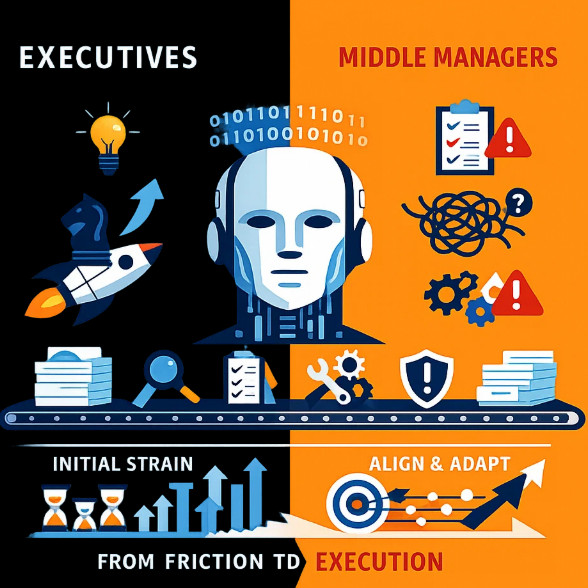
* 기업의 AI 성과를 막는 가장 큰 장애물은 기술 자체가 아니다. 같은 AI를 두고도 경영진과 중간관리자가 전혀 다른 현실을 보고 있다는 점이 더 치명적인 문제다.
* 경영진은 AI를 성장과 혁신, 경쟁 우위의 기회로 바라본다. 반면 중간관리자는 늘어난 검토 업무, 모호한 책임, 현장 혼란 같은 실행의 부담을 먼저 체감한다.
* AI는 처음부터 일을 줄여주는 만능 도구로 작동하지 않는다. 오히려 도입 초기에는 검수, 조정, 교육, 리스크 관리 같은 새로운 노동을 조직 안에 더 많이 만들어낼 수 있다.
* 그래서 AI의 성패는 단순히 도입했느냐에 있지 않다. 어떤 업무에 어떻게 적용하고, 누가 판단하고, 어디까지 책임질지를 다시 설계할 때 비로소 성과가 난다.
* 앞으로 기업의 경쟁력은 더 좋은 AI를 먼저 사는 능력만으로 결정되지 않을 가능성이 크다. 조직 안의 시차와 온도차를 얼마나 빠르게 줄이고 하나의 실행력으로 묶어내느냐가 진짜 승부처가 될 것이다.
***
경영진과 중간관리자의 시차가 만드는 조직의 비용
2026년 4월 8일 공개된 하버드비즈니스리뷰의 글은 많은 기업이 이미 체감하고 있지만 제대로 설명하지 못했던 문제를 정확히 짚는다. 기업의 최고경영진과 중간관리자는 같은 AI를 보고도 전혀 다른 현실을 말하고 있으며, 그 차이가 단순한 의견 불일치에 그치지 않고 실제 비용으로 번지고 있다는 것이다. 위에서는 AI를 성장의 수단, 경쟁 우위의 열쇠, 미래 준비의 상징으로 받아들이지만, 가운데에서는 아직 정리되지 않은 업무, 늘어난 책임, 모호해진 기준, 그리고 실패했을 때 자신에게 돌아올 부담으로 체감하는 경우가 많다. 그래서 어떤 회사는 AI를 전사 전략이라고 부르면서도 실제로는 파일럿 단계의 혼란을 반복하고, 어떤 조직은 도입 사실은 화려하게 발표했지만 현장에서는 오히려 일의 속도와 품질이 흔들린다. 문제는 기술이 없어서가 아니라, 같은 기술을 둘러싼 조직의 시선과 언어가 아직 하나로 맞춰지지 않았다는 데 있다.
같은 AI를 보고도 왜 전혀 다른 말을 하게 되는가
경영진이 AI를 바라보는 방식은 대체로 거시적이다. 그들의 관심은 시장 변화, 경쟁사 대응, 비용 절감, 생산성 향상, 새로운 수익모델, 주주와 이사회를 향한 설명 가능성에 놓여 있다. 이 관점에서 AI는 더 늦기 전에 올라타야 할 흐름이며, 잘만 활용하면 조직 전체를 한 단계 끌어올릴 수 있는 전략 자산처럼 보인다. 그래서 경영진 회의에서 AI는 자주 ‘기회’의 언어로 등장한다. 더 빨리 일할 수 있다, 더 적은 인력으로 더 많은 성과를 낼 수 있다, 고객 경험을 개선할 수 있다, 시장 변화에 더 민첩하게 대응할 수 있다는 식의 기대가 앞선다. 이 기대는 전혀 이상하지 않다. 실제로 AI는 일부 업무에서 초안 작성, 자료 정리, 검색, 코드 보조, 반복 업무 처리 같은 분야에서 분명한 효율을 만들어내고 있기 때문이다.
하지만 중간관리자의 눈에 비친 AI는 훨씬 더 구체적이고 거칠다. 그들은 기술의 가능성보다 먼저 기술이 업무에 들어왔을 때 생기는 마찰을 본다. 새로운 툴을 도입하면 누구를 교육해야 하는지, 기존 승인 절차는 어떻게 바꿔야 하는지, 잘못된 결과물이 나왔을 때 누가 책임질지, 보안이나 품질 문제는 어디까지 허용할 수 있는지, 실무자들이 만든 초안을 누가 검수할지 같은 질문이 한꺼번에 쏟아진다. 경영진에게 AI가 ‘방향’이라면, 중간관리자에게 AI는 ‘처리해야 하는 현실’이다. 이 차이는 단순한 태도 차이가 아니다. 각자가 서 있는 위치가 다르기 때문에 보이는 것이 다르고, 그래서 같은 기술을 두고도 전혀 다른 말을 하게 된다.
바로 이 지점에서 많은 오해가 생긴다. 위에서는 중간관리자가 변화에 소극적이라고 느끼고, 가운데에서는 경영진이 현실을 모른 채 낙관만 한다고 느낀다. 그러나 실제로는 둘 중 하나만 틀린 것이 아니라, 서로 다른 층위의 진실을 보고 있는 경우가 많다. 경영진이 보는 AI는 회사의 미래이고, 중간관리자가 보는 AI는 오늘의 업무다. 미래와 오늘이 연결되지 않으면 조직은 방향은 있는데 발이 묶인 상태가 된다. 그래서 AI 시대에 필요한 것은 단순한 기술 도입이 아니라, 서로 다른 위치에서 나온 인식을 하나의 실행 언어로 바꾸는 일이다. 그 작업이 빠질수록 조직은 같은 AI를 놓고도 각자 다른 현실을 말하게 되고, 그 순간부터 성과의 지연은 이미 시작된다.
기대는 위에서 커지고 부담은 가운데로 떨어진다
많은 기업에서 AI 도입의 출발점은 위다. 경영진은 비전과 속도를 말하고, 시장은 조급함을 더하며, 조직은 뒤처지면 안 된다는 압박 속에서 움직인다. 그러나 실제 실행 단계에 들어가면 부담은 대부분 중간관리자에게 몰린다. 새로운 도구를 팀에 적용해봐야 하고, 실무자가 만든 결과물을 검토해야 하며, 기존 프로세스를 바꿔야 하고, 성과는 내되 사고는 막아야 한다. 특히 생성형 AI처럼 속도는 빠르지만 오류 가능성도 있는 기술일수록 중간관리자의 부담은 더 커진다. 현장에서는 “AI를 쓰라”는 말보다 “AI를 써도 되는 기준이 무엇인가”가 훨씬 중요한데, 이 기준은 대개 명확하게 정리되지 않은 채 아래로 내려온다.
이때 생기는 대표적 현상이 하나 있다. 위에서는 AI 도입이 업무를 줄여줄 것이라고 기대하지만, 실제 현장에서는 한동안 일이 더 늘어나는 것이다. 초안은 빨리 나오지만 검토는 더 자주 해야 하고, 실수는 줄어들지 않으며, 팀원마다 활용 수준이 달라 관리 포인트는 오히려 많아진다. 어떤 조직에서는 AI가 문서를 빨리 써주지만, 그 문장이 정확한지 검토하는 시간이 더 들어간다. 또 어떤 팀에서는 검색과 정리는 빨라졌지만, 잘못된 정보가 섞일 위험 때문에 최종 확인 절차가 더 복잡해진다. 결국 AI는 단번에 노동을 없애기보다 노동의 모양을 먼저 바꾼다. 문제는 많은 조직이 이 전환 비용을 충분히 계산하지 않는다는 데 있다.
그래서 중간관리자는 종종 두 개의 압박을 동시에 받는다. 위에서는 “왜 아직 성과가 안 나오느냐”고 묻고, 아래에서는 “오히려 일이 늘었다”고 토로한다. 한쪽에서는 낙관을 관리해야 하고, 다른 한쪽에서는 피로를 달래야 한다. 이 역할은 생각보다 무겁다. 관리자는 변화의 전도사처럼 행동해야 하면서도, 동시에 리스크의 방파제 역할도 해야 하기 때문이다. 그 결과 AI 도입은 조직 전체의 혁신 프로젝트로 포장되지만, 실제로는 중간층의 보이지 않는 추가 노동 위에 얹혀 돌아가는 경우가 많다.
이 부담 구조를 제대로 보지 않으면 기업은 늘 비슷한 실수를 반복한다. AI에 대한 기대는 커지는데 현장의 신뢰는 줄어들고, 경영진은 “왜 이렇게 느리냐”고 묻지만 관리자들은 “무엇을 기준으로 움직여야 하는지조차 불분명하다”고 느낀다. 결국 실행은 지연되고, 조직 안에는 AI 자체보다 AI를 둘러싼 피로가 먼저 쌓인다. 그래서 지금 필요한 것은 더 강한 독려가 아니라 더 정교한 설계다. 누가 어떤 부담을 떠안고 있는지, 어떤 단계에서 일이 늘어나는지, 어떤 기준이 빠져 있는지부터 드러내야 한다. 기대가 위에서 커질수록, 그 기대가 नीचे로 번질 때 어떤 형태의 노동과 책임으로 변하는지를 세밀하게 봐야 한다. 그렇지 않으면 AI는 혁신의 도구가 아니라, 조직 안에서 또 하나의 피로한 과제가 되어버린다.
성과를 막는 진짜 병목은 기술이 아니라 조직의 온도차다
AI 프로젝트가 기대만큼 빨리 성과를 내지 못할 때 많은 기업은 먼저 기술적 이유를 찾는다. 데이터가 부족하다, 보안 이슈가 있다, 모델의 품질이 들쭉날쭉하다, 시스템 연동이 어렵다, 예산이 충분하지 않다는 식이다. 물론 이런 문제는 실제로 중요하다. 하지만 요즘 많은 기업의 병목은 기술 자체보다 조직 내부의 온도차에서 더 크게 발생한다. 경영진은 AI를 “이미 가야 할 길”로 생각하는데, 중간관리자와 현장 실무자는 “아직 정리되지 않은 불확실한 과제”로 받아들이는 것이다. 한쪽은 확신을 갖고 속도를 요구하고, 다른 한쪽은 불확실성을 줄일 장치가 먼저 필요하다고 느낀다. 이 상태에서는 좋은 툴을 들여놔도 빠르게 성과가 나기 어렵다.
조직의 온도차는 여러 형태로 나타난다. 어떤 회사에서는 경영진이 AI를 거의 필수 언어처럼 사용하지만, 현장에서는 어디까지 활용해야 하는지조차 명확하지 않다. 또 어떤 회사에서는 AI 활용을 장려하면서도, 오류가 생겼을 때 책임 소재는 개인에게 남겨둔다. 그러면 사람들은 자연스럽게 보수적으로 움직인다. 적극적으로 써보라는 메시지는 위에서 내려오지만, 사고가 나면 그 부담은 아래가 감당해야 하기 때문이다. 이런 상황에서는 조직이 겉으로는 AI 친화적으로 보일지 몰라도 실제로는 매우 조심스럽고 소극적인 사용 문화가 자리 잡기 쉽다.
이 온도차는 결국 비용으로 바뀐다. 첫째, 프로젝트가 느려진다. 둘째, AI가 어디에 유용한지보다 어디에 쓰면 위험한지에 대한 방어적 계산이 앞선다. 셋째, 일부 팀만 실험적으로 쓰고 전체 조직은 따라오지 못하면서 전사적 확산이 막힌다. 넷째, 성과 측정 방식이 모호해져 성공과 실패를 학습 자산으로 만들지 못한다. 다섯째, 조직 안에서 AI를 둘러싼 피로와 냉소가 누적된다. 결국 기술적 한계보다 더 무서운 것은 “이건 우리 일에 잘 맞지 않는다”는 정서가 퍼지는 것이다. 이런 정서가 자리 잡으면 이후 더 좋은 모델, 더 좋은 시스템이 들어와도 조직은 이미 마음을 닫은 상태가 된다.
그래서 AI 시대의 핵심 질문은 “어떤 모델을 쓸 것인가”만이 아니다. “우리 조직은 AI를 어떤 현실로 이해하고 있는가”가 더 중요하다. 위에서는 혁신이라고 말하고 아래에서는 위험이라고 말한다면, 그 조직은 이미 언어가 갈라진 것이다. 언어가 갈라진 조직은 실행에서 엇박자가 날 수밖에 없다. 기술 투자는 할 수 있지만, 기술 전환은 일어나지 않는다. 이 차이는 매우 크다. 투자만 한 조직은 늘 성과를 기다리지만, 전환에 성공한 조직은 일하는 방식 자체가 바뀐다.
AI를 둘러싼 병목을 진짜로 풀고 싶다면, 기술 로드맵만이 아니라 조직의 인식 지형도를 먼저 봐야 한다. 어느 부서는 기대가 과도한지, 어느 팀은 방어적으로 굳어 있는지, 중간관리자는 무엇을 가장 큰 위험으로 보는지, 실무자들은 무엇을 가장 번거롭게 느끼는지 파악해야 한다. 그렇게 해야만 기술 문제와 조직 문제를 구분할 수 있고, 어디에 자원을 투입해야 하는지도 선명해진다. 결국 AI의 성공 여부는 성능표에만 달려 있지 않다. 그 기술을 둘러싼 조직의 체감 온도를 얼마나 빠르게 맞추느냐가, 생각보다 훨씬 더 결정적인 변수다.
중간관리자는 저항 세력이 아니라 번역자다
AI 도입이 막히는 조직에서는 중간관리자가 종종 ‘걸림돌’처럼 묘사된다. 변화에 소극적이고, 새로운 방식을 못 믿고, 늘 리스크만 본다는 평가가 붙는다. 그러나 이런 시선은 상황을 너무 단순하게 본 것이다. 중간관리자는 대개 변화의 적이 아니라 변화의 번역자다. 위에서 내려오는 전략 언어를 실무가 이해할 수 있는 업무 언어로 바꾸고, 현장에서 올라오는 문제를 다시 의사결정 가능한 보고 언어로 바꾸는 사람이 바로 이들이다. 만약 이 번역 과정이 제대로 작동하지 않으면 조직은 쉽게 두 개의 세계로 갈라진다. 위에서는 “왜 이렇게 좋은 기술을 안 쓰느냐”고 묻고, 아래에서는 “왜 현실을 모른 채 도입만 외치느냐”고 반응한다.
이 번역자의 역할은 AI 시대에 더욱 중요해졌다. 과거의 디지털 전환도 그랬지만, 생성형 AI는 특히 결과물의 질과 활용 범위가 매번 다르게 나타나기 때문에 기준을 세우는 일이 더 어렵다. 실무자들은 속도를 원하고, 경영진은 성과를 원하며, 법무나 보안 부서는 통제를 원한다. 이 서로 다른 요구를 한 업무 흐름 안에서 조정해야 하는 사람이 바로 중간관리자다. 그런데 많은 기업은 이 계층을 전략의 공동 설계자가 아니라 전달자 정도로만 취급한다. 그러면 중간관리자는 설계 권한 없이 책임만 지게 되고, 그 상태에서 AI는 자연스럽게 불편한 과제가 된다.
중간관리자를 중심에 두고 봐야 하는 이유는 단순하다. 실제로 조직 변화가 멈추는 지점이 대부분 이 층에서 드러나기 때문이다. 실무자는 사용해보라고 하면 일단 써볼 수 있다. 경영진은 방향을 정하고 예산을 배정할 수 있다. 하지만 일상적 운영, 성과 평가, 리스크 통제, 인력 배치, 업무 우선순위 조정 같은 현실적 문제는 대부분 관리자 레벨에서 해석되고 결정된다. 즉, 이들이 납득하지 못한 AI는 조직에 뿌리내리기 어렵다. 반대로 이들이 제대로 이해하고 공감한 AI는 훨씬 더 빠르게 확산된다. 관리자는 단순한 통로가 아니라 확산의 핵심 축이다.
그래서 기업이 정말 해야 할 일은 중간관리자를 설득하는 것이 아니라, 중간관리자가 현실적으로 움직일 수 있는 조건을 만들어주는 것이다. 예를 들어 AI 사용에 따른 품질 기준을 명확히 정리하고, 오류가 났을 때의 책임 구조를 개인에게만 떠넘기지 않으며, 어떤 업무에선 시도해도 되고 어떤 업무에선 엄격한 검수가 필요한지를 구체화해야 한다. 또한 AI 활용으로 인해 관리자에게 새롭게 늘어난 노동, 이를테면 결과물 검토, 팀원 지도, 사용 기준 관리 같은 숨은 업무를 공식적으로 인정할 필요도 있다. 그래야 관리자도 AI를 추가 부담이 아니라 관리 가능한 변화로 받아들일 수 있다.
이 계층을 무시한 채 기술 도입만 밀어붙이는 조직은 겉으로는 빠르게 움직이는 듯 보여도 내부에서는 쉽게 마찰을 키운다. 반면 중간관리자를 전략의 중심 번역자로 인정하는 조직은 실행 속도가 오히려 더 안정적이다. 이유는 간단하다. 전략과 현실 사이의 언어가 맞춰지기 때문이다. 결국 AI 시대에 중간관리자는 저항 세력이 아니라 연결 장치다. 이들을 빼고는 조직은 위의 야심과 아래의 현실을 이어 붙일 수 없다. 그리고 이 연결이 끊긴 조직에서는 아무리 좋은 기술도 끝내 성과로 이어지기 어렵다.
도입보다 중요한 것은 업무의 재설계다
많은 기업이 AI 전략을 말할 때 가장 쉽게 빠지는 함정은, 도구를 들여오는 일을 곧 변화라고 생각하는 것이다. 새로운 플랫폼을 구매하고, 사내 계정을 배포하고, 교육 영상을 만들고, 몇 개 팀에서 파일럿을 돌리면 뭔가 큰 전환이 시작된 것처럼 느껴진다. 하지만 실제 변화는 그다음에 시작된다. 어떤 업무를 AI가 맡고, 어디까지 인간이 판단하고, 어떤 결과물은 바로 써도 되고 어떤 것은 반드시 검토해야 하는지, 기존의 승인 체계와 보고 체계를 어떻게 바꿀지 정하지 않으면 AI는 그저 기존 업무 위에 하나의 단계가 더 붙는 것에 그친다. 이 경우 도입은 있었지만 전환은 없다.
업무 재설계가 중요한 이유는 AI가 기존 업무를 단순히 대체하지 않기 때문이다. 대부분의 경우 AI는 일의 순서, 검토 방식, 책임 구조를 다시 묻게 만든다. 예전에는 사람이 처음부터 끝까지 만들던 일을 이제는 AI가 초안을 만들고 사람이 다듬는 방식으로 바꿀 수 있다. 그러면 사람의 역할은 단순 생산자에서 편집자, 판단자, 검수자로 이동한다. 문제는 많은 조직이 이 이동을 정식 업무 변화로 인정하지 않는다는 데 있다. 역할은 바뀌었는데 평가 기준은 그대로고, 절차는 달라졌는데 책임 구조는 예전 방식 그대로 남는다. 그 결과 사람들은 AI를 활용하면서도 어딘가 불안정하고 모호한 상태에 놓인다.
특히 생성형 AI는 빠르게 결과를 만들어내는 대신, 결과의 품질이 상황에 따라 크게 흔들릴 수 있다. 그래서 어떤 업무에서는 아주 유용하지만, 어떤 업무에서는 오히려 추가 검토 비용이 더 커질 수 있다. 예를 들어 아이디어 초안, 문장 정리, 내부 검색, 회의 요약, 반복 답변 같은 분야에서는 큰 효율이 날 수 있다. 반면 법적 책임이 크거나 사실 오류에 민감한 업무, 또는 고객 신뢰를 직접 건드리는 업무는 훨씬 더 신중해야 한다. 모든 업무에 같은 속도로 AI를 적용하려고 하면 필연적으로 마찰이 생긴다. 조직마다, 부서마다, 업무 종류마다 적합한 방식이 다르기 때문이다.
그래서 진짜 중요한 것은 ‘전사 도입’이라는 구호가 아니라 ‘업무별 설계’다. 어디에서 AI가 시간을 아껴주는지, 어디에서는 사람이 최종 판단을 반드시 해야 하는지, 어떤 부서는 정확성이 핵심이고 어떤 부서는 속도가 핵심인지 세밀하게 구분해야 한다. 또한 성과 측정 방식도 새로 짜야 한다. 단순히 사용량을 늘리는 것이 목표가 아니라, 오류를 줄였는지, 반복 업무 시간이 줄었는지, 의사결정 속도가 개선됐는지, 고객 만족도가 높아졌는지처럼 실제 효과를 보는 기준이 필요하다. 그래야 AI가 유행을 따라 쓰는 도구가 아니라 조직 생산성을 바꾸는 수단이 된다.
업무 재설계는 결국 조직이 AI를 얼마나 진지하게 받아들이는지를 보여주는 척도이기도 하다. 도구만 배포하는 조직은 AI를 하나의 옵션처럼 다루지만, 업무 구조를 다시 짜는 조직은 AI를 일하는 방식의 변화로 본다. 이 둘의 차이는 시간이 갈수록 커질 가능성이 크다. 앞의 조직은 늘 “생각보다 성과가 늦다”고 느낄 것이고, 뒤의 조직은 비로소 어떤 영역에서 AI가 진짜 효과를 내는지 축적해갈 것이다. 성과는 기술이 자동으로 만드는 것이 아니다. 기술이 들어온 뒤, 그 기술에 맞게 사람의 역할과 기준과 흐름을 다시 짤 때 비로소 만들어진다.
앞으로의 경쟁력은 기술 격차보다 조율 격차에서 벌어진다
많은 사람은 앞으로 기업 간 차이가 더 좋은 모델을 얼마나 먼저 확보하느냐에서 갈릴 것이라고 생각한다. 물론 일정 부분은 맞는 말이다. 하지만 시간이 갈수록 더 본질적인 격차는 기술 자체보다 조율 능력에서 벌어질 가능성이 커 보인다. 비슷한 AI 툴을 쓰더라도 어떤 회사는 실질적 성과를 만들고, 어떤 회사는 끝없이 파일럿만 반복한다. 그 차이는 모델의 성능 차이만으로 설명되지 않는다. 위의 전략, 가운데의 조정, 아래의 실행이 얼마나 빠르게 하나의 방향으로 맞물리느냐가 훨씬 더 중요한 변수로 작용한다.
AI는 전통적인 IT 시스템보다 훨씬 더 넓은 층위의 조율을 요구한다. 기술 부서만의 일이 아니라 인사, 법무, 보안, 현업, 교육, 평가 체계까지 함께 얽히기 때문이다. 경영진은 속도를 원하고, 현업은 실용성을 원하며, 통제 부서는 안전성을 원한다. 이 셋이 동시에 움직이지 않으면 어느 한쪽의 발목이 다른 한쪽을 붙잡게 된다. 그래서 AI 시대의 경쟁력은 단순히 ‘무엇을 샀는가’보다 ‘서로 다른 요구를 얼마나 빨리 합의 가능한 구조로 만들었는가’에서 드러난다. 이 조율에 성공한 조직은 AI를 부분 실험이 아니라 조직의 작동 방식으로 전환할 수 있고, 실패한 조직은 계속해서 선언과 현실의 간극 속에 머물게 된다.
이 조율 능력은 곧 문화의 문제이기도 하다. 현장의 불안을 문제 제기로 받아들이지 않고 저항으로만 해석하는 조직은 쉽게 균열을 키운다. 반대로 관리자와 실무자의 우려를 데이터처럼 다루고, 그 우려를 반영해 기준과 프로세스를 조정하는 조직은 변화의 속도를 더 안정적으로 끌어올린다. AI 시대에는 낙관만으로도 안 되고, 보수성만으로도 안 된다. 필요한 것은 낙관과 경계를 함께 다룰 수 있는 운영 감각이다. 어느 부서에서 무엇이 잘 작동하고 무엇이 문제인지 빠르게 공유하고, 실패를 숨기지 않고 수정하며, 관리자에게는 책임만이 아니라 권한과 기준도 함께 주는 조직이 결국 앞서 나갈 가능성이 크다.
앞으로는 AI를 많이 쓴 회사보다 AI를 잘 맞춘 회사가 더 강해질 수 있다. 여기서 잘 맞춘다는 것은 모델을 정교하게 튜닝했다는 뜻만이 아니다. 조직 안에서 누가 어떤 방식으로 AI를 사용하고, 무엇을 인간이 최종 책임지고, 어떤 성과를 기대할 수 있는지에 대한 공통 감각을 만들었다는 뜻이다. 이 공통 감각이 있는 조직은 시행착오를 겪어도 빨리 수정할 수 있다. 반대로 이 감각이 없는 조직은 한 번의 실패가 전체 기술 불신으로 번지기 쉽다.
결국 AI 시대 기업의 진짜 실력은 화려한 도입 발표에서 드러나지 않는다. 그것은 경영진의 야심과 현장의 피로가 충돌할 때 어떤 선택을 하느냐에서 드러난다. 위에서는 더 크게 보고, 아래에서는 더 구체적으로 보며, 가운데에서는 더 복잡하게 느낀다. 이 서로 다른 감각을 하나의 실행력으로 묶어내는 기업만이 AI를 비용이 아니라 자산으로 바꿀 수 있다. 그래서 앞으로의 승부는 기술 격차보다 조율 격차에서 더 크게 갈릴 가능성이 높다. AI를 둘러싼 시차를 줄이는 능력, 서로 다른 현실 인식을 같은 방향으로 묶는 능력, 그리고 도입보다 재설계를 먼저 생각하는 능력이 결국 기업의 장기 경쟁력을 가를 것이다.
AI는 이미 많은 회사에 들어왔다. 그러나 들어온 것과 자리 잡은 것은 다르다. 더 많은 기업이 이 차이를 체감하게 될수록, 질문도 달라질 것이다. “우리는 AI를 도입했는가”가 아니라 “우리는 AI를 둘러싼 조직의 언어를 맞췄는가”가 더 중요한 질문이 된다. 성과가 늦게 오는 이유는 종종 기술이 부족해서가 아니다. 서로 다른 속도로 움직이는 조직이 아직 하나의 리듬을 찾지 못했기 때문이다. 그리고 이 리듬을 먼저 찾는 회사가, 결국 AI 시대의 성과를 먼저 가져가게 될 것이다.
Reference
Harvard Business Review. “Managers and Executives Disagree on AI—and It’s Costing Companies.” April 8, 2026.
Harvard Business Review. “Close the Gap Between AI Ambition and Execution.” April 15, 2026.
Why Is AI Always Being Introduced, Yet Performance Arrives So Slowly?
[Key Message]
* The biggest obstacle blocking corporate AI performance is not the technology itself. The more serious problem is that executives and middle managers are looking at the same AI but seeing completely different realities.
* Executives tend to view AI as an opportunity for growth, innovation, and competitive advantage. Middle managers, by contrast, feel the burden of execution first, including increased review work, unclear responsibility, and confusion on the ground.
* AI does not function as a magic tool that reduces work from the very beginning. In many cases, especially in the early stage of adoption, it can actually create more labor inside the organization through review, coordination, training, and risk management.
* That is why the success or failure of AI does not depend simply on whether it has been adopted. Real performance emerges only when companies redesign how it is applied to work, who makes judgments, and where responsibility begins and ends.
* In the future, corporate competitiveness is unlikely to be determined only by who buys better AI first. The real dividing line will be how quickly a company can reduce internal time lags and temperature gaps and turn them into a single execution capability.
***
The organizational cost created by the time lag between executives and middle managers
A Harvard Business Review article published on April 8, 2026, precisely identifies a problem that many companies are already feeling but have not been able to explain clearly. Senior executives and middle managers within the same company are talking about the same AI in completely different ways, and that gap is not merely a matter of differing opinions but is spreading into real costs. At the top, AI is received as a means of growth, a key to competitive advantage, and a symbol of future readiness. In the middle, however, it is often experienced as unfinished work, increased responsibility, unclear standards, and the burden that will return to them if something goes wrong. As a result, some companies call AI a company-wide strategy while in practice repeating the confusion of the pilot stage, and some organizations announce its adoption in grand terms while, on the ground, the speed and quality of work actually become unstable. The problem is not that the technology is lacking, but that the organization’s gaze and language surrounding the same technology have not yet been aligned into one.
Why Do People Looking at the Same AI End Up Saying Completely Different Things?
The way executives view AI is generally macro-level. Their attention is focused on market shifts, responses to competitors, cost reduction, productivity improvement, new revenue models, and explainability to shareholders and boards. From this perspective, AI appears to be a wave they must get on before it is too late, and if used well, it looks like a strategic asset that can lift the entire organization to another level. That is why, in executive meetings, AI often appears in the language of “opportunity.” The expectation comes first: work can be done faster, more results can be achieved with fewer people, customer experience can be improved, and the organization can respond more nimbly to market changes. These expectations are not strange at all. In fact, AI is clearly creating efficiency in certain areas of work, such as drafting, organizing materials, searching, code assistance, and handling repetitive tasks.
But the AI seen through the eyes of middle managers is far more concrete and rough-edged. Before they see the potential of the technology, they see the friction that arises when the technology enters actual work. Questions come all at once: who must be trained when a new tool is introduced, how the existing approval process should be changed, who will be responsible if flawed output appears, how far security or quality issues can be tolerated, and who will review the drafts produced by frontline employees. If AI is “direction” to executives, AI is “reality that must be handled” to middle managers. This difference is not merely a difference in attitude. Because they stand in different places, they see different things, and that is why they end up saying completely different things about the same technology.
This is precisely where many misunderstandings arise. From above, middle managers seem passive toward change, while from the middle, executives seem blindly optimistic without understanding reality. But in truth, it is often not that one side is simply wrong. In many cases, they are seeing truths from different layers. The AI that executives see is the company’s future; the AI that middle managers see is today’s work. If the future and today are not connected, the organization becomes a body with direction but with its feet tied down. That is why what is needed in the age of AI is not simple technology adoption, but the work of transforming perceptions formed from different positions into one language of execution. The more that work is missing, the more the organization will keep talking about different realities while looking at the same AI, and from that moment, the delay in performance has already begun.
Expectations Grow at the Top, but the Burden Falls into the Middle
In many companies, AI adoption begins at the top. Executives speak of vision and speed, the market adds urgency, and the organization moves under pressure not to fall behind. But once actual execution begins, most of the burden falls on middle managers. They have to apply new tools to their teams, review the output produced by frontline employees, change existing processes, deliver results, and prevent accidents at the same time. The more a technology resembles generative AI, which is fast but also prone to errors, the heavier the burden on middle managers becomes. On the ground, the question “What are the standards for using AI?” is far more important than simply being told “Use AI,” yet those standards are usually sent downward without being clearly organized.
One representative phenomenon appears at this point. At the top, there is the expectation that AI will reduce work, but on the ground, work often increases for a while. Drafts may come out faster, but they must be reviewed more often. Mistakes do not necessarily decrease, and because team members vary in how well they use the tools, the number of management points actually increases. In some organizations, AI writes documents quickly, but more time is required to verify whether the wording is accurate. In other teams, search and organization become faster, but the final verification process becomes more complicated because of the risk that incorrect information may be mixed in. In the end, AI does not eliminate labor all at once; rather, it first changes the shape of labor. The problem is that many organizations do not sufficiently calculate this transition cost.
As a result, middle managers often receive two kinds of pressure at the same time. From above comes the question, “Why aren’t results appearing yet?” From below comes the complaint, “Work has actually increased.” They must manage optimism on one side and soothe fatigue on the other. This role is heavier than it appears. Managers must behave like evangelists of change while also serving as breakwaters against risk. As a result, AI adoption is packaged as an innovation project for the whole organization, but in reality, it is often sustained on top of the invisible additional labor of the middle layer.
If this burden structure is not seen properly, companies keep repeating the same mistake. Expectations for AI rise, but trust on the ground falls. Executives ask, “Why is this so slow?” while managers feel, “Even the standards for how we are supposed to move are unclear.” In the end, execution is delayed, and within the organization, fatigue surrounding AI accumulates before AI itself does. What is needed now is not stronger encouragement, but more precise design. It is necessary to reveal who is carrying what burden, at what stage work is increasing, and which standards are missing. The more expectations rise at the top, the more carefully the organization must examine what form of labor and responsibility those expectations take as they spread downward. Otherwise, AI becomes not a tool of innovation, but just another exhausting task within the organization.
The Real Bottleneck Blocking Performance Is Not Technology, but the Temperature Gap Inside the Organization
When AI projects fail to produce results as quickly as expected, many companies first look for technical reasons. They say there is not enough data, there are security issues, model quality is inconsistent, system integration is difficult, or budgets are insufficient. Of course, these issues are genuinely important. But in many companies today, the bigger bottleneck arises not from the technology itself but from the temperature gap inside the organization. Executives think of AI as “a path we must already be on,” while middle managers and frontline employees accept it as “an uncertain task that has not yet been organized.” One side demands speed with confidence, while the other feels that mechanisms to reduce uncertainty must come first. In this state, even a good tool cannot quickly produce results.
This temperature gap appears in many forms. In some companies, executives use AI almost as if it were essential vocabulary, while on the ground it is still not even clear how far it should be used. In other companies, AI use is encouraged, but if an error occurs, responsibility remains with the individual. Then people naturally begin to move conservatively. The message to use it actively comes down from above, but if something goes wrong, the burden must be borne below. In such a situation, an organization may appear outwardly AI-friendly, yet in reality a very cautious and passive culture of use is likely to take root.
This temperature gap eventually turns into cost. First, projects slow down. Second, defensive calculations about where AI might be risky come before thinking about where it is useful. Third, only some teams use it experimentally while the rest of the organization does not follow, which blocks organization-wide expansion. Fourth, the method for measuring performance remains vague, preventing success and failure from being turned into learning assets. Fifth, fatigue and cynicism surrounding AI accumulate within the organization. In the end, what is more frightening than technical limits is the spread of the feeling that “this does not really fit our work.” Once this sentiment takes hold, even better models and better systems entering later will face an organization whose mind is already closed.
That is why the central question in the age of AI is not only “Which model should we use?” The more important question is, “What reality does our organization believe AI to be?” If the top calls it innovation while the lower levels call it risk, then the organization’s language has already split. An organization with split language cannot help but fall out of step in execution. It can make technology investments, but it cannot achieve technological transformation. The difference between those two things is enormous. An organization that has only invested will always wait for results, while an organization that has successfully transformed will see its very way of working change.
If a company truly wants to solve the bottleneck surrounding AI, it must first look not only at the technology roadmap but at the map of perceptions across the organization. It must identify which departments are overly expectant, which teams are frozen defensively, what middle managers see as the greatest risks, and what frontline employees find most cumbersome. Only then can it distinguish technical problems from organizational ones, and only then does it become clear where resources should be invested投入. Ultimately, the success or failure of AI is not determined only on a performance chart. The far more decisive variable is how quickly the organization can align the felt temperature surrounding that technology.
Middle Managers Are Not a Resistance Force, but Translators
In organizations where AI adoption stalls, middle managers are often described as obstacles. They are said to be passive toward change, unable to trust new methods, and always focused only on risk. But this view is far too simplistic. Middle managers are usually not enemies of change, but translators of change. They are the people who turn the strategic language coming down from above into working language that frontline employees can understand, and who turn the problems coming up from the ground back into reportable language that decision-makers can act on. If this translation process fails to function properly, the organization easily splits into two worlds. At the top, people ask, “Why won’t they use such a good technology?” Below, people respond, “Why are they shouting only about adoption without understanding reality?”
The role of this translator has become even more important in the age of AI. As with previous digital transformations, generative AI in particular makes it harder to establish standards because the quality of outputs and the range of possible uses vary each time. Frontline employees want speed, executives want results, and legal or security departments want control. The person who must coordinate these different demands within a single workflow is the middle manager. Yet many companies treat this layer not as a co-designer of strategy, but merely as a transmitter. Then middle managers are left with responsibility but without design authority, and in that state AI naturally becomes an uncomfortable assignment.
The reason middle managers must be placed at the center is simple. In reality, the point where organizational change stops is usually revealed at this layer. Frontline employees may at least try a tool if they are told to use it. Executives can set direction and allocate budgets. But practical issues such as day-to-day operation, performance evaluation, risk control, workforce allocation, and adjusting work priorities are mostly interpreted and decided at the manager level. In other words, AI that this group has not accepted is unlikely to take root in an organization. On the other hand, AI that this group properly understands and empathizes with spreads much faster. Managers are not merely a channel; they are a central axis of diffusion.
So what companies really need to do is not persuade middle managers, but create conditions in which middle managers can move realistically. For example, they need to clearly organize quality standards for AI use, avoid leaving responsibility for errors solely with individuals, and specify which tasks may invite experimentation and which require strict review. It is also necessary to formally recognize the hidden labor newly added to managers through AI adoption, such as reviewing outputs, guiding team members, and managing usage standards. Only then can managers accept AI not as an additional burden, but as a manageable change.
Organizations that push technology adoption while ignoring this layer may appear to move quickly on the surface, but internally they easily increase friction. By contrast, organizations that recognize middle managers as the central translators of strategy achieve execution that is actually more stable. The reason is simple. The language between strategy and reality becomes aligned. In the end, middle managers in the AI era are not a resistance force, but a connecting device. Without them, an organization cannot join the ambition above with the reality below. And in organizations where that connection is broken, no matter how good the technology is, it is difficult for it to lead to performance in the end.
More Important Than Adoption Is the Redesign of Work
The easiest trap many companies fall into when talking about AI strategy is thinking that bringing in a tool itself constitutes change. They purchase a new platform, distribute internal accounts, create training videos, and run pilots in a few teams, and it feels as though some major transformation has begun. But the real change begins after that. If it is not decided which tasks AI will handle, where humans will make judgments, which outputs can be used immediately, which must be reviewed, and how existing approval and reporting systems should be changed, then AI merely adds one more step on top of the old work. In that case, there has been adoption, but there has been no transformation.
Work redesign matters because AI does not simply replace existing work. In most cases, AI forces organizations to ask again about the order of work, the method of review, and the structure of responsibility. Work that used to be created entirely by a person can now be shifted into a model in which AI generates the first draft and a person refines it. Then the human role moves from simple producer to editor, judge, and reviewer. The problem is that many organizations do not officially recognize this shift as a formal change in work. Roles have changed, but evaluation standards remain the same; procedures have changed, but responsibility structures remain in their old form. As a result, people find themselves in an unstable and ambiguous condition even while using AI.
Generative AI in particular produces results quickly, but the quality of those results can fluctuate greatly depending on the situation. That is why it can be highly useful in some tasks, while in others the added cost of review may become even greater. In areas such as idea drafting, sentence refinement, internal search, meeting summaries, and repetitive responses, substantial efficiency may be achieved. But work with major legal responsibility, work highly sensitive to factual error, or work that directly touches customer trust requires much greater caution. If an organization tries to apply AI to every task at the same speed, friction will inevitably arise. Each organization, each department, and each type of work requires a different approach.
That is why what truly matters is not the slogan of “organization-wide adoption,” but “task-by-task design.” It is necessary to distinguish in detail where AI saves time, where humans must retain final judgment, which departments are centered on accuracy, and which are centered on speed. Methods of measuring performance must also be rebuilt. The goal is not simply to increase usage volume, but to see whether errors were reduced, whether time spent on repetitive work declined, whether decision-making speed improved, and whether customer satisfaction rose. Only then can AI become not a trendy tool, but a means of transforming organizational productivity.
Work redesign is also a measure of how seriously an organization takes AI. An organization that merely distributes tools treats AI as one option, while an organization that restructures work sees AI as a change in the way work itself is done. The difference between the two is likely to widen over time. The former will always feel that “results are arriving more slowly than expected,” while the latter will finally begin to accumulate knowledge about where AI truly works. Performance is not something technology produces automatically. It is created only when, after the technology enters, people’s roles, standards, and workflows are redesigned to fit it.
In the Future, Competitiveness Will Be Determined More by Coordination Gaps Than by Technology Gaps
Many people think that future differences between companies will be determined by how quickly they secure better models. That is true to some extent. But over time, a more fundamental gap is likely to emerge not from the technology itself but from the ability to coordinate. Even when using similar AI tools, some companies produce tangible results while others endlessly repeat pilots. That difference cannot be explained only by differences in model performance. A far more important variable is how quickly the strategy above, the coordination in the middle, and the execution below align in one direction.
AI requires coordination across much broader layers than traditional IT systems. It is not only the concern of the technology department, but also intertwined with HR, legal, security, business teams, training, and evaluation systems. Executives want speed, business units want practicality, and control functions want safety. If these three do not move together, one side’s restraint will hold back the others. That is why competitiveness in the age of AI is revealed less by “what was purchased” than by “how quickly differing demands were turned into an agreed structure.” Organizations that succeed in this coordination can turn AI from a partial experiment into the operating method of the organization. Those that fail remain stuck in the gap between declaration and reality.
This ability to coordinate is also a matter of culture. An organization that interprets anxiety from the ground not as a problem signal but only as resistance easily deepens internal cracks. By contrast, an organization that treats the concerns of managers and frontline employees like data, and adjusts standards and processes to reflect those concerns, can raise the speed of change far more stably. In the age of AI, optimism alone is not enough, and conservatism alone is not enough either. What is needed is an operational sense that can handle optimism and caution together. The organizations most likely to move ahead are those that quickly share what works and what fails in each department, do not hide failure but revise it, and give managers not only responsibility but also authority and standards.
In the future, companies that use a lot of AI may not be the strongest; companies that fit AI well into their organization may be stronger. Here, “fit it well” does not mean only that they have finely tuned a model. It means that they have created a shared sense within the organization about who uses AI in what way, what humans remain finally responsible for, and what kinds of performance can realistically be expected. An organization that has this shared sense can correct itself quickly even when it encounters trial and error. By contrast, an organization that lacks this sense is more likely to let a single failure spread into distrust of the entire technology.
In the end, a company’s real ability in the age of AI does not reveal itself in flashy announcements of adoption. It reveals itself in the choices it makes when executive ambition collides with frontline fatigue. Those above see more broadly, those below see more concretely, and those in the middle feel things as more complicated. Only companies that can bind these different senses into a single execution capability will be able to turn AI from a cost into an asset. That is why future competition is likely to be determined more by coordination gaps than by technology gaps. The ability to shorten the time lag surrounding AI, the ability to bind different perceptions of reality in the same direction, and the ability to think first about redesign rather than mere adoption will ultimately determine long-term corporate competitiveness.
AI has already entered many companies. But entering and taking root are different things. As more companies come to feel this difference, the question will also change. The more important question will no longer be, “Have we adopted AI?” but rather, “Have we aligned the organizational language surrounding AI?” The reason performance often arrives slowly is not, in many cases, because the technology is lacking. It is because an organization moving at different speeds has not yet found one rhythm. And the companies that find that rhythm first will ultimately be the ones that seize performance first in the age of AI.
Reference
Harvard Business Review. “Managers and Executives Disagree on AI—and It’s Costing Companies.” April 8, 2026.
Harvard Business Review. “Close the Gap Between AI Ambition and Execution.” April 15, 2026.