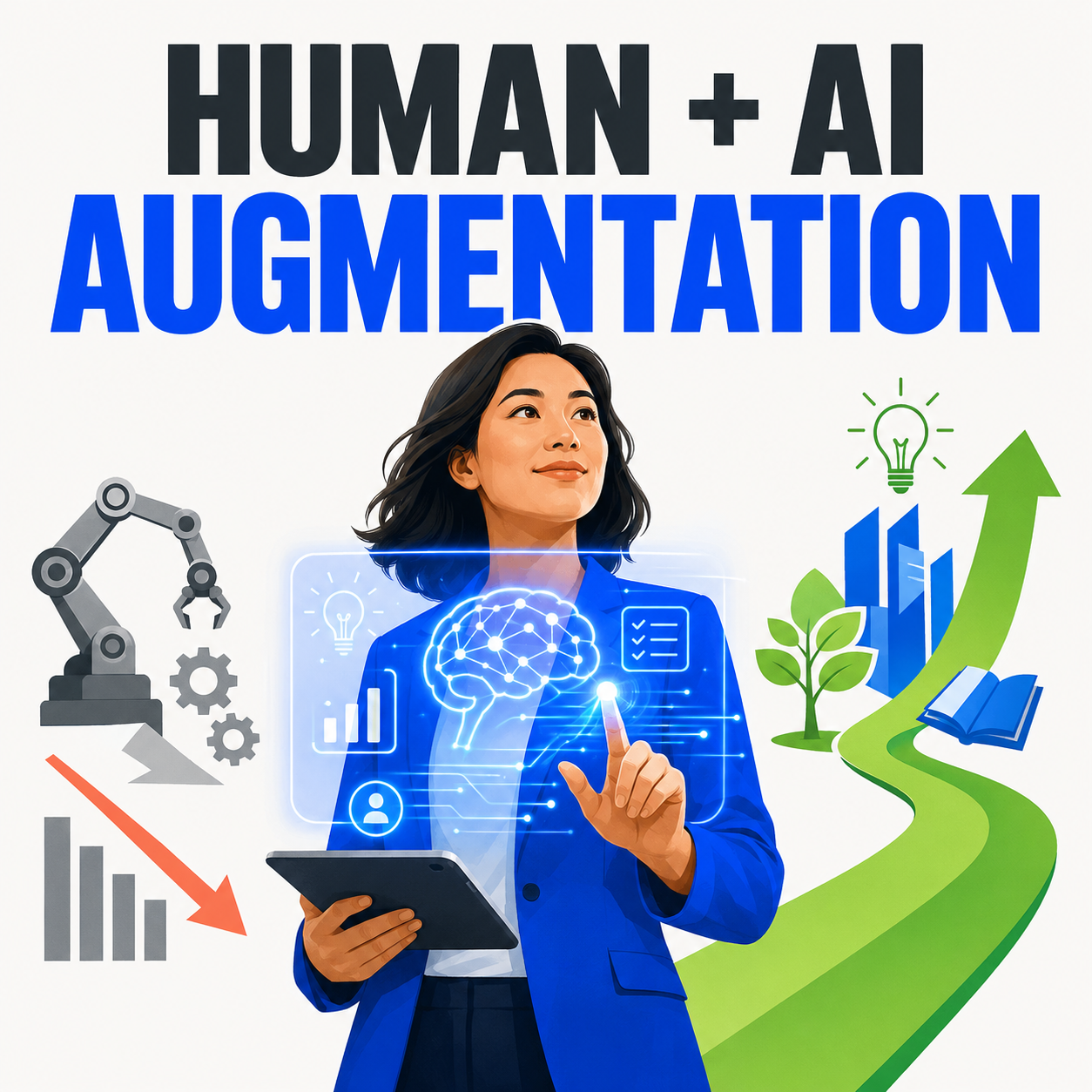
AI를 비용과 인력을 줄이는 도구로 볼 것인가, 새로운 가치와 성장을 만드는 기반으로 활용할 것인가. 자동화는 빠른 성과를 보여주지만 조직의 지식과 인재, 혁신 역량을 약화시키는 숨은 비용을 남길 수 있다. 사람을 대체하기보다 사람의 능력을 확장하는 증강 전략이 기업의 장기 경쟁우위를 결정할 수 있다.
[Key Message]
* 자동화는 단기적인 비용 절감에 효과적이지만, 증강은 인간의 능력을 확장해 장기적인 성장과 혁신을 만든다.
* AI를 인력 감축의 도구로만 활용하면 직원의 신뢰와 참여가 낮아지고 핵심 인재와 조직 지식이 사라질 수 있다.
* AI의 진정한 가치는 사람을 대체하는 데 있지 않다. 인간의 판단력과 창의성, 문제 해결 능력을 높이는 데 있다.
* 반복 업무는 자동화하되, 확보된 시간과 자원을 직원의 학습과 업무 재설계, 새로운 가치 창출에 투자해야 한다.
* AI 전략의 성과는 줄어든 인원보다 새로운 매출과 혁신, 고객 가치, 직원 역량이 얼마나 증가했는가로 평가해야 한다.
***
AI 전략의 갈림길
인공지능이 기업 경영의 중심으로 들어오면서 경영진은 중요한 선택 앞에 놓였다. 사람이 하던 일을 AI에 맡겨 비용과 인력을 줄일 것인가, 아니면 AI를 활용해 사람이 더 많은 가능성을 실현하도록 만들 것인가. 전자는 자동화이고 후자는 증강이다. 두 전략 모두 같은 기술을 사용하지만 기술을 도입하는 목적과 조직에 남기는 결과는 크게 다르다.
자동화는 손익계산서의 비용을 줄이는 데 초점을 맞춘다. 반복적인 업무를 AI에 맡기고 필요한 인원을 줄이면 인건비와 운영비를 절감할 수 있다. 처리 속도가 빨라지고 오류가 감소하며, 같은 양의 업무를 더 적은 자원으로 수행할 수 있다. 성과가 숫자로 빠르게 나타나기 때문에 경영진과 투자자에게 설명하기도 쉽다.
증강은 비용보다 성장에 관심을 둔다. AI를 활용해 직원의 판단력과 창의성, 문제 해결 능력을 확장하고 이를 새로운 상품과 서비스, 고객 경험으로 연결한다. 기존 업무를 더 싸게 수행하는 데 머물지 않고 기업이 만들어낼 수 있는 가치와 진입할 수 있는 시장의 범위를 넓힌다. 자동화가 현재의 운영 효율을 높이는 전략이라면 증강은 미래의 성장 가능성을 키우는 전략에 가깝다.
두 전략의 차이는 단순히 사람과 기계가 담당하는 업무의 비율에 있지 않다. 자동화 중심의 기업은 “AI로 몇 명의 업무를 대체할 수 있는가”라고 묻는다. 증강 중심의 기업은 “AI를 활용하면 직원이 어떤 새로운 가치를 만들 수 있는가”라고 묻는다. 질문이 달라지면 투자 방식과 조직 운영, 직원에게 보내는 신호, 성과를 평가하는 기준도 달라진다.
기업이 자동화에 먼저 끌리는 이유는 불확실성이 작아 보이기 때문이다. 한 사람이 한 시간 동안 처리하던 업무를 AI가 몇 분 만에 끝낸다면 절감되는 시간과 비용을 쉽게 계산할 수 있다. 반면 증강을 통해 어떤 상품이 탄생하고, 어떤 고객이 유입되며, 어떤 시장이 열릴지는 미리 정확하게 계산하기 어렵다. 비용 절감은 즉각적인 숫자로 나타나지만 혁신은 실험과 실패, 학습을 거친 뒤에야 모습을 드러낸다.
경영진의 평가 기간이 짧을수록 자동화의 매력은 더욱 커진다. 분기 실적을 개선해야 하고 투자자에게 즉각적인 성과를 제시해야 하는 상황에서는 장기적인 역량 축적보다 단기적인 비용 절감이 우선되기 쉽다. AI 도입과 인력 감축을 동시에 발표하면 시장에 강한 혁신 의지를 보여주는 것처럼 보일 수도 있다. 그러나 인원을 줄였다는 사실이 곧 기업의 경쟁력이 높아졌다는 의미는 아니다.
비용은 줄었지만 새로운 매출을 만들지 못할 수 있고, 업무 속도는 빨라졌지만 고객이 체감하는 가치는 달라지지 않을 수도 있다. 남은 직원에게 더 많은 일이 집중되고 조직의 전문성이 약해진다면 초기의 절감 효과는 오래가지 못한다. 자동화가 기업을 효율적으로 만들 수는 있지만, 효율성만으로 기업의 미래가 보장되지는 않는다.
새로운 기술은 언제나 인간의 일을 일부 대체하는 동시에 새로운 역할을 만들어왔다. 중요한 것은 기술이 일자리를 없애는가 아니면 만드는가라는 단순한 질문이 아니다. 기술을 통해 확보한 시간과 자원을 어디에 다시 투자하는지가 더 중요하다. 절약된 비용을 단기 이익으로 돌릴 수도 있고, 직원의 학습과 상품 개발, 고객 서비스 개선에 재투자할 수도 있다.
증기기관이 등장했다고 해서 모든 기업이 같은 성과를 거둔 것은 아니었다. 전기가 보급됐다고 해서 모든 공장의 생산성이 동시에 높아진 것도 아니었다. 기존의 작업 방식을 그대로 둔 채 동력만 교체한 기업보다 새로운 기술에 맞춰 공정과 조직을 다시 설계한 기업이 더 큰 성과를 얻었다. AI도 마찬가지다. 기술을 보유하는 것보다 기술을 중심으로 사람과 업무를 어떻게 재구성하느냐가 중요하다.
따라서 자동화와 증강의 선택은 기술적인 문제를 넘어 경영 철학의 문제다. AI가 무엇을 할 수 있는지만 살펴서는 충분하지 않다. 기업이 어떤 미래를 만들고 싶은지, 직원에게 어떤 역할을 맡기고 싶은지, 고객에게 어떤 가치를 제공하려는지를 먼저 정해야 한다. 기술의 기능은 빠르게 비슷해질 수 있지만 기술을 활용하는 조직의 목적과 방식은 쉽게 복제되지 않는다.
자동화의 성과와 숨은 비용
자동화의 장점은 분명하다. 정형화된 자료를 입력하고, 문서를 분류하고, 회의 내용을 정리하며, 반복적인 문의에 답하는 업무는 AI가 빠르게 처리할 수 있다. 공장과 물류센터에서는 생산 일정과 재고 흐름을 최적화하고, 금융기관에서는 이상 거래를 감지하며, 의료기관에서는 행정 부담을 줄일 수 있다. 사람이 반드시 직접 수행할 필요가 없는 업무를 자동화하면 시간과 비용을 절약할 수 있다.
위험은 자동화 자체가 아니라 자동화를 기업의 유일한 AI 전략으로 삼을 때 나타난다. 무엇을 더 잘 만들 것인가보다 누구의 업무를 없앨 것인가에 관심이 집중되면 AI 도입은 인력 감축의 다른 이름이 된다. 직원은 새로운 기술을 자신의 능력을 높여주는 도구가 아니라 자신의 자리를 위협하는 존재로 받아들인다. 이러한 인식은 기술의 성능만큼이나 AI 도입의 성패에 큰 영향을 미친다.
직원이 AI 도입 이후 자신의 일자리가 사라질 수 있다고 느끼면 새로운 도구를 적극적으로 실험하기 어렵다. 자신이 발견한 효율적인 사용법이 결국 자신의 역할을 없애는 근거가 될 수 있기 때문이다. 조직은 직원에게 AI 활용 아이디어를 제출하라고 요구하지만, 직원은 자신의 업무를 가장 효과적으로 자동화할 방법을 스스로 보고해야 하는 모순에 놓인다.
AI를 잘 활용할수록 자신의 가치가 커지는 것이 아니라 자신의 자리가 사라질 수 있다고 생각한다면 협조와 참여는 줄어든다. 유용한 사용법을 발견해도 동료와 공유하지 않고, 업무 지식을 문서로 남기기보다 개인적으로 보유하려 할 수 있다. 조직이 AI를 통해 얻고자 했던 집단적 학습이 고용 불안 때문에 오히려 막히는 것이다.
자동화에 대한 불안은 눈에 잘 보이지 않는 방식으로 조직에 퍼진다. 직원은 새로운 업무를 제안하기보다 현재의 역할을 지키는 데 집중한다. 실패 가능성이 있는 실험을 피하고 이미 검증된 방식만 반복한다. 동료와 협력하기보다 자신의 전문 영역을 보호하려 한다. 혁신을 위해 도입한 기술이 조직을 방어적이고 폐쇄적으로 만드는 역설이 발생한다.
핵심 인재의 이탈도 중요한 비용이다. 능력 있는 직원일수록 자신의 전문성과 성장 가능성을 존중하는 조직을 선택할 수 있다. 기업이 AI를 사람을 줄이는 도구로만 활용한다는 신호를 보내면 당장 감축 대상이 아닌 직원도 장기적인 미래를 불안하게 느낀다. 조직이 자신에게 투자할 의지가 없다고 판단한 인재는 더 나은 기회를 찾아 떠난다.
사람이 조직을 떠날 때 사라지는 것은 직무기술서에 적힌 업무만이 아니다. 특정 고객이 무엇을 중요하게 생각하는지, 예상하지 못한 문제가 발생했을 때 누구와 협의해야 하는지, 공식 절차가 작동하지 않을 때 어떤 판단을 내려야 하는지와 같은 암묵적 지식도 함께 사라진다. 이러한 지식은 문서와 데이터로 완전히 남기 어렵다.
AI는 축적된 기록을 분석하고 과거의 패턴을 찾아낼 수 있다. 그러나 기록되지 않은 맥락과 현장의 감각, 오랜 협업을 통해 형성된 신뢰까지 그대로 이어받을 수는 없다. 비용을 줄이기 위해 숙련 인력을 내보낸 기업이 뒤늦게 비슷한 수준의 경험을 다시 확보하려면 훨씬 더 많은 시간과 비용을 들여야 한다.
숙련 인력을 지나치게 줄이면 미래의 전문가를 키울 통로도 좁아진다. 전문가는 어느 날 갑자기 만들어지지 않는다. 초보자가 비교적 단순한 업무부터 맡아보고 시행착오를 겪으며 숙련자의 판단 과정을 가까이에서 배우는 시간이 필요하다. 단순 업무를 모두 자동화하고 신입 채용을 줄이면 현재의 생산성은 높아질 수 있지만, 몇 년 뒤 복잡한 문제를 책임질 중간 경력자와 전문가가 부족해질 수 있다.
AI의 결과를 검토하고 오류를 발견하려면 해당 분야의 지식과 경험이 필요하다. 그런데 자동화를 이유로 숙련 인력을 줄이면 AI를 감독할 사람도 함께 줄어든다. 겉으로는 매끄럽고 설득력 있지만 실제로는 잘못된 결과가 의사결정에 사용될 위험이 커진다. 기술에 대한 의존도가 높아질수록 인간의 판단 능력이 더 중요해지지만, 자동화 중심의 조직은 바로 그 능력을 약화시킬 수 있다.
자동화가 만들어낸 시간 절약이 반드시 직원의 여유로 이어지는 것도 아니다. AI 덕분에 한 가지 업무를 빨리 끝내면 조직은 그만큼 더 많은 업무를 부여할 수 있다. 처리량은 늘어나지만 AI가 만든 결과를 검토하고 수정하며 여러 작업을 조정하는 새로운 부담도 생긴다. 직원은 더 많은 일을 동시에 관리하면서 지속적으로 주의를 전환해야 한다.
속도는 빨라졌지만 업무의 밀도와 피로는 오히려 높아질 수 있다. 어제 한 시간 걸리던 일이 오늘 십 분 만에 끝나면 내일은 더 많은 결과를 요구받는다. AI가 제공한 생산성 향상이 직원에게 돌아가지 않고 더 높은 업무량과 더 짧은 마감 시간으로 바뀌면 기술에 대한 반감은 커진다. 초기에는 생산성이 크게 향상되더라도 피로와 소진이 누적되면 장기적인 성과는 떨어질 수밖에 없다.
자동화의 효과는 측정하기 쉽지만 숨은 비용은 뒤늦게 나타난다. 절감된 인건비는 이번 분기의 숫자로 확인할 수 있다. 반면 직원의 신뢰 하락과 협업 감소, 인재 이탈, 전문성 약화는 수개월이나 수년 뒤에 드러난다. 단기 지표만 바라보는 기업은 비용을 줄이는 동안 장기 경쟁력의 기반을 조금씩 소모하고 있다는 사실을 알아차리기 어렵다.
그렇다고 모든 자동화를 경계할 필요는 없다. 위험하고 지루하며 반복적인 일을 AI에 맡기는 것은 직원의 업무 경험을 개선할 수 있다. 중요한 것은 자동화로 생긴 이익을 어떻게 사용하는가다. 줄어든 업무만큼 사람을 줄이는 데 그칠 것인지, 확보된 시간을 더 중요한 판단과 창의적인 문제 해결, 고객과의 관계 형성에 사용할 것인지에 따라 결과는 달라진다.
증강이 만드는 성장의 선순환
증강은 AI가 인간을 대신해 완성된 결과를 내놓는 방식이 아니라 인간이 더 나은 판단과 행동을 할 수 있도록 돕는 방식이다. AI는 방대한 자료를 빠르게 검색하고 패턴을 찾아내며 여러 가능성을 제안한다. 사람은 목적을 설정하고 맥락을 이해하며 결과의 의미를 판단한다. 두 능력이 결합될 때 사람이나 AI가 혼자서는 만들기 어려운 성과가 나온다.
의사는 AI를 활용해 수많은 검사 기록과 연구 결과를 검토하고 놓치기 쉬운 징후를 발견할 수 있다. 그러나 환자의 생활환경과 가치관을 이해하고 치료 방향을 함께 결정하는 일은 인간의 역할로 남는다. 금융 상담가는 AI가 분석한 다양한 선택지를 바탕으로 고객의 목표와 위험 감수 수준에 맞는 판단을 내릴 수 있다. 연구자는 AI로 자료와 가설을 빠르게 탐색하면서 어떤 질문이 중요한지를 결정하는 데 더 많은 시간을 쓸 수 있다.
증강의 가장 큰 효과는 기존 업무를 빠르게 처리하는 데 그치지 않는다. 과거에는 비용과 시간, 전문성의 한계로 시도하지 못했던 일을 가능하게 만든다. 소규모 기업도 여러 시장의 자료를 분석하고 다양한 고객에게 맞춤형 서비스를 제공하며 빠르게 시제품을 만들 수 있다. 개인의 능력과 조직의 규모가 만들어내던 한계가 낮아지면서 새로운 사업 기회가 열린다.
자동화가 필요한 자원을 줄여 생산성을 높이는 방식이라면 증강은 기업이 만들어내는 가치 자체를 키우는 방식이다. 같은 인원으로 더 많은 업무를 처리하는 것뿐 아니라 더 높은 품질의 상품과 서비스를 만들어낸다. 고객의 요구를 세밀하게 파악하고 지금까지 제공하지 못했던 해결책을 제시하며 새로운 수익원을 발견한다.
기업의 장기적인 가치는 비용을 얼마나 줄였는가보다 고객에게 어떤 새로운 가치를 제공했는가에 의해 결정된다. 비용 절감에는 한계가 있다. 인력과 운영비를 계속 줄이다 보면 언젠가는 더 줄일 수 없는 지점에 도달한다. 그러나 새로운 상품과 서비스, 시장을 통해 창출할 수 있는 가치는 정해져 있지 않다. 증강 전략이 장기 성장과 연결되는 이유다.
증강 전략에서는 직원이 AI 도입의 대상이 아니라 주체가 된다. 실제 업무를 수행하는 사람은 어느 과정에서 시간이 낭비되는지, 어떤 정보가 부족한지, 고객이 어디에서 불편을 느끼는지를 가장 잘 알고 있다. 현장 직원이 AI를 직접 실험하고 사용법을 개선할 수 있도록 하면 기술 부서가 미처 발견하지 못한 활용법이 나타난다. 작은 개선이 축적되면서 조직 전체의 업무 방식이 달라진다.
직원이 AI를 자신의 성장 도구로 인식하면 학습의 동기도 강해진다. 새로운 기능을 익히고 더 좋은 질문을 만드는 법을 배우며 AI가 내놓은 결과를 평가하는 능력을 키운다. 처음에는 단순히 시간을 절약하기 위해 사용했던 도구가 점차 사고의 범위를 넓히는 협력 수단으로 발전한다. 직원의 전문성과 AI 활용 능력이 함께 성장하면서 조직에는 쉽게 복제하기 어려운 역량이 축적된다.
이러한 과정은 성장의 선순환을 만든다. 조직이 직원의 능력을 높이기 위해 AI에 투자하면 직원은 자신이 존중받고 있다고 느낀다. 신뢰가 높아지면 새로운 도구를 적극적으로 사용하고 아이디어를 공유한다. 활용이 늘어날수록 더 좋은 업무 방식과 상품이 만들어지고, 성과가 확인되면 조직은 사람과 기술에 다시 투자할 여력을 얻는다.
자동화 중심 조직에서도 AI 활용법은 쌓일 수 있다. 그러나 그 지식이 인력 감축으로 이어질 것이라는 불안이 존재하면 직원은 경험을 공유하려 하지 않는다. 증강 중심 조직에서는 자신의 발견이 자신의 역할을 더 중요하게 만들어준다는 믿음이 형성된다. 개인의 학습이 팀의 학습으로, 팀의 학습이 기업의 자산으로 연결될 가능성이 커진다.
증강은 직원의 역할을 축소하기보다 확장한다. 단순한 실행자가 문제를 정의하고 결과를 평가하는 사람으로 이동한다. 자료를 정리하는 데 많은 시간을 쓰던 직원은 자료의 의미를 해석하고 의사결정에 참여할 수 있다. 정해진 답변을 반복하던 상담 직원은 복잡한 상황을 이해하고 고객과의 관계를 회복하는 일에 집중할 수 있다. 업무의 중심이 처리에서 판단으로, 반복에서 창조로 옮겨간다.
다만 AI가 반복 업무를 대신한다고 해서 사람이 자동으로 더 창의적인 일을 하게 되는 것은 아니다. 조직이 남는 시간을 다시 반복 업무로 채우면 증강의 가능성은 사라진다. 직원에게 더 높은 수준의 권한과 책임을 부여하고 학습과 실험에 사용할 시간을 보장해야 한다. 업무만 제거하고 역할을 재설계하지 않으면 직원은 자신의 정체성과 성장 경로를 잃을 수 있다.
증강에는 자동화보다 더 많은 초기 투자가 필요하다. 도구를 구입하는 것만으로는 충분하지 않다. 직원 교육과 업무 절차의 재설계, 데이터 정비, 책임 기준의 수립이 필요하다. 실패를 허용하는 실험 환경도 마련해야 한다. 초기에는 생산성이 일시적으로 떨어질 수 있으며 직원마다 활용 수준이 달라 혼란이 생길 수도 있다.
그러나 이러한 투자는 시간이 흐를수록 복리처럼 작용한다. AI 활용 경험을 쌓은 직원은 더 복잡한 문제를 해결하고 동료에게 지식을 전한다. 팀은 성공과 실패의 사례를 공유하면서 조직에 맞는 활용 원칙을 발전시킨다. 경쟁사가 같은 AI 도구를 구매하더라도 오랜 기간 축적된 사람과 기술의 협업 방식까지 곧바로 따라 하기는 어렵다.
AI 기술은 빠르게 보편화된다. 오늘 특정 기업만 사용할 수 있는 기능도 얼마 지나지 않아 많은 기업이 비슷한 가격으로 이용할 수 있다. 따라서 기술에 대한 접근권만으로는 지속적인 경쟁우위를 만들기 어렵다. 진정한 차이는 기술을 이해하고 현장에 적용하며 새로운 가치를 만들어내는 사람과 조직의 능력에서 발생한다.
직원 경험과 업무 재설계
AI 도입의 성패는 기술의 정확도만으로 결정되지 않는다. 직원이 기술을 어떻게 받아들이고 실제 업무에서 어떻게 사용하는지가 중요하다. 아무리 뛰어난 시스템을 도입해도 직원이 불신하거나 자신의 역할과 맞지 않는다고 느끼면 활용은 형식적인 수준에 머문다. 반대로 완벽하지 않은 도구라도 직원이 필요성을 이해하고 개선 과정에 참여하면 실질적인 가치를 만들어낼 수 있다.
AI 전략을 세울 때는 기술 도입 발표보다 직원에게 보내는 신호를 먼저 살펴야 한다. 경영진이 비용 절감과 인원 감축만 강조하면 직원은 AI가 자신을 평가하고 대체하기 위해 도입됐다고 해석한다. 반대로 반복 업무를 줄이고 더 가치 있는 일을 맡길 것이라는 약속과 구체적인 지원이 제시되면 AI를 성장의 기회로 받아들일 가능성이 커진다.
말만으로 신뢰를 만들 수는 없다. 증강을 강조하면서 실제로는 AI 활용 성과를 근거로 인력을 줄인다면 직원은 경영진의 설명을 믿지 않는다. 교육과 직무 전환, 새로운 역할 설계에 실제 예산을 투입해야 한다. 자동화로 절감된 자원의 일부가 직원의 성장과 조직의 혁신에 다시 사용된다는 사실을 행동으로 보여줘야 한다.
업무 재설계의 출발점은 직무 전체가 아니라 업무를 세분화해서 바라보는 것이다. 하나의 직무에는 반복적인 자료 처리, 복잡한 판단, 타인과의 협력, 감정적인 소통, 책임 있는 의사결정이 함께 들어 있다. 이 가운데 AI가 잘하는 업무와 사람이 더 잘하는 업무를 구분해야 한다. 특정 업무가 자동화될 수 있다는 이유만으로 그 업무를 포함한 직무 전체를 없애서는 안 된다.
반복적이고 규칙이 명확하며 결과를 쉽게 검증할 수 있는 업무는 자동화에 적합하다. 방대한 정보를 비교하거나 초안을 만들고 일정한 형식으로 정리하는 일도 AI의 도움을 받을 수 있다. 반면 목표가 모호하고 다양한 이해관계가 얽혀 있으며 결과에 대한 책임이 큰 업무는 인간의 판단이 중심이 돼야 한다. 공감과 신뢰, 윤리적 판단이 필요한 상황에서도 사람의 역할은 중요하다.
효과적인 업무 구조는 사람이 목표와 기준을 정하고 AI가 대안을 제시한 뒤 사람이 최종 결과를 검토하는 방식이다. 검토자가 단순히 승인 단추를 누르는 사람이 되어서는 안 된다. AI의 결과를 의심하고 근거를 확인하며 필요하면 거부할 수 있는 지식과 권한을 가져야 한다. 책임은 인간에게 남겨두면서 실제 판단 능력은 약화시키는 형식적인 감독은 오히려 위험하다.
직원 교육도 단순한 사용법 안내를 넘어야 한다. 어떤 명령을 입력하는지뿐 아니라 AI가 어떤 방식으로 오류를 만들 수 있는지, 결과를 어떻게 검증해야 하는지, 민감한 정보를 어떻게 다뤄야 하는지를 배워야 한다. 자신의 전문지식과 AI의 결과를 결합하는 방법도 익혀야 한다. 중요한 역량은 AI에게 답을 받는 기술이 아니라 받은 답을 평가하고 더 나은 질문으로 이어가는 판단력이다.
초보자와 전문가에게 같은 도구를 제공한다고 같은 결과가 나오는 것은 아니다. 전문가는 AI의 오류와 미묘한 차이를 알아차릴 수 있지만 초보자는 그럴듯한 답을 그대로 받아들일 가능성이 크다. AI가 초보자의 업무 속도를 높일 수는 있어도 경험과 판단력을 즉시 대신해주지는 않는다. 교육과 멘토링 없이 도구만 제공하면 낮은 품질의 결과가 더 빠르게 생산될 수 있다.
신입 직원이 기본 업무를 직접 경험하고 숙련자의 피드백을 받는 과정도 유지해야 한다. AI가 초안을 만들더라도 직원이 그 원리와 맥락을 이해하도록 해야 한다. 속도와 학습이 충돌할 때 단기적인 처리량만 선택하면 장기적인 전문성은 약해진다. 당장의 효율성을 위해 미래의 숙련자를 키우는 과정을 없애서는 안 된다.
직원 참여는 업무 재설계의 핵심 조건이다. 현장과 떨어진 곳에서 표준 절차를 정한 뒤 일방적으로 적용하면 실제 업무의 복잡성을 놓칠 수 있다. 어떤 과정에서 AI가 도움이 됐는지, 어디에서 추가 작업을 만들었는지, 고객 경험에 어떤 변화가 있었는지를 직원에게 물어야 한다. 사용자의 피드백을 바탕으로 도구와 절차를 지속적으로 수정해야 한다.
AI 활용을 강제로 높이는 것만으로는 의미 있는 참여를 만들 수 없다. 사용 횟수나 생성된 문서 수를 성과로 평가하면 직원은 필요하지 않은 상황에서도 AI를 사용한다. 중요한 것은 도구의 사용량이 아니라 업무의 품질과 고객 가치, 직원의 학습이 어떻게 달라졌는가다. AI를 많이 사용한 조직이 아니라 적절한 문제에 제대로 사용한 조직이 성과를 얻는다.
관리자의 역할도 달라져야 한다. 결과물을 통제하고 업무량을 배분하는 역할을 넘어 직원이 AI와 효과적으로 협업할 수 있도록 환경을 만드는 사람이 돼야 한다. 어떤 업무를 AI에 맡기고 어디에서 인간이 개입할지 함께 논의하며 직원이 실패 사례를 숨기지 않고 공유하도록 해야 한다. 기술을 잘 쓰는 개인을 찾는 것보다 팀 전체가 학습할 수 있는 문화를 만드는 일이 중요하다.
업무 재설계는 한 번의 프로젝트로 끝나지 않는다. AI의 기능이 빠르게 발전하기 때문에 오늘의 역할 구분이 내일도 유효하다는 보장은 없다. 정기적으로 업무 흐름을 검토하고 인간과 AI의 역할을 다시 조정해야 한다. 다만 기술이 새로워질 때마다 인력을 즉시 줄이는 방식으로 대응하면 조직은 안정적인 학습 기반을 만들 수 없다. 기술의 발전 속도만큼 구성원이 적응할 시간도 필요하다.
장기 경쟁우위의 조건
기업이 장기적인 AI 경쟁력을 확보하려면 성과를 측정하는 기준부터 바꿔야 한다. 절약한 시간과 비용, 줄어든 인원만으로 AI의 가치를 판단하면 자동화 전략이 언제나 더 성공적인 것처럼 보인다. 증강이 만들어내는 학습과 혁신, 고객 관계, 조직의 적응력은 기존 회계 지표에 즉시 나타나지 않기 때문이다.
비용 절감은 여전히 중요한 지표지만 유일한 지표가 되어서는 안 된다. AI 도입 이후 새로운 상품과 서비스가 얼마나 만들어졌는지, 고객 만족도와 재구매율이 어떻게 달라졌는지, 직원이 더 복잡한 문제를 해결할 수 있게 됐는지를 함께 살펴야 한다. 핵심 인재의 유지율과 직원 몰입도, 부서 간 협업 수준도 중요한 판단 기준이다.
평가하는 시간의 범위도 넓혀야 한다. 자동화 전략은 초기 몇 개 분기 동안 높은 수익을 보여줄 수 있다. 그러나 인재 이탈과 역량 약화, 고객 경험의 저하가 누적되면 비용 절감 효과보다 더 큰 손실이 발생할 수 있다. 반대로 증강 전략은 교육과 재설계에 비용이 들어 초기 성과가 작아 보이지만 시간이 흐르면서 새로운 수익과 조직 역량을 만들어낸다.
두 전략의 장기적인 차이는 결국 조직 안에 무엇이 남는가에서 드러난다. 자동화만 추구한 기업에는 더 적은 인원과 더 많은 시스템이 남을 수 있다. 증강을 추구한 기업에는 AI를 능숙하게 활용하는 사람과 개선된 업무 방식, 새로운 상품과 고객 지식이 남는다. 시스템은 구매하거나 교체할 수 있지만 사람과 조직에 축적된 능력은 오랜 시간에 걸쳐 만들어진다.
자동화와 증강을 완전히 대립하는 선택으로 볼 필요는 없다. 모든 반복 업무를 사람이 계속 수행하게 하는 것은 바람직하지 않다. 증강 중심의 기업도 불필요한 업무를 적극적으로 자동화해야 한다. 다만 자동화의 목적을 사람을 제거하는 데 두지 않고 사람이 더 가치 있는 일에 집중하도록 만드는 데 둬야 한다.
핵심은 자동화로 확보된 여유를 성장으로 전환하는 연결 구조다. 업무 시간이 줄어들었을 때 직원에게 더 많은 반복 업무를 부여하거나 인력을 줄이는 대신 고객을 이해하고 새로운 아이디어를 실험할 시간을 제공할 수 있다. 절약된 비용을 교육과 연구개발에 재투자할 수도 있다. 이러한 선택이 자동화를 증강의 기반으로 바꾼다.
AI 전략을 세울 때는 세 가지 질문이 필요하다. 이 기술은 어떤 비용을 줄일 수 있는가. 이 기술은 직원이 어떤 새로운 능력을 갖게 하는가. 그렇게 확장된 능력은 고객과 기업에 어떤 새로운 가치를 만들어내는가. 첫 번째 질문에만 답할 수 있다면 AI 전략은 단기적인 효율화에 머물 가능성이 크다.
리더의 책임은 AI로 대체할 수 있는 업무를 찾아내는 데서 끝나지 않는다. 기술 변화 이후에도 사람이 의미 있는 역할을 수행할 수 있도록 미래의 직무를 설계해야 한다. 직원이 새로운 능력을 습득할 시간과 기회를 제공하고 AI의 혜택이 조직 전체에 돌아갈 수 있는 원칙을 마련해야 한다. AI 시대의 리더십은 기술 선택보다 변화의 결과를 책임지는 능력에서 드러난다.
기업 문화도 중요한 경쟁력이다. 직원이 AI를 사용할 때 실수를 숨겨야 하는 조직에서는 학습이 일어나기 어렵다. AI의 한계와 실패를 공개적으로 논의하고 결과를 비판적으로 검토하며 좋은 활용법을 함께 공유할 수 있어야 한다. 기술에 대한 맹신과 무조건적인 거부 사이에서 실용적인 균형을 찾는 문화가 필요하다.
고객의 신뢰도 빼놓을 수 없다. 기업이 AI를 이용해 서비스를 제공하더라도 중요한 판단과 책임의 주체가 누구인지 분명해야 한다. 비용을 줄이기 위해 인간과의 접점을 지나치게 없애면 고객은 효율성보다 소외감을 느낄 수 있다. 특히 복잡하거나 감정적인 문제가 발생했을 때 고객이 사람의 설명과 책임 있는 대응을 받을 수 있도록 해야 한다.
AI가 발전할수록 인간의 가치가 사라지는 것은 아니다. 인간의 가치가 발휘되는 지점이 달라질 뿐이다. 정보를 기억하고 정해진 형식으로 생산하는 능력의 가치는 낮아질 수 있다. 대신 무엇이 중요한지 판단하고 서로 다른 관점을 연결하며 불확실한 상황에서 책임을 지는 능력이 중요해진다. 타인의 감정을 이해하고 신뢰를 형성하며 공동의 목적을 만드는 능력도 더욱 귀해진다.
증강 전략은 인간이 AI보다 모든 일을 잘할 수 있다는 믿음에 기대지 않는다. 오히려 AI가 잘하는 일과 사람이 잘하는 일을 냉정하게 구분한다. 기술의 우수성을 인정하면서도 기업의 목적과 책임, 의미를 기계에 넘기지 않는다. AI의 속도와 분석력에 인간의 판단과 창의성, 관계 형성 능력을 결합하는 것이 핵심이다.
장기적으로 승리하는 기업은 가장 많은 인력을 줄인 기업이 아닐 가능성이 크다. 같은 기술을 활용하면서도 직원이 더 유능해지고 고객이 더 큰 가치를 경험하도록 만든 기업이 앞서갈 것이다. 비용 절감만으로는 경쟁사가 따라오기 어려운 차별화를 만들기 어렵지만 사람과 AI가 함께 축적한 지식과 신뢰, 혁신 역량은 쉽게 복제되지 않는다.
AI 시대의 경쟁은 인간과 기계의 대결이 아니다. 기업이 기술을 통해 인간의 역할을 얼마나 축소했는가가 아니라 인간의 가능성을 얼마나 확장했는가를 두고 벌어지는 경쟁이다. 자동화는 기업을 더 가볍게 만들 수 있지만 증강은 기업을 더 강하게 만들 수 있다. 빠르게 비용을 줄인 기업이 초기에는 앞서 보일 수 있어도 새로운 기회를 발견하고 변화에 적응하며 사람의 역량을 계속 키운 기업이 더 오래 성장한다.
AI 전략의 진정한 성과는 줄어든 인원표가 아니라 달라진 조직의 능력에서 확인돼야 한다. 직원이 이전보다 더 나은 질문을 던지고, 더 복잡한 문제를 해결하며, 고객에게 새로운 가치를 제공할 수 있게 됐다면 AI는 성공적으로 도입된 것이다. 반대로 비용은 줄었지만 직원의 신뢰와 전문성, 혁신 의지가 약해졌다면 단기적인 효율성 뒤에서 미래의 경쟁력을 잃고 있을 수 있다.
자동화는 오늘의 비용을 줄이는 기술이 될 수 있다. 증강은 내일의 가능성을 키우는 전략이 될 수 있다. 기업의 장기적인 승패는 AI가 얼마나 많은 사람을 대신했는지가 아니라 AI와 함께 일하는 사람이 얼마나 더 큰 가치를 만들어냈는가에 의해 결정될 것이다.
Reference
Harvard Business Review, April 2026, Why Companies That Choose AI Augmentation Over Automation May Win in the Long Run
Companies That Choose Augmentation Over Automation May Win in the Long Run
Should AI be viewed as a tool for reducing costs and headcount, or as a foundation for creating new value and growth? Automation can deliver rapid results, but it may also impose hidden costs by weakening organizational knowledge, talent, and innovative capacity. An augmentation strategy that expands human capabilities rather than replacing people may determine a company’s long-term competitive advantage.
[Key Message]
* Automation can deliver short-term cost savings, but augmentation expands human capabilities and supports long-term growth and innovation.
* Using AI solely to reduce headcount can weaken employee trust and engagement while causing the loss of key talent and organizational knowledge.
* The true value of AI lies not in replacing people, but in strengthening human judgment, creativity, and problem-solving capabilities.
* Companies should automate repetitive tasks while reinvesting the time and resources saved in employee learning, work redesign, and new value creation.
* The success of an AI strategy should be measured not by headcount reductions, but by growth in revenue, innovation, customer value, and employee capabilities.
***
The Strategic Crossroads of AI
As artificial intelligence moves to the center of corporate management, executives face an important choice. Should they assign human work to AI to reduce costs and headcount, or use AI to help people realize more of their potential? The former is automation, while the latter is augmentation. Both strategies employ the same technology, but their objectives and organizational consequences are markedly different.
Automation focuses on reducing expenses on the income statement. Assigning repetitive tasks to AI and reducing the number of people required can lower labor and operating costs. Work is completed faster, errors decrease, and the same volume of work can be handled with fewer resources. Because the results appear quickly in measurable figures, they are also easy to explain to executives and investors.
Augmentation is concerned with growth rather than cost reduction. It uses AI to expand employees’ judgment, creativity, and problem-solving abilities and connects these enhanced capabilities to new products, services, and customer experiences. Instead of merely performing existing work more cheaply, it broadens both the value a company can create and the markets it can enter. Automation is primarily a strategy for improving current operating efficiency, whereas augmentation is closer to a strategy for expanding future growth potential.
The difference between the two strategies is not simply the proportion of work assigned to humans and machines. An automation-centered company asks, “How many people’s work can AI replace?” An augmentation-centered company asks, “What new value can employees create with AI?” When the question changes, so do investment decisions, organizational operations, the signals sent to employees, and the standards used to evaluate performance.
Companies are initially drawn to automation because it appears to involve less uncertainty. If AI can finish in a few minutes what previously took one person an hour, the time and cost savings are easy to calculate. By contrast, it is difficult to predict exactly which products augmentation will produce, which customers it will attract, or which markets it will open. Cost savings appear immediately in the numbers, while innovation becomes visible only after experimentation, failure, and learning.
The shorter the period over which executives are evaluated, the more attractive automation becomes. When quarterly results must improve and immediate outcomes must be presented to investors, short-term cost reductions can easily take precedence over the accumulation of long-term capabilities. Announcing an AI initiative alongside workforce reductions may also appear to signal a strong commitment to innovation. Reducing headcount, however, does not necessarily mean that a company has become more competitive.
Costs may decline without generating new revenue, and work may be completed faster without improving the value experienced by customers. If more work is concentrated among the remaining employees and organizational expertise deteriorates, the initial savings may not last. Automation can make a company more efficient, but efficiency alone cannot guarantee its future.
New technologies have always replaced some forms of human work while creating new roles. The important issue is not the simplistic question of whether technology destroys or creates jobs. What matters more is where the time and resources released by technology are reinvested. The savings can be converted into short-term profits, or they can be reinvested in employee learning, product development, and better customer service.
The arrival of the steam engine did not produce identical results for every company. Nor did the spread of electricity raise the productivity of every factory at the same time. Companies that redesigned their processes and organizations around new technologies achieved greater results than those that simply replaced their source of power while preserving their existing work methods. The same is true of AI. Possessing the technology matters less than reorganizing people and work around it.
The choice between automation and augmentation is therefore a matter of management philosophy as much as technology. Examining what AI can do is not enough. A company must first decide what kind of future it wants to create, what roles it wants employees to perform, and what value it intends to provide customers. Technological capabilities can quickly become similar across companies, but an organization’s purpose and method of using that technology are not easily replicated.
The Results and Hidden Costs of Automation
The benefits of automation are clear. AI can quickly enter structured data, classify documents, summarize meetings, and respond to repetitive inquiries. It can optimize production schedules and inventory flows in factories and distribution centers, detect unusual transactions at financial institutions, and reduce administrative burdens in health care organizations. Automating tasks that do not necessarily require direct human involvement can save both time and money.
The danger arises not from automation itself but from treating it as a company’s only AI strategy. When attention is focused more on whose work can be eliminated than on what can be created or improved, AI adoption becomes another name for workforce reduction. Employees come to regard the new technology not as a tool for enhancing their abilities but as a threat to their positions. This perception can influence the success of AI adoption as much as the performance of the technology itself.
Employees who believe that AI may eventually eliminate their jobs are unlikely to experiment actively with new tools. The efficient methods they discover could ultimately become evidence that their own roles are unnecessary. The organization asks employees to propose ideas for using AI, but those employees find themselves in the contradictory position of having to report the most effective ways to automate their own work.
When employees believe that greater proficiency with AI could eliminate their positions rather than increase their value, cooperation and participation decline. They may discover useful applications but refrain from sharing them with colleagues, or retain job knowledge personally instead of documenting it. The collective learning the organization sought to achieve through AI can instead be obstructed by employment insecurity.
Anxiety about automation spreads throughout an organization in ways that are not always visible. Employees focus on protecting their current roles rather than proposing new work. They avoid experiments that might fail and repeat only established methods. Instead of collaborating with colleagues, they attempt to defend their own areas of expertise. Technology introduced to promote innovation can paradoxically make an organization defensive and closed.
The departure of key talent is another significant cost. Highly capable employees are more able to choose organizations that respect their expertise and growth potential. When a company signals that it intends to use AI solely to reduce its workforce, even employees who are not immediate targets of downsizing may feel uncertain about their long-term future. Talent that concludes the organization has no intention of investing in its development will leave in search of better opportunities.
When people leave an organization, more disappears than the work described in their job descriptions. Tacit knowledge also leaves with them: what particular customers consider important, whom to consult when an unexpected problem arises, and how to exercise judgment when formal procedures fail. Such knowledge cannot be fully preserved in documents and data.
AI can analyze accumulated records and identify historical patterns. It cannot, however, completely inherit undocumented context, practical intuition, or trust built through years of collaboration. A company that dismisses experienced employees to reduce costs may later need to spend far more time and money restoring a comparable level of expertise.
Excessive reductions in experienced personnel also narrow the pathway for developing future experts. Expertise does not emerge overnight. Novices need time to begin with relatively simple tasks, learn through trial and error, and observe how experienced professionals make decisions. Automating every simple task and reducing entry-level hiring may raise productivity today, but it can leave a company without enough mid-career professionals and experts to take responsibility for complex problems several years later.
Reviewing AI output and identifying errors require knowledge and experience in the relevant field. When experienced personnel are eliminated in the name of automation, the people capable of supervising AI are eliminated as well. The risk increases that outputs that appear polished and persuasive but are actually incorrect will be used in decision-making. The more dependent an organization becomes on technology, the more important human judgment becomes, yet an automation-centered organization may weaken precisely that capability.
The time saved through automation does not necessarily create greater freedom for employees. If AI allows one task to be completed more quickly, the organization may simply assign more work. The volume of work increases, but so do the new burdens of reviewing and correcting AI-generated output and coordinating multiple tasks. Employees must manage more work simultaneously while continually shifting their attention.
Work may accelerate while becoming more intensive and exhausting. If a task that took an hour yesterday takes ten minutes today, employees may be expected to produce even more tomorrow. Resistance to technology grows when AI-driven productivity gains are converted not into benefits for employees but into heavier workloads and shorter deadlines. Productivity may rise sharply at first, but long-term performance inevitably declines when fatigue and burnout accumulate.
The benefits of automation are easy to measure, while its hidden costs emerge later. Labor savings can be identified in the current quarter’s figures. Declining employee trust, reduced collaboration, talent attrition, and weakened expertise may take months or years to become visible. A company focused only on short-term indicators may fail to recognize that it is gradually consuming the foundations of its long-term competitiveness while cutting costs.
This does not mean that every form of automation should be treated with suspicion. Assigning dangerous, tedious, and repetitive work to AI can improve the employee experience. What matters is how the gains from automation are used. The outcome depends on whether a company merely reduces its workforce in proportion to the work eliminated or uses the time released for more important judgment, creative problem-solving, and stronger customer relationships.
The Virtuous Cycle Created by Augmentation
Augmentation does not mean allowing AI to produce a complete result in place of a person. It means using AI to help people make better judgments and take better actions. AI can rapidly search vast quantities of material, identify patterns, and suggest multiple possibilities. People establish objectives, understand context, and assess the meaning of the results. Combining these capabilities produces outcomes that neither humans nor AI could easily achieve alone.
Physicians can use AI to review enormous quantities of test records and research findings and identify signs that might otherwise be missed. Understanding a patient’s living conditions and values and jointly determining a course of treatment, however, remain human responsibilities. Financial advisers can use alternatives analyzed by AI to make decisions suited to a client’s objectives and tolerance for risk. Researchers can employ AI to explore data and hypotheses quickly, allowing them to devote more time to deciding which questions truly matter.
The greatest benefit of augmentation extends beyond completing existing work more quickly. It makes possible work that could not previously be attempted because of constraints involving cost, time, or expertise. Even small companies can analyze multiple markets, deliver personalized services to diverse customers, and rapidly develop prototypes. As the limitations once imposed by individual ability and organizational size diminish, new business opportunities emerge.
If automation raises productivity by reducing the resources required, augmentation increases the value that a company produces. It not only enables the same number of people to handle more work but also helps them create higher-quality products and services. A company can understand customer needs in greater detail, offer solutions that were previously unavailable, and discover new sources of revenue.
A company’s long-term value is determined less by how much cost it has eliminated than by what new value it provides customers. Cost reduction has a limit. A business that continues reducing personnel and operating expenses eventually reaches a point where nothing more can be removed. The potential value created through new products, services, and markets, however, has no fixed limit. This is why augmentation is connected to long-term growth.
Under an augmentation strategy, employees are not the objects of AI adoption but its principal agents. People who perform the work understand best where time is wasted, what information is missing, and where customers experience frustration. When frontline employees are allowed to experiment with AI and improve how it is used, they discover applications that a technology department may overlook. Small improvements accumulate until the organization’s entire way of working begins to change.
When employees view AI as a tool for their own development, their motivation to learn also strengthens. They learn new functions, improve their ability to ask better questions, and develop the judgment required to evaluate AI-generated results. A tool initially used simply to save time gradually evolves into a means of extending thought. Employee expertise and AI proficiency grow together, allowing the organization to accumulate capabilities that competitors cannot easily reproduce.
This process creates a virtuous cycle of growth. When an organization invests in AI to strengthen employee capabilities, employees feel respected. Greater trust encourages them to use new tools actively and share ideas. Increased use produces better working methods and products, and demonstrated results give the organization the resources to reinvest in people and technology.
Knowledge about using AI can also accumulate in an automation-centered organization. If employees fear that this knowledge will be used to eliminate jobs, however, they are unlikely to share their experience. In an augmentation-centered organization, employees believe that their discoveries will make their roles more valuable. Individual learning is therefore more likely to become team learning, and team learning more likely to become an organizational asset.
Augmentation expands employees’ roles rather than reducing them. Employees move from merely executing tasks to defining problems and evaluating outcomes. A worker who once spent most of the day organizing data can interpret its meaning and participate in decision-making. A customer service employee who previously repeated predetermined answers can focus on understanding complex situations and restoring customer relationships. The center of work shifts from processing to judgment and from repetition to creation.
AI’s assumption of repetitive tasks does not automatically make human work more creative. If the organization fills the newly available time with more repetitive assignments, the potential of augmentation disappears. Employees must receive greater authority and responsibility, along with protected time for learning and experimentation. If tasks are removed without redesigning roles, employees may lose both their professional identity and their path for growth.
Augmentation requires more initial investment than automation. Purchasing tools is not enough. Companies must train employees, redesign work processes, organize data, and establish standards of responsibility. They must also create an environment where experiments are permitted to fail. Productivity may temporarily decline during the early stages, while differences in employees’ proficiency may create confusion.
These investments, however, compound over time. Employees who accumulate experience with AI solve more complex problems and transfer their knowledge to colleagues. Teams share successful and unsuccessful cases and develop principles of use suited to their organization. Even if a competitor purchases the same AI tools, it cannot immediately reproduce the patterns of human-technology collaboration accumulated over many years.
AI technology is rapidly becoming widely available. A capability accessible only to a particular company today may soon be offered to many businesses at a similar price. Access to technology alone therefore cannot create a durable competitive advantage. The real difference comes from the ability of people and organizations to understand technology, apply it in the field, and use it to create new value.
Employee Experience and Work Redesign
The success of AI adoption is not determined by technological accuracy alone. What matters is how employees perceive the technology and use it in their actual work. Even the most advanced system will be used only superficially if employees distrust it or believe that it is incompatible with their roles. Conversely, even an imperfect tool can create practical value when employees understand its purpose and participate in improving it.
When designing an AI strategy, leaders should first consider the signals being sent to employees, even before announcing the introduction of the technology. If executives emphasize only cost reduction and workforce cuts, employees will interpret AI as a system introduced to evaluate and replace them. If leaders instead offer specific support and a credible promise that AI will reduce repetitive work and enable people to perform more valuable roles, employees are more likely to regard it as an opportunity for growth.
Words alone cannot create trust. Employees will not believe executives who speak of augmentation while using the results of AI adoption to justify workforce reductions. Companies must make genuine investments in training, job transitions, and the design of new roles. They must demonstrate through action that some of the resources saved through automation will be reinvested in employee development and organizational innovation.
Work redesign should begin by examining the tasks within a job rather than treating the job as a single unit. One job can include repetitive data processing, complex judgment, collaboration with others, emotional communication, and accountable decision-making. Companies must distinguish the tasks AI performs well from those that people perform better. The fact that one task can be automated does not justify eliminating the entire job that contains it.
Tasks that are repetitive, governed by clear rules, and easy to verify are suitable for automation. AI can also assist with comparing large quantities of information, preparing drafts, and organizing content in standardized formats. Work involving ambiguous goals, multiple competing interests, and significant responsibility for outcomes should remain centered on human judgment. Human involvement is also vital in situations requiring empathy, trust, and ethical judgment.
An effective work structure allows people to establish goals and standards, AI to propose alternatives, and people to review the final result. The reviewer must not be reduced to someone who merely clicks an approval button. Reviewers need the knowledge and authority to question AI output, verify its basis, and reject it when necessary. Supervision is dangerous when responsibility remains with people while their actual capacity for judgment is weakened.
Employee training must also extend beyond basic instructions for operating the technology. Employees should learn not only what prompts to enter but also how AI can produce errors, how its output should be verified, and how sensitive information must be handled. They also need to learn how to combine their professional knowledge with AI-generated results. The essential capability is not merely obtaining an answer from AI, but evaluating that answer and turning it into a better question.
Giving novices and experts the same tool does not produce the same results. Experts can detect errors and subtle distinctions in AI output, while novices are more likely to accept a plausible answer without question. AI may increase the speed of a novice’s work, but it cannot instantly replace experience and judgment. Providing tools without education and mentoring may simply accelerate the production of low-quality results.
Organizations should also preserve the process through which new employees experience fundamental tasks directly and receive feedback from experienced colleagues. Even when AI produces the first draft, employees need to understand the underlying principles and context. If short-term output is always prioritized whenever speed and learning come into conflict, long-term expertise will deteriorate. The process of developing future professionals should not be eliminated for the sake of immediate efficiency.
Employee participation is essential to work redesign. Procedures designed far from the front line and imposed unilaterally can overlook the complexity of actual work. Organizations should ask employees where AI has been helpful, where it has created additional work, and how it has changed the customer experience. Tools and procedures should then be continually revised in response to user feedback.
Meaningful engagement cannot be created simply by forcing employees to use AI more often. If performance is evaluated by the number of uses or documents generated, employees will use AI even when it is unnecessary. What matters is not the volume of tool use but the changes in work quality, customer value, and employee learning. Success belongs not to the organization that uses AI most frequently, but to the one that applies it properly to the right problems.
The role of managers must also change. They must move beyond controlling outputs and allocating workloads to creating an environment in which employees can collaborate effectively with AI. Managers should discuss with employees which tasks to assign to AI and where human intervention is necessary, while ensuring that unsuccessful cases can be shared openly. Developing a culture in which the entire team learns is more important than identifying a few individuals who are skilled at using the technology.
Work redesign is not a project that ends after a single implementation. Because AI capabilities are developing rapidly, today’s division of responsibilities may not remain valid tomorrow. Organizations must review workflows regularly and continue adjusting the roles of humans and AI. If every technological advance is met with an immediate workforce reduction, however, the organization cannot build a stable foundation for learning. Employees need time to adapt, just as technology needs time to develop.
The Conditions for Long-Term Competitive Advantage
To secure long-term competitiveness through AI, companies must begin by changing how they measure performance. If the value of AI is judged only by the time and money saved or the number of positions eliminated, automation will always appear to be the more successful strategy. The learning, innovation, customer relationships, and organizational adaptability created by augmentation do not immediately appear in conventional accounting indicators.
Cost reduction remains an important measure, but it should not be the only one. Companies should also examine how many new products and services have been created since AI was introduced, how customer satisfaction and repeat purchases have changed, and whether employees can solve more complex problems. The retention of key talent, employee engagement, and collaboration across departments are also important standards of evaluation.
The period used for evaluation must also be extended. An automation strategy may produce impressive returns over the first several quarters. As talent attrition, weakened capabilities, and declining customer experiences accumulate, however, the losses may eventually exceed the initial savings. An augmentation strategy may appear less successful at first because it requires spending on training and redesign, but it can generate new revenue and organizational capabilities over time.
The long-term difference between the two strategies is ultimately revealed by what remains inside the organization. A company that pursues only automation may be left with fewer people and more systems. A company that pursues augmentation retains people who can use AI effectively, improved ways of working, new products, and deeper customer knowledge. Systems can be purchased or replaced, but capabilities embedded in people and organizations take years to build.
Automation and augmentation do not need to be treated as entirely opposing choices. It is not desirable for people to continue performing every repetitive task. An augmentation-centered company should also automate unnecessary work aggressively. The difference is that it does not make the elimination of people the purpose of automation. It uses automation to help people focus on more valuable work.
The key is to create a mechanism that converts the capacity released by automation into growth. When working hours are reduced, a company can give employees time to understand customers and test new ideas instead of assigning more repetitive work or reducing headcount. It can also reinvest the savings in training and research and development. These choices turn automation into a foundation for augmentation.
Three questions are necessary when formulating an AI strategy. What costs can this technology reduce? What new capabilities can this technology give employees? What new value can those expanded capabilities create for customers and the company? If a company can answer only the first question, its AI strategy is likely to remain confined to short-term efficiency gains.
A leader’s responsibility does not end with identifying the tasks AI can replace. Leaders must design the jobs of the future so that people can continue to perform meaningful roles after technological change. They must provide employees with the time and opportunities to acquire new capabilities and establish principles that distribute the benefits of AI across the organization. Leadership in the AI era is revealed less through the choice of technology than through the ability to take responsibility for the consequences of change.
Corporate culture is also an important source of competitiveness. Learning is difficult in an organization where employees feel compelled to hide mistakes involving AI. People must be able to discuss the limitations and failures of AI openly, examine its results critically, and share effective applications. Organizations need a culture that finds a practical balance between blind faith in technology and unconditional resistance to it.
Customer trust cannot be overlooked. Even when a company uses AI to provide services, it must clearly identify who is responsible for important judgments and outcomes. When human contact is excessively removed to reduce costs, customers may experience alienation rather than efficiency. Particularly when complex or emotional problems arise, customers must be able to receive an explanation and accountable response from another person.
Human value does not disappear as AI advances. The areas in which human value is expressed merely change. The value of memorizing information and producing content in predetermined formats may decline. The ability to determine what matters, connect different perspectives, and accept responsibility under uncertainty becomes more important. The capacity to understand other people’s emotions, build trust, and create a shared purpose also becomes more valuable.
An augmentation strategy does not depend on the belief that humans can perform every task better than AI. On the contrary, it requires a clear-eyed distinction between what AI does well and what people do well. It recognizes the strengths of technology without surrendering corporate purpose, responsibility, and meaning to machines. The central task is to combine the speed and analytical power of AI with human judgment, creativity, and relationship-building abilities.
The companies that win in the long run are unlikely to be those that eliminate the largest number of employees. Companies that use the same technology to make their employees more capable and deliver greater value to customers will move ahead. Cost reduction alone rarely creates a form of differentiation that competitors cannot match, but the knowledge, trust, and innovative capacity accumulated by people working with AI are not easily replicated.
Competition in the AI era is not a confrontation between humans and machines. It is a competition over how far companies can expand human potential through technology, not how far they can diminish the human role. Automation can make a company leaner, but augmentation can make it stronger. Companies that reduce costs quickly may appear to lead at first, but those that discover new opportunities, adapt to change, and continually strengthen human capabilities will grow for longer.
The true results of an AI strategy should be found not in a reduced headcount table but in the transformed capabilities of the organization. AI has been successfully adopted when employees can ask better questions, solve more complex problems, and provide customers with new value. If costs have declined while employee trust, expertise, and willingness to innovate have weakened, the company may be losing its future competitiveness behind the appearance of short-term efficiency.
Automation can be a technology for reducing today’s costs. Augmentation can be a strategy for expanding tomorrow’s possibilities. The long-term fate of a company will be determined not by how many people AI has replaced, but by how much greater value people working with AI can create.
Reference
Harvard Business Review, April 2026, Why Companies That Choose AI Augmentation Over Automation May Win in the Long Run