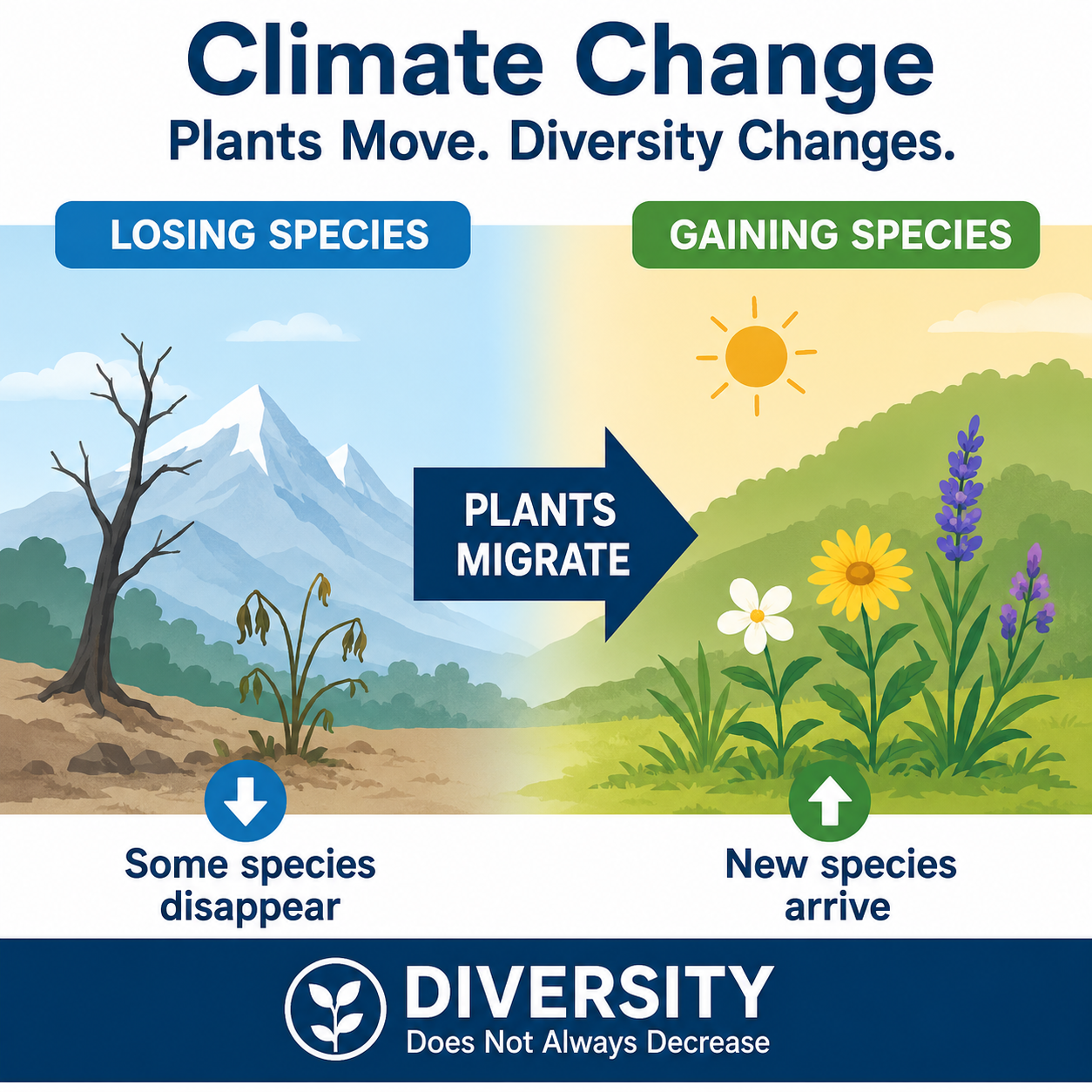
사라지는 식물만큼, 새로 들어오는 식물도 있다. 기후변화는 생태계를 단순히 비우는 힘이 아니라, 생명이 살아갈 장소와 관계를 다시 짜는 힘으로 작동하고 있다. 문제는 지역의 식물 수가 늘어나는 것처럼 보여도, 그것이 지구 전체의 생물다양성 손실을 막아준다는 뜻은 아니라는 데 있다.
[Key Message]
* 기후변화는 식물 다양성을 단순히 줄이는 것이 아니라, 지역별로 식물의 유입과 소멸이 동시에 일어나는 복잡한 생태 재편을 만든다.
* 어떤 지역에서는 새로운 식물종이 들어오며 지역 다양성이 늘 수 있지만, 이것이 전 지구적 멸종 위험이 줄어든다는 뜻은 아니다.
* 식물 다양성은 단순한 종 수가 아니라, 어떤 종이 사라지고 어떤 종이 들어오며 생태계의 고유성과 기능이 어떻게 바뀌는지를 함께 봐야 한다.
* 기후변화로 식물은 새로운 서식지를 찾아 이동하지만, 이동 속도와 서식지 단절, 토양·곤충·수분 매개자 등 생태 조건의 한계 때문에 모든 종이 살아남을 수 있는 것은 아니다.
* 미래의 생물다양성 보전은 현재의 보호구역을 지키는 데서 그치지 않고, 기후 피난처 확보, 서식지 연결, 종자 보전, 온실가스 감축을 함께 추진하는 방향으로 바뀌어야 한다.
***
기후변화는 자연을 한 방향으로만 바꾸지 않는다
기후변화와 생물다양성을 이야기할 때 가장 먼저 떠오르는 장면은 대체로 비슷하다. 기온이 오르고, 비가 내리는 방식이 달라지고, 가뭄과 폭염이 잦아지며, 생물들이 살던 터전을 잃어간다는 이야기다. 숲은 말라가고, 산호초는 하얗게 변하고, 북극의 얼음은 줄어들며, 야생동물은 더 이상 익숙한 계절의 리듬을 따라가지 못한다. 이 설명은 틀리지 않다. 기후변화는 이미 많은 생물에게 가장 큰 생존 압력 중 하나가 되었고, 생물다양성 감소를 가속하는 핵심 요인으로 작동하고 있다.
하지만 자연은 언제나 단순한 한 방향의 변화만으로 설명되지 않는다. 어떤 생물이 사라지는 동안, 다른 생물은 새롭게 들어온다. 어떤 지역의 서식지가 더 이상 적합하지 않게 되는 동안, 다른 지역은 새롭게 적합한 장소가 된다. 추운 기후에 묶여 있던 식물은 더 북쪽으로 이동하고, 낮은 고도에 살던 식물은 더 높은 산지로 올라가며, 건조했던 지역에 강수량이 늘어나면 이전에는 정착하기 어려웠던 식물이 새롭게 자리를 잡기도 한다. 기후변화는 자연을 단순히 줄이는 힘이면서 동시에, 자연의 지도를 다시 그리는 힘이기도 하다.
2026년 5월, 준나 왕, 브루누 F. 올리베이라, 프랜시스 C. 무어, 대니얼 J. 코자르, 푸융숴, 둥샤오리 등 연구진이 사이언스(Science)에 발표한 연구는 6만 종이 넘는 식물의 미래 서식지 변화를 분석해, 기후변화가 식물 다양성을 단순히 감소시키는 것이 아니라 지역별로 유입과 소멸이 동시에 일어나는 복잡한 재편 과정임을 보여줬다. 흔히 기후변화는 생물다양성을 줄인다고 말하지만, 실제 현장에서는 어떤 지역에서 식물종이 줄고, 어떤 지역에서는 늘고, 또 어떤 지역에서는 종 수는 비슷해도 구성 자체가 달라질 수 있다.
이 대목이 중요하다. 생물다양성은 단순히 숫자의 문제가 아니다. 한 지역에 식물이 몇 종 있는가도 중요하지만, 어떤 식물이 사라지고 어떤 식물이 들어왔는지, 그 변화가 토양과 곤충과 동물과 인간의 삶에 어떤 영향을 주는지까지 함께 봐야 한다. 겉으로 보기에는 식물종 수가 늘어난 것처럼 보여도, 그 과정에서 오랫동안 그 지역을 지켜온 고유종이 사라지고 널리 퍼지는 일반종이 들어왔다면 생태계의 의미는 전혀 달라진다. 숫자는 증가했지만, 고유성은 줄어들 수 있다.
기후변화 시대의 자연은 비어가는 동시에 채워지고 있다. 어떤 숲에서는 기존 식물이 사라지고, 다른 식물이 그 빈자리를 차지한다. 어떤 초원에서는 과거에 없던 식물이 나타나고, 어떤 산지에서는 낮은 곳의 식물이 위쪽으로 올라온다. 이 변화는 한눈에 보기에는 풍성해 보일 수 있다. 그러나 그 풍성함은 안정의 신호가 아니라, 생태계가 흔들리고 있다는 신호일 수도 있다. 새로운 식물의 등장은 자연의 회복일 수도 있지만, 기존 질서가 무너진 결과일 수도 있다.
지역의 증가와 지구의 손실은 동시에 일어날 수 있다
기후변화가 식물 다양성에 미치는 영향을 이해하려면 먼저 ‘어디를 기준으로 볼 것인가’를 물어야 한다. 한 마을의 숲, 한 산의 능선, 한 나라의 식물상, 지구 전체의 생물다양성은 서로 다른 단위다. 지역 단위에서는 새로운 식물이 들어오면서 종 수가 늘어날 수 있다. 그러나 지구 전체로 시야를 넓히면 그 증가가 반드시 좋은 소식은 아니다. 어느 지역에서 새로 발견되는 식물은 다른 지역에서 밀려난 식물일 수 있고, 어떤 종은 이동할 곳을 찾는 동안 다른 종은 더 이상 갈 곳이 없어질 수 있다.
생태계 변화에서 가장 흔한 착시는 지역의 숫자를 전체의 건강으로 오해하는 데서 생긴다. 한 지역에 식물종이 늘었다는 사실만 보면 기후변화가 꼭 나쁜 것만은 아닌 듯 보인다. 실제로 따뜻해진 기후나 늘어난 강수량이 일부 지역에서는 새로운 식물의 정착을 가능하게 만들 수 있다. 하지만 이 현상은 기후변화가 생물다양성 위기를 완화한다는 뜻이 아니다. 오히려 생물들이 기존 서식지에서 밀려나고 있다는 뜻일 수 있다.
식물의 이동은 동물의 이동보다 훨씬 느리고 복잡하다. 새나 포유류는 몸을 움직여 비교적 빠르게 서식지를 옮길 수 있다. 그러나 식물은 뿌리를 내린 뒤 스스로 걸어갈 수 없다. 씨앗이 바람을 타고, 물길을 따라가고, 새나 포유류의 몸에 묻어 이동하고, 때로는 인간의 이동과 농업 활동에 실려 퍼질 뿐이다. 이동은 세대와 세대를 거쳐 천천히 일어난다. 문제는 기후변화의 속도가 이 자연스러운 이동 속도보다 빠를 수 있다는 점이다.
또한 씨앗이 새로운 장소에 도착한다고 해서 곧바로 정착이 보장되는 것도 아니다. 식물에게 필요한 것은 기온만이 아니다. 강수량, 토양의 산도, 영양분, 햇빛, 주변 식물과의 경쟁, 곤충과 미생물, 꽃가루를 옮겨주는 수분 매개자까지 모두 맞아야 한다. 기후 조건만 적합해졌다고 해서 생존 조건 전체가 완성되는 것은 아니다. 식물의 서식지는 단순한 공간이 아니라, 수많은 관계가 겹쳐진 생태적 자리다.
그래서 기후변화에 따른 식물 이동은 일부 종에게는 기회가 되지만, 모든 종에게 탈출구가 되지는 못한다. 넓은 지역에 퍼져 살 수 있고 다양한 환경에 적응할 수 있는 식물은 새로운 서식지를 찾아갈 가능성이 크다. 반면 특정한 산지, 섬, 해안, 습지, 토양에 의존하는 식물은 이동 자체가 쉽지 않다. 산꼭대기에 사는 식물은 더 이상 올라갈 곳이 없고, 섬의 식물은 바다를 건너야 하며, 특정 토양에만 사는 식물은 기후가 맞아도 다른 곳에서 뿌리내리기 어렵다.
지역의 다양성이 늘어난다는 사실은 그래서 이중적인 의미를 갖는다. 한편으로는 자연이 변화에 반응하고 있다는 신호다. 생물은 가만히 멸종을 기다리기만 하지 않는다. 가능한 곳으로 이동하고, 새로운 조건에 적응하고, 새 관계를 만든다. 그러나 다른 한편으로는 기존 생태계가 흔들리고 있다는 신호이기도 하다. 한 지역의 증가가 다른 지역의 감소와 연결되어 있다면, 그 증가는 전체 생물다양성의 회복이 아니라 재배치일 뿐이다.
사라지는 서식지는 이동으로 해결되지 않는다
기후변화 시대의 생물다양성 논의에서 자주 등장하는 해법 중 하나는 생물이 이동할 수 있도록 돕는 것이다. 숲과 숲을 연결하고, 보호구역 사이의 생태 통로를 만들고, 도로나 도시 개발로 끊어진 서식지를 다시 잇는 방식이다. 이런 접근은 중요하다. 기후가 변하면 생물은 새로운 기후 조건을 찾아 이동해야 하고, 이동 경로가 막혀 있으면 멸종 위험은 커진다.
그러나 이동만으로 모든 문제가 해결되지는 않는다. 더 큰 문제는 이동할 곳 자체가 사라지는 경우다. 기온이 오르고 강수 패턴이 바뀌면서 어떤 식물에게 적합한 기후 공간이 전반적으로 줄어들 수 있다. 과거에는 넓게 펼쳐져 있던 서식 가능 지역이 미래에는 조각처럼 흩어지거나, 아예 사라질 수 있다. 이때 이동은 충분한 해법이 되지 못한다. 갈 수 있는 길이 있어도 도착할 장소가 없다면, 생존은 보장되지 않는다.
특히 기후변화가 강하게 진행될수록 이런 문제는 심각해진다. 온실가스 배출이 계속 늘어나고 기온 상승 폭이 커지면, 식물은 더 빠르고 더 먼 이동을 요구받는다. 그러나 식물의 이동 속도에는 한계가 있다. 씨앗이 퍼지고, 싹이 트고, 성장하고, 다시 씨앗을 만드는 데는 시간이 걸린다. 한 세대가 길고 성장 속도가 느린 나무는 더욱 그렇다. 숲을 이루는 나무가 기후대를 따라 이동하려면 수십 년, 수백 년의 시간이 필요할 수 있다.
여기에 인간이 만든 장벽도 겹친다. 농경지, 도시, 도로, 산업단지, 댐, 광산, 목초지 등은 식물의 이동 경로를 끊는다. 자연스럽게 이어져 있던 숲과 초원은 조각나고, 식물은 적합한 기후를 찾아가더라도 중간에 정착할 공간을 잃는다. 기후변화와 토지 이용 변화가 결합하면 식물은 이중의 압박을 받는다. 한쪽에서는 기후가 밀어내고, 다른 쪽에서는 인간이 길을 막는다.
그래서 식물 보전은 단순히 미래의 기후 지도를 예측하는 데서 끝나지 않는다. 실제로 식물이 이동할 수 있는지, 이동한 뒤 살아남을 수 있는지, 새로운 지역에서 생태계 기능을 유지할 수 있는지까지 함께 봐야 한다. 기후가 맞는 지역이 지도 위에는 존재해도, 그곳이 이미 도시가 되었거나 농경지로 바뀌었거나 다른 생태적 조건을 갖추지 못했다면 식물에게는 실질적인 피난처가 될 수 없다.
기후변화는 생물의 분포를 바꾸는 동시에 생존 가능 면적 자체를 줄인다. 이것이 이번 논의의 핵심이다. 이동은 일부 지역의 식물 다양성을 유지하거나 늘릴 수 있지만, 전 지구적 멸종 위험을 크게 낮추지는 못한다. 어떤 식물은 새로운 지역으로 확장되지만, 어떤 식물은 전체 서식 가능 면적을 잃는다. 이동의 성공 사례만 보면 자연이 적응하고 있는 것처럼 보이지만, 그 뒤에는 조용히 사라지는 식물들이 있다.
새로운 식물 공동체가 만들어진다
기후변화가 만들어내는 가장 흥미롭고도 불확실한 장면은 새로운 식물 공동체의 등장이다. 과거에는 함께 살지 않았던 식물들이 한 지역에서 만나기 시작한다. 더 따뜻해진 지역으로 남쪽의 식물이 올라오고, 강수량이 변한 지역으로 습한 환경을 좋아하는 식물이 들어오고, 인간 활동을 따라 빠르게 퍼지는 식물이 기존 식물과 경쟁한다. 이렇게 만들어진 식물 조합은 과거의 숲이나 초원과 다르다.
생태계는 오랫동안 형성된 관계의 결과다. 어떤 식물은 특정 곤충에게 먹이를 제공하고, 어떤 곤충은 특정 꽃의 꽃가루를 옮긴다. 어떤 나무는 특정 새에게 둥지 자리를 제공하고, 어떤 풀은 토양의 수분과 영양분 흐름을 조절한다. 식물이 바뀌면 곤충이 바뀌고, 곤충이 바뀌면 새와 포유류가 바뀐다. 식물은 생태계의 배경이 아니라, 생태계를 움직이는 기반이다.
새로운 식물 공동체가 생기면 생태계의 리듬도 달라진다. 꽃이 피는 시기, 잎이 나는 시기, 열매가 맺히는 시기, 낙엽이 지는 시기가 바뀐다. 문제는 이 리듬이 다른 생물의 생활 주기와 맞아야 한다는 점이다. 꽃은 피었지만 꽃가루를 옮겨줄 곤충이 아직 나오지 않았거나, 열매는 맺혔지만 그것을 먹는 새의 이동 시기와 맞지 않는다면 생태계의 연결은 약해진다. 식물의 이동은 단순한 위치 변화가 아니라 시간표의 변화이기도 하다.
새로 들어온 식물이 반드시 나쁜 것은 아니다. 어떤 식물은 변화한 환경에서 토양을 붙잡고, 탄소를 저장하고, 동물에게 새로운 먹이를 제공할 수 있다. 기후가 이미 달라진 지역에서는 과거의 식물보다 새롭게 들어온 식물이 오히려 생태계 기능을 안정시키는 역할을 할 수도 있다. 자연은 고정된 박물관이 아니며, 생태계는 늘 변화해왔다. 중요한 것은 변화 그 자체를 무조건 막는 것이 아니라, 어떤 변화가 생태계의 기능과 고유성을 해치는지 판단하는 일이다.
그러나 새 조합은 위험도 함께 품고 있다. 어떤 식물은 기존 식물을 빠르게 밀어내고, 물과 영양분 경쟁을 심화시키며, 병해충의 확산을 돕고, 산불 위험을 높일 수 있다. 특히 기후변화로 스트레스를 받은 생태계는 외부에서 들어온 종의 영향을 더 크게 받을 수 있다. 기존 식물이 약해진 틈을 타 새로운 식물이 빠르게 확산하면, 지역 생태계의 균형은 짧은 시간에 크게 달라질 수 있다.
이런 변화는 인간에게도 직접적인 영향을 준다. 식물은 토양을 붙잡고, 물을 저장하고, 탄소를 흡수하고, 농업과 임업의 기반을 제공한다. 약용식물, 식량작물의 야생 근연종, 목재 자원, 섬유와 염료와 향료의 원천도 식물 다양성에 기대고 있다. 어떤 지역의 식물 구성이 바뀌면 경관만 달라지는 것이 아니라, 물 관리, 산불 위험, 농업 생산성, 지역 문화, 생태 관광, 질병 확산 가능성까지 함께 바뀔 수 있다.
따라서 새로운 식물 공동체의 등장은 단순한 학술적 관심사가 아니다. 그것은 앞으로 인간이 어떤 자연 속에서 살아가게 될지에 관한 질문이다. 미래의 숲은 지금의 숲과 다를 수 있다. 미래의 들판은 지금의 들판과 다른 식물로 채워질 수 있다. 기후변화는 자연의 외형만 바꾸는 것이 아니라, 자연이 인간 사회에 제공해온 기능과 혜택의 방식까지 바꾼다.
식물은 느리지만, 변화는 빠르다
식물은 흔히 정적인 존재로 여겨진다. 동물처럼 뛰거나 날거나 헤엄치지 않기 때문이다. 그러나 식물도 이동한다. 다만 그 이동은 씨앗과 세대의 언어로 이루어진다. 바람에 날리는 씨앗, 새의 몸속을 지나 멀리 퍼지는 씨앗, 강물에 떠내려가는 씨앗, 동물의 털에 붙어 이동하는 씨앗은 식물의 이동 방식이다. 숲은 멈춰 있는 것처럼 보이지만, 긴 시간의 눈으로 보면 천천히 이동하는 생명의 흐름이다.
문제는 기후변화가 그 긴 시간의 질서를 압축하고 있다는 데 있다. 과거의 기후 변화는 수천 년, 수만 년에 걸쳐 진행되는 경우가 많았다. 식물은 세대를 거치며 조금씩 분포를 바꿀 수 있었다. 그러나 오늘날 인간이 만든 기후변화는 매우 빠르게 진행되고 있다. 산업화 이후 축적된 온실가스는 지구 평균기온을 끌어올리고 있으며, 극한기상은 더 잦고 강해지고 있다. 식물에게 주어진 적응의 시간이 줄어들고 있다.
이 속도의 차이는 생태계에 큰 압박을 준다. 빠르게 번식하는 풀과 잡초성 식물은 변화에 비교적 빨리 반응할 수 있다. 반면 오래 사는 나무, 특정한 환경에서만 자라는 희귀식물, 번식 주기가 긴 식물은 변화 속도를 따라가기 어렵다. 숲의 주역인 나무가 기후에 맞춰 이동하지 못하면 숲 전체의 구조가 흔들릴 수 있다. 나무가 사라지면 그늘, 습도, 토양, 곤충, 새의 서식처가 함께 달라진다.
식물의 느린 이동은 보전 전략에서도 중요한 의미를 갖는다. 단순히 보호구역을 지정해 현재의 식물을 지키는 방식만으로는 충분하지 않을 수 있다. 현재 보호구역이 미래에도 해당 식물에게 적합한 기후를 유지한다는 보장이 없기 때문이다. 오늘의 보호구역이 내일의 기후 위기 지역이 될 수 있다. 반대로 지금은 특별히 주목받지 않는 지역이 미래에는 중요한 기후 피난처가 될 수도 있다.
그래서 미래의 생물다양성 보전은 시간의 문제를 함께 다뤄야 한다. 지금 어떤 식물이 어디에 있는가뿐 아니라, 30년 뒤, 50년 뒤, 100년 뒤 어디에서 살아남을 수 있는지를 살펴야 한다. 보호구역은 고정된 점이 아니라 연결된 네트워크가 되어야 하고, 식물의 이동 가능성을 고려한 통로와 완충 지대가 필요하다. 씨앗이 퍼질 수 있는 길, 숲이 이어질 수 있는 길, 강과 산지가 연결되는 길을 마련해야 한다.
물론 인간이 식물의 이동을 직접 돕는 방식도 논의될 수 있다. 멸종 위험이 큰 식물의 씨앗을 미래에 적합할 것으로 예상되는 지역에 옮겨 심거나, 식물원과 종자은행을 활용해 유전적 다양성을 보존하는 방법이다. 그러나 이런 방식은 신중해야 한다. 잘못된 이동은 새로운 지역의 생태계를 교란할 수 있고, 예상하지 못한 경쟁과 질병 문제를 만들 수 있다. 식물을 옮기는 일은 단순한 구조 작업이 아니라, 생태계 전체의 관계를 건드리는 일이다.
기후변화 시대의 보전은 그래서 더 어렵다. 과거에는 사라지지 않게 지키는 것이 중심이었다면, 이제는 변하는 자연 속에서 무엇을 지키고 무엇을 받아들일지 판단해야 한다. 과거의 상태를 완전히 유지하는 것은 점점 더 어려워지고 있다. 그러나 그렇다고 모든 변화를 자연스러운 적응으로 받아들일 수도 없다. 고유종의 소멸, 서식지의 붕괴, 생태계 기능의 약화는 분명한 손실이다.
숫자보다 중요한 것은 생태계의 고유성이다
생물다양성은 흔히 종 수로 표현된다. 한 지역에 몇 종이 사는지, 한 숲에 몇 종의 식물이 있는지, 한 나라에 몇 종의 고유종이 있는지 같은 숫자는 생태계의 상태를 보여주는 중요한 지표다. 그러나 숫자만으로는 충분하지 않다. 같은 100종이라도 어떤 100종인가에 따라 생태학적 의미는 완전히 다르다.
예를 들어 한 지역에 원래 100종의 식물이 살고 있었고, 기후변화 이후에도 100종이 남았다고 가정할 수 있다. 겉으로 보면 변화가 없어 보인다. 하지만 그중 30종의 고유식물이 사라지고, 대신 다른 지역에서 흔히 볼 수 있는 30종이 들어왔다면 이야기는 달라진다. 종 수는 그대로지만, 지역의 고유성은 줄어들었다. 그 지역에서만 볼 수 있던 생태적 특성과 진화의 역사가 사라진 것이다.
또 다른 경우도 있다. 식물종 수가 100종에서 120종으로 늘어날 수 있다. 숫자만 보면 다양성이 증가했다. 그러나 새로 들어온 20종이 기존 식물과 강하게 경쟁하고, 토양의 성질을 바꾸고, 물 사용량을 늘리고, 산불 위험을 키운다면 그 증가는 건강한 다양성이라고 말하기 어렵다. 다양성의 양과 다양성의 질은 다를 수 있다.
생물다양성에는 고유성, 기능, 관계, 회복력이 함께 들어 있다. 고유성은 특정 지역에만 존재하는 생명의 역사다. 기능은 식물이 탄소를 저장하고, 토양을 보호하고, 먹이망을 지탱하는 역할이다. 관계는 식물과 곤충, 미생물, 동물, 인간 사이의 연결이다. 회복력은 가뭄, 폭염, 병해충, 산불 같은 충격 이후에도 생태계가 다시 균형을 찾을 수 있는 힘이다. 종 수가 늘었다고 해서 이 모든 요소가 함께 좋아지는 것은 아니다.
특히 기후변화는 생태계의 균질화를 부를 수 있다. 다양한 지역의 고유한 식물들이 사라지고, 적응력이 강하고 넓게 퍼질 수 있는 식물들이 여러 지역에 공통적으로 나타날 수 있다. 그러면 각 지역의 식물종 수는 유지되거나 늘어날 수 있지만, 지구 전체의 생태적 개성은 줄어든다. 어느 곳을 가도 비슷한 식물이 나타나는 세계는 숫자로는 풍성해 보여도, 실제로는 더 가난한 자연일 수 있다.
이 문제는 문화와도 연결된다. 식물은 단지 생물학적 존재가 아니다. 지역의 풍경, 음식, 약재, 의례, 언어, 기억과 연결되어 있다. 어떤 나무는 한 지역의 상징이고, 어떤 꽃은 계절의 감각을 만들며, 어떤 풀은 오래된 생활 지혜와 연결되어 있다. 기후변화로 이런 식물이 사라지면 자연의 손실은 문화의 손실로 이어진다. 생물다양성의 감소는 인간이 세계를 기억하고 감각하는 방식의 변화이기도 하다.
그래서 기후변화가 식물 다양성을 무조건 줄이지만은 않는다는 말은 매우 조심스럽게 읽어야 한다. 이 말은 기후변화가 안전하다는 뜻이 아니다. 오히려 생물다양성의 변화가 숫자보다 훨씬 복잡하다는 뜻이다. 지역의 증가, 전 지구적 손실, 고유성의 약화, 생태계 기능의 변화가 동시에 일어날 수 있다. 자연은 단순히 줄어드는 것이 아니라, 낯선 방식으로 다시 조립되고 있다.
보전 전략도 달라져야 한다
기후변화가 식물의 분포와 지역 다양성을 복잡하게 바꾼다면, 보전 전략도 달라져야 한다. 과거의 보전은 주로 특정 지역을 보호하고, 그 안에 있는 종을 지키는 방식에 가까웠다. 국립공원, 자연보호구역, 습지보호지역, 산림보호구역은 이런 접근의 대표적인 수단이다. 물론 이런 방식은 여전히 중요하다. 서식지 파괴를 막지 못하면 어떤 기후 적응 전략도 제대로 작동하기 어렵다.
하지만 기후변화 시대에는 보호구역만으로 충분하지 않다. 기후대가 이동하면 생물에게 필요한 장소도 이동한다. 현재의 보호구역이 미래의 피난처가 아닐 수 있고, 현재 보호받지 못하는 지역이 미래에는 중요한 서식지가 될 수 있다. 따라서 보전은 고정된 지도를 넘어 미래의 기후 지도를 함께 고려해야 한다. 보호할 장소는 현재의 가치뿐 아니라 미래의 가능성까지 기준으로 삼아야 한다.
먼저 중요한 것은 기후 피난처를 찾아 보호하는 일이다. 기후 피난처는 주변보다 변화가 완만하거나, 다양한 미세기후를 제공해 생물이 살아남을 가능성이 큰 지역을 뜻한다. 깊은 계곡, 북향 사면, 습한 산림, 고도 차가 큰 산지, 지하수의 영향을 받는 습지 등은 일부 식물에게 피난처가 될 수 있다. 이런 지역은 기후변화 속에서도 생물다양성을 지탱하는 핵심 공간이 될 수 있다.
둘째, 연결성이 중요하다. 식물이 이동하려면 서식지가 이어져 있어야 한다. 보호구역이 섬처럼 고립되어 있으면 생물은 기후 변화에 따라 이동하기 어렵다. 숲과 숲, 습지와 습지, 산지와 하천을 잇는 생태 네트워크가 필요하다. 도시와 농경지 사이에도 생물의 이동을 돕는 녹지축과 완충 지대를 만들 수 있다. 연결된 자연은 단절된 자연보다 변화에 강하다.
셋째, 종자은행과 식물원의 역할이 커진다. 모든 식물을 현장에서만 지킬 수는 없다. 서식지가 급격히 줄어드는 식물, 이동할 곳이 없는 식물, 개체 수가 너무 적은 식물은 씨앗과 유전 자원을 따로 보전해야 한다. 종자은행은 미래의 복원 가능성을 남기는 보험과 같다. 식물원은 단순한 전시 공간이 아니라, 멸종 위기 식물의 유전적 다양성을 보존하고 연구하는 생명 보관소가 될 수 있다.
넷째, 보전의 우선순위를 정교하게 세워야 한다. 모든 식물을 같은 방식으로 지킬 수는 없다. 넓게 퍼진 식물과 좁은 지역에만 사는 식물, 빠르게 번식하는 식물과 성장 속도가 느린 식물, 생태계 기능에서 핵심 역할을 하는 식물과 문화적 가치가 큰 식물은 서로 다른 전략이 필요하다. 기후변화에 취약한 고유종과 좁은 서식지에 의존하는 식물은 특히 세심하게 보호해야 한다.
다섯째, 온실가스 감축이 가장 근본적인 보전 전략이라는 사실을 잊어서는 안 된다. 식물이 이동할 수 있도록 돕고, 보호구역을 넓히고, 종자은행을 강화하는 일은 중요하다. 그러나 기후변화의 속도와 규모가 계속 커지면 이런 노력은 한계에 부딪힌다. 생물다양성을 지키는 가장 근본적인 방법은 기후변화 자체를 늦추는 것이다. 자연이 적응할 시간을 벌어주는 것이야말로 가장 중요한 보전이다.
인간 사회도 식물의 변화에서 자유롭지 않다
식물 다양성의 변화는 자연만의 문제가 아니다. 인간 사회는 식물에 깊이 의존한다. 먹을거리, 목재, 섬유, 약품, 연료, 종이, 향신료, 고무, 염료, 조경, 휴식 공간, 탄소 흡수, 물 순환, 토양 보호 등 수많은 기능이 식물에서 나온다. 식물은 인간 문명의 배경이 아니라, 인간 생활의 기반이다.
기후변화로 식물의 분포가 바뀌면 농업도 영향을 받는다. 작물 자체도 식물이지만, 작물 주변의 야생식물 역시 중요하다. 야생식물은 수분 매개 곤충의 서식처가 되고, 해충의 천적을 지탱하며, 토양의 건강에 영향을 준다. 식물 다양성이 줄거나 구성이 바뀌면 농업 생태계의 안정성도 달라진다. 특정 지역에서 어떤 식물이 사라지는 일은 결국 식량 생산과도 연결될 수 있다.
약용식물의 문제도 있다. 인간이 사용하는 많은 의약품과 건강 자원은 식물에서 출발했다. 아직 연구되지 않은 식물도 많고, 특정 지역의 전통 지식 속에만 남아 있는 식물 이용법도 많다. 기후변화로 식물이 사라지면 단지 한 종의 생물이 없어지는 것이 아니라, 미래의 의학적 가능성과 지역의 지식 자산이 함께 사라질 수 있다.
산림의 변화는 탄소 순환과도 연결된다. 식물은 광합성을 통해 대기 중 이산화탄소를 흡수하고, 나무와 토양에 탄소를 저장한다. 기후변화로 식물 생장이 약해지거나 숲이 줄어들면 탄소 흡수 능력도 떨어질 수 있다. 이는 다시 기후변화를 악화시키는 되먹임으로 이어질 수 있다. 식물이 약해지면 기후변화가 심해지고, 기후변화가 심해지면 식물이 더 큰 압박을 받는 악순환이 만들어질 수 있다.
물 관리도 식물과 깊게 연결되어 있다. 숲과 초원은 빗물을 붙잡고, 토양 침식을 줄이며, 하천의 흐름을 조절한다. 식물 구성이 바뀌면 물을 머금는 능력, 증산 작용, 토양 안정성도 달라진다. 어떤 식물이 늘어나느냐에 따라 가뭄에 대한 취약성이나 홍수 위험도 바뀔 수 있다. 식물 다양성의 변화는 눈에 잘 보이지 않지만, 물과 토양이라는 삶의 조건을 바꾸는 변화다.
도시도 예외가 아니다. 도시 녹지는 폭염을 완화하고, 미세먼지를 줄이고, 사람에게 휴식과 심리적 안정감을 제공한다. 기후변화가 심해질수록 도시에서 어떤 나무를 심고 어떤 식물을 보전할 것인지는 더 중요한 문제가 된다. 과거에 잘 자라던 가로수가 미래의 더위와 가뭄을 견디지 못할 수 있고, 새롭게 도입한 식물이 도시 생태계에 예상치 못한 영향을 줄 수도 있다. 도시의 식물 선택은 미관의 문제가 아니라 기후 적응의 문제다.
결국 식물 다양성의 변화는 자연보호 전문가만의 관심사가 아니다. 농부, 임업 종사자, 도시 계획가, 보건 전문가, 기업, 정부, 시민 모두에게 영향을 미친다. 식물이 바뀌면 풍경이 바뀌고, 풍경이 바뀌면 생활이 바뀐다. 기후변화 시대의 식물 이동은 숲속의 조용한 사건이 아니라, 인간 사회의 미래 조건을 바꾸는 사건이다.
낙관도 비관도 아닌 정확한 이해가 필요하다
기후변화가 식물 다양성을 무조건 줄이지만은 않는다는 이야기는 쉽게 오해될 수 있다. 어떤 사람은 이를 기후변화가 생각보다 심각하지 않다는 증거로 받아들일 수 있다. 지역에 따라 식물종이 늘어난다면 자연이 알아서 적응하는 것 아니냐고 생각할 수도 있다. 그러나 이것은 위험한 해석이다. 지역의 증가가 전 지구적 위험을 지우지는 못한다.
반대로 모든 변화를 재앙으로만 보는 것도 충분하지 않다. 실제 자연에서는 유입과 소멸이 동시에 일어난다. 생물은 새로운 조건에 반응하고, 일부 식물은 확장하고, 일부 지역은 더 풍부한 식물상을 갖게 될 수 있다. 기후변화의 영향은 지역과 종과 시간에 따라 다르게 나타난다. 이런 복잡성을 이해해야 더 현실적인 대응이 가능하다.
낙관과 비관 사이에서 필요한 것은 정확한 이해다. 지역의 식물 다양성이 늘어나는 현상이 어디에서, 왜, 어떤 종을 중심으로 일어나는지 살펴야 한다. 그 증가가 생태계 기능을 강화하는지, 아니면 기존 고유종의 손실을 가리는지 따져야 한다. 새로 들어온 식물이 어떤 관계를 만들고, 기존 식물과 어떤 경쟁을 벌이며, 곤충과 동물에게 어떤 영향을 주는지도 봐야 한다.
기후변화 시대의 생물다양성은 단순한 손익계산서로 정리되지 않는다. 어떤 지역은 얻고, 어떤 지역은 잃는다. 어떤 종은 확장하고, 어떤 종은 사라진다. 어떤 생태계는 새롭게 조합되고, 어떤 생태계는 회복력을 잃는다. 한쪽의 증가와 다른 쪽의 손실이 같은 시간에 일어나는 것이 기후변화의 현실이다.
이 복잡함은 정책에도 중요한 메시지를 던진다. 생물다양성 보전은 단순한 면적 확대나 종 수 관리만으로는 부족하다. 지역별 변화의 방향을 세밀하게 읽고, 고유종과 취약종을 우선 보호하며, 미래의 기후 조건을 고려한 장기 전략을 세워야 한다. 자연을 과거의 모습으로 고정하려는 태도와 모든 변화를 방치하는 태도 사이에서, 더 정교한 판단이 필요하다.
무엇보다 기후변화 대응과 생물다양성 보전은 분리될 수 없다. 온실가스를 줄이지 않으면 식물에게 필요한 시간과 공간은 계속 줄어든다. 서식지를 보호하지 않으면 식물은 이동할 길을 잃는다. 유전적 다양성을 보전하지 않으면 변화에 적응할 가능성도 낮아진다. 기후정책, 토지정책, 농업정책, 산림정책, 도시정책이 함께 움직여야 한다.
자연은 줄어드는 동시에 다시 짜이고 있다
기후변화 시대의 식물 다양성을 이해하는 데 가장 중요한 문장은 아마도 이것이다. 자연은 줄어드는 동시에 다시 짜이고 있다. 어떤 식물은 사라지고, 어떤 식물은 들어온다. 어떤 지역은 비어가고, 어떤 지역은 채워진다. 어떤 생태계는 단순해지고, 어떤 생태계는 낯선 조합으로 복잡해진다. 변화는 한 방향이 아니라 여러 방향으로 동시에 진행된다.
그러나 이 복잡함이 기후위기의 심각성을 낮추지는 않는다. 오히려 더 세심한 관찰이 필요하다는 뜻이다. 단순히 식물종 수가 늘었는지 줄었는지만 보아서는 중요한 변화를 놓칠 수 있다. 지역의 숫자가 늘어도 전 지구적 멸종 위험은 커질 수 있고, 새 식물이 들어와도 고유한 생태계는 약해질 수 있다. 생태계의 겉모습이 풍성해 보여도, 그 안의 관계는 불안정해질 수 있다.
기후변화가 식물 다양성을 무조건 줄이지만은 않는다는 사실은 자연의 회복력을 보여주는 동시에, 자연의 취약성을 드러낸다. 식물은 가능한 방식으로 이동하고 적응하려 한다. 그러나 변화의 속도가 너무 빠르고, 인간이 만든 장벽이 너무 많고, 적합한 서식지가 너무 빠르게 줄어들면 그 적응은 한계에 부딪힌다. 이동은 희망의 일부지만, 충분한 해답은 아니다.
미래의 식물 세계는 지금과 다를 것이다. 숲의 구성은 바뀌고, 산지의 식물대는 이동하고, 도시와 농경지 주변의 식물상도 달라질 것이다. 어떤 변화는 불가피하고, 어떤 변화는 막아야 하며, 어떤 변화는 관리해야 한다. 기후변화 시대의 보전은 자연을 과거에 묶어두는 일이 아니라, 생명이 살아남을 수 있는 조건을 최대한 넓히는 일에 가까워지고 있다.
결국 이 논의가 던지는 질문은 단순하다. 식물이 몇 종 남을 것인가가 아니라, 어떤 식물이 어디에서 어떤 관계를 맺으며 살아남을 것인가. 지역의 다양성이 늘어나는 장면 뒤에서 어떤 생명이 사라지고 있는가. 새롭게 채워지는 자연은 과연 건강한 자연인가. 이 질문에 답하려면 숫자 너머의 생태계를 봐야 한다.
기후변화는 식물 다양성을 무조건 줄이지만은 않는다. 그러나 그렇다고 안심할 이유도 없다. 기후변화는 자연을 단순히 비우는 것이 아니라, 낯선 방식으로 다시 배열한다. 그 재배열 속에서 어떤 생명은 기회를 얻고, 어떤 생명은 끝내 자리를 잃는다. 미래의 자연을 지키는 일은 바로 그 차이를 읽어내는 일에서 시작된다.
Reference
Science, May 2026, Climate-induced range shifts support local plant diversity but don’t reduce extinction risk
Climate Change Does Not Necessarily Reduce Plant Diversity in Every Case
For every plant that disappears, another plant may newly arrive. Climate change is not only a force that empties ecosystems, but also a force that reshapes where life can exist and how living things relate to one another. The problem is that even when the number of plant species in a region appears to increase, this does not mean that the global loss of biodiversity is being prevented.
[Key Message]
* Climate change does not simply reduce plant diversity; it drives a complex ecological reorganization in which plant species arrive and disappear at the same time across different regions.
* In some regions, local plant diversity may increase as new species move in, but this does not mean that the global risk of extinction is being reduced.
* Plant diversity should not be measured only by the number of species, but also by which species are lost, which species arrive, and how ecosystem uniqueness and function are transformed.
* Plants may shift their habitats in response to climate change, but not all species can survive because of limits in migration speed, fragmented habitats, soil conditions, insects, and pollinators.
* Future biodiversity conservation must go beyond protecting today’s reserves and include climate refuges, connected habitats, seed conservation, and greenhouse gas reduction.
***
Climate change does not transform nature in only one direction
When climate change and biodiversity are discussed, the first image that usually comes to mind is fairly familiar. Temperatures rise, rainfall patterns change, droughts and heat waves become more frequent, and living things gradually lose the places where they have long survived. Forests dry out, coral reefs turn white, Arctic ice shrinks, and wild animals can no longer keep pace with the seasonal rhythms they once knew. This explanation is not wrong. Climate change has already become one of the greatest survival pressures for many forms of life, and it is acting as a major driver accelerating the decline of biodiversity.
But nature cannot always be explained as a simple change moving in only one direction. While some living things disappear, others newly arrive. While one region’s habitat becomes no longer suitable, another region becomes newly suitable. Plants tied to cold climates move farther north, plants that once lived at lower elevations move up into higher mountains, and when rainfall increases in formerly dry regions, plants that previously struggled to establish themselves may begin to take root. Climate change is a force that reduces nature, but at the same time, it is also a force that redraws nature’s map.
In May 2026, a study published in Science by researchers including Junna Wang, Bruno F. Oliveira, Frances C. Moore, Daniel J. K. Karger, Fu Yongshuo, and Dong Xiaoli analyzed the future habitat changes of more than 60,000 plant species and showed that climate change does not simply reduce plant diversity, but instead drives a complex process of reorganization in which species inflows and losses occur simultaneously across different regions. It is often said that climate change reduces biodiversity, but in actual ecosystems, plant species may decline in some regions, increase in others, and in still others the total number of species may remain similar while the composition itself changes completely.
This point is important. Biodiversity is not simply a matter of numbers. It is important to know how many plant species exist in a given region, but it is equally important to examine which plants are disappearing, which plants are arriving, and how those changes affect soil, insects, animals, and human life. Even if the number of plant species appears to increase on the surface, if long-standing endemic species disappear in the process and are replaced by widespread generalist species, the ecological meaning becomes entirely different. The number may rise, but uniqueness may decline.
Nature in the age of climate change is being emptied and filled at the same time. In some forests, existing plants disappear, and other plants take their place. In some grasslands, plants that were not there in the past appear, and in some mountain regions, plants from lower elevations move upward. At first glance, these changes may look like abundance. But that abundance may not be a sign of stability; it may be a signal that the ecosystem is being shaken. The arrival of new plants may represent nature’s recovery, but it may also be the result of the collapse of an existing order.
Local increases and global losses can occur at the same time
To understand how climate change affects plant diversity, the first question to ask is “What scale are we using as the standard?” A village forest, a mountain ridge, a country’s flora, and the biodiversity of the entire planet are all different units of observation. At the local level, the number of species may increase as new plants arrive. But when the view is widened to the entire planet, that increase is not necessarily good news. A plant newly found in one region may be a plant that has been pushed out of another region, and while some species find places to move to, others may eventually have nowhere left to go.
One of the most common illusions in ecological change comes from mistaking local numbers for the health of the whole. If we look only at the fact that plant species have increased in one region, climate change may seem not entirely bad. In fact, warmer temperatures or increased rainfall may make it possible for new plants to establish themselves in some regions. But this phenomenon does not mean that climate change is easing the biodiversity crisis. Rather, it may mean that living things are being pushed out of their original habitats.
Plant movement is far slower and more complex than animal movement. Birds and mammals can move their bodies and relocate their habitats relatively quickly. Plants, however, cannot walk away once they have put down roots. Their seeds spread on the wind, travel along waterways, move on the bodies of birds or mammals, and sometimes disperse through human movement and agricultural activity. Movement occurs slowly, across generations. The problem is that the pace of climate change may be faster than this natural pace of movement.
Nor does the arrival of a seed in a new place guarantee successful establishment. Plants need more than the right temperature. Rainfall, soil acidity, nutrients, sunlight, competition with nearby plants, insects, microorganisms, and pollinators that carry pollen all have to align. Suitable climate conditions alone do not complete the full set of survival conditions. A plant’s habitat is not merely a space, but an ecological position formed by many overlapping relationships.
That is why plant migration caused by climate change becomes an opportunity for some species, but not an escape route for all species. Plants that can live across broad regions and adapt to various environments are more likely to find new habitats. By contrast, plants that depend on specific mountains, islands, coastlines, wetlands, or soils have a much harder time moving. Plants living on mountaintops have nowhere higher to go, island plants must cross the sea, and plants that grow only in certain soils may be unable to take root elsewhere even if the climate is suitable.
An increase in local diversity therefore carries a double meaning. On the one hand, it is a signal that nature is responding to change. Living things do not simply wait passively for extinction. They move where they can, adapt to new conditions, and form new relationships. On the other hand, however, it is also a signal that existing ecosystems are being destabilized. If an increase in one region is connected to a decline in another region, then that increase is not a recovery of overall biodiversity, but merely a redistribution.
Disappearing habitats cannot be solved by movement alone
One frequently discussed solution in debates about biodiversity in the age of climate change is helping living things move. This includes connecting forests to other forests, creating ecological corridors between protected areas, and reconnecting habitats that have been fragmented by roads or urban development. Such approaches are important. When the climate changes, living things must move in search of new climate conditions, and if their routes are blocked, extinction risks rise.
But movement alone does not solve every problem. The larger problem arises when there is no longer any place to move to. As temperatures rise and rainfall patterns change, the climate space suitable for certain plants may shrink overall. Areas that were once broadly suitable may become fragmented into isolated patches in the future, or disappear altogether. In such cases, movement is not enough. Even if there is a route to travel, survival cannot be guaranteed if there is no place to arrive.
This problem becomes more serious as climate change intensifies. If greenhouse gas emissions continue to rise and the scale of warming increases, plants will be required to move faster and farther. But there are limits to how quickly plants can move. Seeds must disperse, germinate, grow, and produce seeds again, all of which takes time. This is especially true for trees with long generations and slow growth. For forest-forming trees to move along with shifting climate zones, decades or even centuries may be required.
Human-made barriers add another layer of difficulty. Farmland, cities, roads, industrial complexes, dams, mines, and pastures cut off the pathways along which plants might move. Forests and grasslands that were once naturally connected become fragmented, and plants lose places to establish themselves in between, even if they are moving toward a suitable climate. When climate change and land-use change combine, plants face a double pressure. Climate pushes them out on one side, while humans block their path on the other.
For this reason, plant conservation cannot end with predicting future climate maps. It must also examine whether plants can actually move, whether they can survive after moving, and whether they can maintain ecosystem functions in new regions. A climate-suitable area may exist on a map, but if that place has already become a city or farmland, or if it does not have the necessary ecological conditions, it cannot serve as a real refuge for plants.
Climate change alters the distribution of living things while also reducing the area in which they can survive. This is the core of the discussion. Movement may help maintain or increase plant diversity in some regions, but it does not greatly reduce the risk of global extinction. Some plants expand into new regions, while others lose the overall area in which they can live. If we look only at successful examples of movement, it may seem that nature is adapting, but behind those cases are plants quietly disappearing.
New plant communities are being formed
One of the most fascinating and uncertain scenes created by climate change is the emergence of new plant communities. Plants that did not live together in the past are beginning to meet in the same regions. Plants from the south move into areas that have become warmer, plants that prefer wetter conditions enter regions where rainfall has changed, and plants that spread rapidly along with human activity compete with existing species. The plant combinations formed in this way are different from the forests or grasslands of the past.
Ecosystems are the result of relationships formed over long periods of time. Some plants provide food for certain insects, and some insects carry pollen for certain flowers. Some trees provide nesting places for particular birds, and some grasses regulate the flow of moisture and nutrients in the soil. When plants change, insects change, and when insects change, birds and mammals change as well. Plants are not the background of an ecosystem; they are the foundation that makes the ecosystem function.
When new plant communities form, the rhythm of the ecosystem changes as well. The timing of flowering, leafing, fruiting, and leaf fall changes. The problem is that this rhythm must align with the life cycles of other organisms. If flowers bloom but the insects that carry their pollen have not yet emerged, or if fruit appears but no longer matches the migration timing of the birds that eat it, ecological connections weaken. Plant movement is not merely a change in location; it is also a change in timing.
Newly arriving plants are not necessarily bad. Some plants can stabilize soil, store carbon, and provide new food sources for animals in changed environments. In regions where the climate has already shifted, newly arriving plants may sometimes stabilize ecosystem functions better than plants from the past. Nature is not a fixed museum, and ecosystems have always changed. The important task is not to block all change simply because it is change, but to judge which changes damage ecosystem function and uniqueness.
But new combinations also carry risks. Some plants may quickly push out existing species, intensify competition for water and nutrients, help pests and diseases spread, and increase wildfire risk. In particular, ecosystems already stressed by climate change may be more strongly affected by incoming species. If new plants spread rapidly while existing plants are weakened, the balance of a local ecosystem can change dramatically in a short period of time.
These changes also have direct effects on humans. Plants hold soil in place, store water, absorb carbon, and provide the foundation for agriculture and forestry. Medicinal plants, wild relatives of food crops, timber resources, and sources of fiber, dyes, and fragrances all depend on plant diversity. When the plant composition of a region changes, it is not only the landscape that changes. Water management, wildfire risk, agricultural productivity, local culture, ecotourism, and the possibility of disease spread may all change as well.
The emergence of new plant communities is therefore not merely an academic matter. It is a question about what kind of nature humans will live within in the future. Future forests may differ from today’s forests. Future fields may be filled with plants different from those we see today. Climate change does not merely alter the outward appearance of nature; it also changes the ways nature has provided functions and benefits to human society.
Plants are slow, but change is fast
Plants are often regarded as static beings. They do not run, fly, or swim like animals. But plants move, too. Their movement, however, takes place through the language of seeds and generations. Seeds carried by the wind, seeds that pass through the bodies of birds and travel long distances, seeds carried downstream by rivers, and seeds that cling to animal fur are all ways in which plants move. A forest may appear still, but seen through the long lens of time, it is a slow-moving flow of life.
The problem is that climate change is compressing this long order of time. In the past, climate changes often unfolded over thousands or tens of thousands of years. Plants could gradually alter their distribution across generations. Today’s human-driven climate change, however, is progressing very rapidly. Greenhouse gases accumulated since industrialization are raising the global average temperature, and extreme weather is becoming more frequent and more intense. The time available for plants to adapt is shrinking.
This difference in speed places great pressure on ecosystems. Fast-reproducing grasses and weedy plants can respond relatively quickly to change. By contrast, long-lived trees, rare plants that grow only in specific environments, and plants with long reproductive cycles struggle to keep up. If the trees that form the core of a forest cannot move in line with the climate, the structure of the entire forest may be shaken. When trees disappear, shade, humidity, soil, insects, and bird habitats all change together.
The slow movement of plants also has major implications for conservation strategy. Simply designating protected areas and preserving the plants currently within them may no longer be sufficient. There is no guarantee that today’s protected areas will maintain suitable climates for those same plants in the future. Today’s protected area may become tomorrow’s climate-risk zone. Conversely, regions that do not currently receive much attention may become important climate refuges in the future.
That is why future biodiversity conservation must also address the question of time. It must examine not only which plants are where today, but also where they may be able to survive 30, 50, or 100 years from now. Protected areas must become connected networks rather than fixed points, and corridors and buffer zones that take plant movement into account are needed. Paths along which seeds can spread, forests can connect, and rivers and mountain systems can link together must be secured.
Of course, ways for humans to directly assist plant movement may also be discussed. This can include moving the seeds of plants at high risk of extinction into areas expected to be suitable in the future, or using botanical gardens and seed banks to preserve genetic diversity. But such approaches must be used carefully. Poorly planned movement can disturb ecosystems in new regions and create unexpected problems of competition and disease. Moving plants is not a simple rescue operation; it is an intervention in the relationships of an entire ecosystem.
Conservation in the age of climate change is therefore more difficult. In the past, the focus was largely on preventing things from disappearing. Now, in a changing natural world, it is necessary to decide what must be protected and what changes must be accepted. It is becoming increasingly difficult to preserve nature exactly as it was in the past. But that does not mean every change can be accepted as natural adaptation. The disappearance of endemic species, the collapse of habitats, and the weakening of ecosystem functions are clearly losses.
More important than numbers is the uniqueness of ecosystems
Biodiversity is often expressed in terms of the number of species. How many species live in a region, how many plant species exist in a forest, and how many endemic species a country has are important indicators that show the state of an ecosystem. But numbers alone are not enough. Even if there are 100 species in both cases, the ecological meaning differs completely depending on which 100 species they are.
For example, suppose that 100 plant species originally lived in a region, and that 100 species still remain after climate change. On the surface, it may look as if nothing has changed. But if 30 endemic plant species disappeared and were replaced by 30 species commonly found in other regions, the story is different. The number of species is the same, but the uniqueness of the region has declined. The ecological characteristics and evolutionary history that could be found only in that region have disappeared.
Another case is also possible. The number of plant species may increase from 100 to 120. Looking only at the number, diversity has increased. But if the 20 newly arriving species compete strongly with existing plants, change soil properties, increase water use, and raise wildfire risk, that increase cannot easily be called healthy diversity. The quantity of diversity and the quality of diversity can be different.
Biodiversity includes uniqueness, function, relationships, and resilience. Uniqueness is the history of life found only in a particular region. Function is the role plants play in storing carbon, protecting soil, and supporting food webs. Relationships are the connections between plants, insects, microorganisms, animals, and humans. Resilience is the ability of an ecosystem to regain balance after shocks such as drought, heat waves, pests, disease, and wildfire. An increase in the number of species does not mean that all of these elements improve together.
Climate change, in particular, can lead to the homogenization of ecosystems. Unique plants from diverse regions may disappear, while plants with strong adaptability and wide dispersal ability may appear commonly across many regions. In that case, the number of plant species in each region may be maintained or even increased, but the ecological distinctiveness of the planet as a whole declines. A world in which similar plants appear everywhere may look rich in numbers, but in reality it may be a poorer natural world.
This issue is connected to culture as well. Plants are not merely biological beings. They are connected to local landscapes, foods, medicines, rituals, languages, and memories. Some trees are symbols of a region, some flowers create the feeling of a season, and some herbs are linked to long-standing practical wisdom. When such plants disappear due to climate change, the loss of nature becomes a loss of culture. The decline of biodiversity is also a change in the way humans remember and perceive the world.
For this reason, the statement that climate change does not necessarily reduce plant diversity in every case must be read very carefully. It does not mean that climate change is safe. Rather, it means that changes in biodiversity are far more complex than numbers alone can show. Local increases, global losses, the weakening of uniqueness, and changes in ecosystem function can occur at the same time. Nature is not simply shrinking; it is being reassembled in unfamiliar ways.
Conservation strategies must also change
If climate change is transforming plant distributions and local diversity in complex ways, conservation strategies must change as well. In the past, conservation mainly involved protecting specific areas and preserving the species within them. National parks, nature reserves, wetland protection areas, and forest reserves are representative tools of this approach. Such methods remain important. If habitat destruction is not stopped, no climate adaptation strategy can work properly.
But in the age of climate change, protected areas alone are not enough. When climate zones move, the places that living things need also move. Today’s protected areas may not be tomorrow’s refuges, and regions that are not protected today may become important habitats in the future. Conservation must therefore go beyond fixed maps and consider future climate maps as well. Places to protect should be chosen not only according to their current value, but also according to their future potential.
First, it is important to identify and protect climate refuges. Climate refuges are areas where change is relatively moderate compared with surrounding regions, or where various microclimates allow living things to survive. Deep valleys, north-facing slopes, humid forests, mountains with large elevation differences, and wetlands influenced by groundwater may serve as refuges for some plants. Such areas can become key spaces that support biodiversity in the midst of climate change.
Second, connectivity is important. For plants to move, habitats must be connected. If protected areas are isolated like islands, living things find it difficult to move in response to climate change. Ecological networks that connect forests to forests, wetlands to wetlands, and mountains to rivers are needed. Even between cities and farmland, green corridors and buffer zones can be created to help living things move. Connected nature is stronger in the face of change than fragmented nature.
Third, the roles of seed banks and botanical gardens are growing. Not all plants can be protected only in the field. Plants whose habitats are rapidly shrinking, plants with nowhere to move, and plants whose populations are too small must have their seeds and genetic resources preserved separately. Seed banks are like insurance that leaves open the possibility of future restoration. Botanical gardens can serve not merely as exhibition spaces, but as living repositories that preserve and study the genetic diversity of endangered plants.
Fourth, conservation priorities must be established more precisely. Not all plants can be protected in the same way. Widely distributed plants and plants found only in narrow regions, fast-reproducing plants and slow-growing plants, plants that play core roles in ecosystem function and plants with great cultural value all require different strategies. Endemic species and plants dependent on narrow habitats that are vulnerable to climate change require especially careful protection.
Fifth, we must not forget that reducing greenhouse gas emissions is the most fundamental conservation strategy. Helping plants move, expanding protected areas, and strengthening seed banks are all important. But if the speed and scale of climate change continue to grow, these efforts will reach their limits. The most fundamental way to protect biodiversity is to slow climate change itself. Buying nature time to adapt is the most important form of conservation.
Human society is not separate from changes in plants
Changes in plant diversity are not a problem for nature alone. Human society depends deeply on plants. Food, timber, fiber, medicine, fuel, paper, spices, rubber, dyes, landscaping, spaces for rest, carbon absorption, water circulation, and soil protection all come from plants. Plants are not the background of human civilization; they are the foundation of human life.
When the distribution of plants changes due to climate change, agriculture is affected as well. Crops themselves are plants, but the wild plants surrounding crops are also important. Wild plants provide habitat for pollinating insects, support natural enemies of pests, and influence soil health. If plant diversity declines or its composition changes, the stability of agricultural ecosystems also changes. The disappearance of certain plants in a region can ultimately be connected to food production.
There is also the issue of medicinal plants. Many medicines and health resources used by humans began with plants. Many plants have not yet been studied, and some ways of using plants remain only within the traditional knowledge of particular regions. When plants disappear because of climate change, it is not merely one biological species that disappears; future medical possibilities and local knowledge assets may disappear with it.
Changes in forests are also connected to the carbon cycle. Through photosynthesis, plants absorb carbon dioxide from the atmosphere and store carbon in trees and soil. If climate change weakens plant growth or reduces forests, their ability to absorb carbon may decline as well. This can create a feedback loop that worsens climate change. If plants weaken, climate change intensifies; if climate change intensifies, plants face even greater pressure. A vicious cycle can emerge.
Water management is also deeply connected to plants. Forests and grasslands hold rainwater, reduce soil erosion, and regulate the flow of rivers. When plant composition changes, the capacity to retain water, transpiration, and soil stability also change. Depending on which plants increase, vulnerability to drought or flood risk may also change. Changes in plant diversity may not be immediately visible, but they alter the basic conditions of life: water and soil.
Cities are no exception. Urban green spaces ease heat waves, reduce fine dust, and provide people with rest and psychological stability. As climate change intensifies, the question of which trees to plant and which plants to conserve in cities becomes more important. Street trees that grew well in the past may not endure future heat and drought, and newly introduced plants may have unexpected effects on urban ecosystems. Plant selection in cities is not a matter of appearance, but a matter of climate adaptation.
In the end, changes in plant diversity are not a concern only for nature conservation experts. Farmers, forestry workers, urban planners, health experts, companies, governments, and citizens are all affected. When plants change, landscapes change, and when landscapes change, life changes. Plant migration in the age of climate change is not a quiet event hidden in the forest, but an event that changes the future conditions of human society.
What is needed is neither optimism nor pessimism, but accurate understanding
The idea that climate change does not necessarily reduce plant diversity in every case can easily be misunderstood. Some people may take it as evidence that climate change is less serious than expected. If plant species increase in some regions, they may think nature is adapting on its own. But this is a dangerous interpretation. A local increase does not erase global risk.
At the same time, it is also insufficient to see every change only as a disaster. In actual nature, inflows and losses happen simultaneously. Living things respond to new conditions, some plants expand, and some regions may come to have richer floras. The effects of climate change differ by region, by species, and over time. This complexity must be understood in order to respond more realistically.
What is needed between optimism and pessimism is accurate understanding. We must examine where, why, and around which species increases in local plant diversity occur. We must determine whether such increases strengthen ecosystem function or merely hide the loss of existing endemic species. We must also examine what relationships newly arriving plants create, what competition they engage in with existing plants, and how they affect insects and animals.
Biodiversity in the age of climate change cannot be summarized in a simple profit-and-loss statement. Some regions gain, and others lose. Some species expand, and others disappear. Some ecosystems are newly assembled, and others lose resilience. The reality of climate change is that gains on one side and losses on another occur at the same time.
This complexity also sends an important message to policy. Biodiversity conservation cannot rely only on expanding protected areas or managing species counts. It must read the direction of change in each region in detail, prioritize endemic and vulnerable species, and establish long-term strategies that consider future climate conditions. More refined judgment is needed between the attitude of trying to freeze nature in its past form and the attitude of allowing every change to proceed unchecked.
Above all, climate change response and biodiversity conservation cannot be separated. If greenhouse gas emissions are not reduced, the time and space plants need will continue to shrink. If habitats are not protected, plants will lose pathways for movement. If genetic diversity is not conserved, the possibility of adaptation will also decline. Climate policy, land policy, agricultural policy, forest policy, and urban policy must move together.
Nature is shrinking and being reorganized at the same time
Perhaps the most important sentence for understanding plant diversity in the age of climate change is this: nature is shrinking and being reorganized at the same time. Some plants disappear, and others arrive. Some regions are emptied, and others are filled. Some ecosystems become simpler, and others become more complex through unfamiliar combinations. Change is not moving in one direction, but in several directions at once.
But this complexity does not reduce the seriousness of the climate crisis. Rather, it means that more careful observation is needed. If we look only at whether the number of plant species has increased or decreased, we may miss important changes. Even if local numbers increase, global extinction risk may grow, and even if new plants arrive, unique ecosystems may weaken. Even if an ecosystem appears abundant on the surface, the relationships within it may become unstable.
The fact that climate change does not necessarily reduce plant diversity in every case reveals nature’s resilience, but also exposes nature’s vulnerability. Plants try to move and adapt in whatever ways are possible. But if the speed of change is too fast, the barriers created by humans are too numerous, and suitable habitats shrink too quickly, that adaptation reaches its limits. Movement is part of hope, but it is not a sufficient answer.
The plant world of the future will be different from the one we know today. The composition of forests will change, plant zones in mountains will shift, and the flora around cities and farmland will also transform. Some changes are unavoidable, some must be prevented, and some must be managed. Conservation in the age of climate change is becoming less about holding nature in the past and more about expanding the conditions under which life can survive.
In the end, the question raised by this discussion is simple. It is not merely how many plant species will remain, but which plants will survive where, and in what relationships. Behind the scene of increasing local diversity, which forms of life are disappearing? Is nature newly filled truly healthy nature? To answer these questions, we must look beyond numbers and see the ecosystem itself.
Climate change does not necessarily reduce plant diversity in every case. But that is no reason to feel reassured. Climate change does not simply empty nature; it rearranges nature in unfamiliar ways. Within that rearrangement, some forms of life gain opportunities, while others eventually lose their place. The work of protecting the future of nature begins with learning to read that difference.
Reference
Science, May 2026, Climate-induced range shifts support local plant diversity but don’t reduce extinction risk