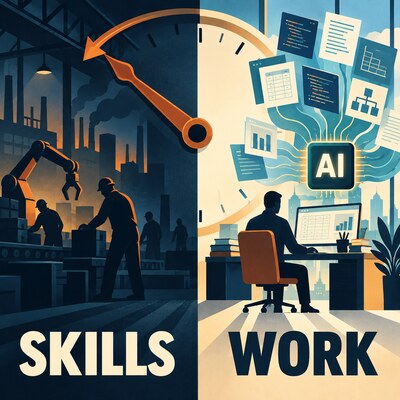
산업혁명의 기계는 공장으로 들어갔다. 컴퓨터는 사무실로 들어왔고, 이제 인공지능(Artificial Intelligence·AI)은 보고서를 쓰고 자료를 분류하며 의사결정을 보조한다. 기술이 블루칼라 노동부터 대체한다는 200년 된 공식이 뒤집힐 가능성이 커졌다.
[Key Message]
* AI는 단순 반복노동만 자동화하지 않는다. 문서 작성, 자료 분석, 일정 조정처럼 사무직이 맡아온 인지 과업에도 직접 들어간다.
* 약 200년에 걸친 특허와 직업 자료를 분석한 연구는 기술 변화의 무게중심이 육체노동에서 인지노동으로 이동했다고 분석했다. 앞으로 5~10년에는 사무·기술·관리직의 상대적 수요가 낮아질 가능성이 크다.
* AI에 노출된 직업이 반드시 사라지는 것은 아니다. 직업 안의 일부 과업만 자동화되면 남은 일의 생산성과 고용이 오히려 증가할 수도 있다.
* 교육 수준이 높으면 기술 변화에 안전하다는 공식도 약해질 수 있다. AI는 고학력자가 주로 맡는 정보 처리와 문서 생산 능력을 대량으로 공급하기 때문이다.
* 협업, 설득, 현장 판단, 창의적 문제 설정처럼 맥락과 인간관계가 중요한 능력은 상대적으로 덜 노출된다. 미래의 경쟁력은 AI보다 빨리 답하는 능력이 아니라 AI가 풀어야 할 문제를 제대로 정하는 능력에서 나올 수 있다.
***
로봇이 공장 대신 사무실로 출근한 날
자동화라는 단어를 들으면 흔히 조립 라인의 로봇 팔이 떠오른다. 컨베이어 벨트 위 자동차 부품을 용접하고, 무거운 상자를 옮기며, 한 치의 오차도 없이 같은 동작을 반복하는 기계다. 산업화 이후 기술은 대부분 인간의 근육을 더 강하고 빠른 기계로 바꾸는 방향으로 발전했다.
그래서 새로운 기술이 등장할 때마다 위험한 직업으로 먼저 거론된 사람도 생산직 노동자였다. 방직기계는 직조공을 위협했고, 트랙터는 농업 노동을 줄였으며, 산업용 로봇은 자동차 공장의 조립 인력을 대신했다. 반대로 회계사, 변호사, 관리자, 연구원처럼 책상에 앉아 판단하고 문서를 만드는 사람은 비교적 안전하다는 인식이 강했다. 기계는 팔을 가질 수 있어도 머리까지 갖기는 어렵다는 믿음이었다.
생성형 AI의 등장은 이 익숙한 그림을 뒤집는다. AI가 가장 쉽게 접근할 수 있는 작업장은 소음 가득한 공장이 아니라 디지털 문서가 쌓인 사무실일 수 있다. 이메일을 요약하고, 회의록을 정리하고, 계약서의 위험 조항을 찾고, 광고 문구를 만들며, 프로그램 코드를 제안하는 일에는 로봇 팔도 작업복도 필요하지 않다. 데이터에 접속할 수 있는 소프트웨어만 있으면 된다.
흥미로운 역설도 생긴다. 배관공이 낡은 건물의 벽을 열어 누수 원인을 찾으려면 공간을 직접 보고, 예상 밖의 배관 구조를 파악하고, 고객에게 수리 방법을 설명해야 한다. 반면 사무실의 분석가는 정해진 형식의 자료를 읽고 표준 보고서를 만드는 데 하루의 상당 부분을 사용할 수 있다. 겉보기에는 분석가의 일이 더 지적이지만, AI가 접근하기 쉬운 쪽은 오히려 화면과 문서 안에서 완결되는 업무다.
특허와 직업을 175년 동안 맞춰보다
노스웨스턴대학교 켈로그경영대학원의 후벤 류, 디미트리스 파파니콜라우, 로런스 슈미트, 브라이언 시그밀러 연구팀은 이러한 변화를 단순한 전망이 아니라 장기 자료를 통해 살펴봤다. 연구팀은 1850년부터 2024년까지 미국에서 축적된 특허 자료를 직업별 과업 정보와 연결했다. 증기기관과 농업기계에서 컴퓨터와 AI에 이르기까지 약 175년 동안 기술이 어떤 업무에 영향을 미쳤는지 추적한 셈이다.
연구의 핵심은 직업의 이름만 비교하지 않았다는 데 있다. 같은 ‘회계사’라도 영수증 입력, 세법 검토, 고객 상담, 감사 계획 수립처럼 서로 다른 과업을 수행한다. 같은 ‘간호사’의 업무에도 환자 기록 작성, 투약 확인, 보호자 설명, 응급상황 판단이 함께 들어 있다. 기술은 직업 전체를 한 번에 삼키기보다 그 안의 특정 과업부터 파고든다.
연구팀은 미국 인구조사 자료에서 직업과 고용 변화를 확인하고, 각 직업이 수행하는 업무를 세분화했다. 이어 대규모 언어모델(Large Language Model·LLM)을 활용해 직업별 과업 설명을 보완하고, 자연어처리(Natural Language Processing·NLP) 기법으로 특허에 담긴 기술과 직업별 과업이 얼마나 가까운지를 측정했다.
예를 들어 어떤 특허가 문서 분류와 정보 검색을 자동화한다면, 그 기술은 문서를 거의 다루지 않는 건설 노동자보다 법률 사무원이나 행정 보조원에게 더 가까운 것으로 분류된다. 이미지 판독 기술은 의료영상 분석 업무와 연결되고, 산업용 절단 기술은 금속 가공 업무와 연결된다. 이런 대응 관계를 장기간 쌓으면 기술이 어느 시기에 어느 직업의 과업을 향했는지 보여주는 지도가 만들어진다.
물론 특허가 실제 현장에서 곧바로 사용됐다는 뜻은 아니다. 특허에는 상용화되지 않은 아이디어도 포함되고, 하나의 기술이 확산되는 속도도 산업마다 다르다. 그럼에도 특허는 새로운 기술이 해결하려고 한 문제가 무엇이었는지 장기간 일관된 방식으로 보여준다. 200년 가까운 노동시장 변화를 한 시야에 넣을 수 있다는 것이 이 연구의 강점이다.
기계는 손을 먼저 가져갔다
19세기 중반부터 이어진 첫 번째 흐름은 예상과 크게 다르지 않았다. 기술 발전은 육체노동과 생산 업무를 강하게 겨냥했다. 농기계는 적은 인원으로 더 넓은 땅을 경작하게 했고, 방직기계는 천을 짜는 속도를 끌어올렸으며, 운송 기술은 사람과 물자를 옮기는 데 필요한 노동을 줄였다.
공장에서도 숙련공이 손으로 하던 동작이 기계의 표준 동작으로 바뀌었다. 노동자가 철판을 정확한 크기로 자르던 업무는 절단기의 기능이 됐고, 사람이 제품을 들어 나르던 일은 지게차와 컨베이어의 몫이 됐다. 기술은 근력과 반복 동작을 기계에 넘기면서 생산량을 크게 늘렸다.
이 과정에서 사라진 것은 단순히 일자리만이 아니었다. 특정 숙련의 시장가치도 달라졌다. 오랜 시간 훈련해 얻은 손기술이 기계의 버튼 하나로 재현되면 숙련의 희소성이 낮아진다. 기업은 같은 제품을 더 적은 인원으로 만들 수 있고, 노동 수요는 새로운 기계를 설계하거나 유지하는 직무 쪽으로 이동한다.
그렇다고 기술에 노출된 모든 직업이 쇠퇴한 것은 아니다. 기술이 한 직업의 핵심 역할을 통째로 대체하면 고용에는 부정적인 압력이 생기지만, 일부 과업만 덜어주면 다른 결과가 나타날 수 있다. 세탁기가 등장했다고 모든 세탁 관련 서비스가 사라진 것은 아니며, 전동공구가 목수를 없애지도 않았다. 작업 속도가 빨라지고 비용이 낮아지면 서비스 수요가 커져 고용이 유지되거나 늘어날 여지도 있다.
연구팀이 1910년 이후의 고용 변화를 분석한 결과에서도 이러한 차이가 나타났다. 기술 노출도가 전반적으로 높은 직업은 고용 증가율이 낮아지는 경향을 보였지만, 일부 과업만 기술의 영향을 받은 직업에서는 생산성 향상과 업무 재편이 고용에 도움이 되는 경우도 있었다. 중요한 질문은 “이 직업이 기술에 노출됐는가”가 아니라 “직업을 구성하는 과업 가운데 무엇이 대체되고 무엇이 강화되는가”다.
컴퓨터가 노동시장의 시계를 돌리다
20세기 중반 이후에는 방향이 달라졌다. 컴퓨터와 정보기술이 확산되면서 발명은 점점 더 인지 과업을 향했다. 계산, 기록, 검색, 분류, 일정 관리처럼 한때 사무직 노동자가 머리와 손으로 처리하던 일이 소프트웨어의 기능으로 이동했다.
처음에는 변화가 비교적 단순했다. 전자계산기는 긴 계산을 줄였고, 스프레드시트는 장부와 예산표를 바꿨으며, 데이터베이스는 서류 캐비닛을 대체했다. 그러나 오늘날 AI는 이미 정리된 정보를 저장하고 불러오는 데 그치지 않는다. 질문을 해석하고, 여러 자료를 요약하며, 초안을 만들고, 일정한 기준에 따라 결과를 평가한다.
한 중간관리자의 하루를 떠올려보면 변화의 범위가 선명해진다. 아침에는 전날 실적을 요약하고, 회의 전에 보고서를 읽으며, 회의가 끝나면 업무를 배분한다. 오후에는 예산표를 검토하고 상사에게 제출할 설명 자료를 만든다. 과거의 소프트웨어는 이 과정에 필요한 파일을 저장했다. 생성형 AI는 이제 파일을 읽어 요점을 정리하고, 이상치를 찾고, 발표 자료의 구조까지 제안한다.
법률 사무실에서도 비슷하다. 수백 쪽의 판례를 검색하고 계약서를 비교하는 데 많은 시간이 필요했지만, AI는 관련 문장을 빠르게 찾아 차이를 정리할 수 있다. 병원에서는 진료 기록의 초안을 작성하고 검사 결과를 분류한다. 광고회사에서는 고객 자료를 바탕으로 여러 문구를 만들고, 정보기술 부서에서는 코드의 오류 가능성을 찾아낸다.
따라서 AI의 충격은 ‘머리를 쓰는 직업’과 ‘머리를 쓰지 않는 직업’ 사이에서 갈리지 않는다. 규칙과 데이터로 표현할 수 있고 디지털 환경 안에서 반복되는 인지 과업이 먼저 노출된다. 고도의 학력이 필요한 업무라도 입력과 출력의 형식이 일정하면 자동화하기 쉽다. 반대로 학력이 크게 필요하지 않은 일이라도 매번 다른 물리적 환경에서 사람을 상대하고 즉석 판단을 내려야 한다면 자동화하기 어렵다.
직업이 아니라 과업이 사라진다
AI와 고용에 관한 논의가 자주 극단으로 흐르는 이유는 직업을 하나의 덩어리로 보기 때문이다. “AI가 회계사를 대체할까”, “변호사가 사라질까”, “개발자가 필요 없어질까”라는 질문에는 예 또는 아니요로 답하기 어렵다. 하나의 직업에는 자동화하기 쉬운 과업과 어려운 과업이 섞여 있기 때문이다.
회계사의 업무 가운데 영수증 분류와 표준 재무제표 초안 작성은 자동화될 가능성이 크다. 하지만 모호한 거래를 어떻게 처리할지 판단하고, 경영진에게 재무 위험을 설명하며, 고객의 의사결정을 지원하는 업무는 그대로 남을 수 있다. 이때 회계사라는 직업은 사라지지 않더라도 구성은 달라진다. 자료 입력 능력의 가치는 낮아지고 검증, 해석, 설명 능력의 가치는 높아진다.
소프트웨어 개발자도 마찬가지다. AI는 반복적인 코드를 만들고 오류 수정안을 제시할 수 있다. 그러나 고객이 실제로 해결하려는 문제가 무엇인지 파악하고, 시스템의 구조를 설계하며, 보안과 성능 사이의 우선순위를 결정하는 일은 별개의 문제다. 코드 작성 시간이 줄어들면 한 개발자가 더 많은 기능을 만들 수 있지만, 기업이 필요한 개발자 수를 줄일지 더 많은 소프트웨어를 만들지는 수요에 달려 있다.
여기서 생산성의 역설이 등장한다. AI가 한 사람의 생산성을 두 배로 높이면 기업은 인원을 절반으로 줄일 수 있다. 하지만 서비스 가격이 낮아져 고객 수요가 세 배로 늘어난다면 오히려 더 많은 사람을 고용할 수도 있다. 자동화 가능성만으로 최종 고용 규모를 단정할 수 없는 이유다.
개인의 체감은 직업 통계보다 먼저 달라질 수 있다. 신입사원이 맡던 자료 조사와 초안 작성이 자동화되면 회사가 당장 직무를 폐지하지 않더라도 채용 인원을 줄일 수 있다. 기존 직원은 AI를 이용해 더 많은 일을 처리하지만, 이제 막 노동시장에 들어오려는 사람은 경험을 쌓을 입구를 잃는다. 직업은 남아 있는데 경력의 첫 계단이 사라지는 현상이다.
따라서 기업은 현재 인원만 볼 것이 아니라 숙련이 형성되는 과정도 살펴야 한다. AI가 초급 과업을 모두 맡으면 미래의 숙련자는 어디에서 훈련될 것인가. 의료 현장에서 기록 보조 업무가 줄더라도 환자 상태를 관찰하며 배우는 과정은 필요하다. 법률 검토의 초안을 AI가 작성하더라도 신입 변호사가 논리 구조를 익힐 기회는 따로 설계해야 한다.
대졸자보다 배관공이 안전할까
연구 모형은 앞으로 5~10년 동안 AI가 사무·기술·관리직의 상대적 노동 수요를 낮출 가능성이 있다고 전망했다. 특히 높은 임금과 교육 수준을 요구하는 직업이 과거보다 더 많이 노출될 수 있다. 산업화 시대에는 교육이 기계를 피해 더 복잡한 업무로 이동하는 사다리였다면, AI 시대에는 그 사다리가 연결된 목적지 자체가 자동화 대상이 될 수 있다.
이는 대학 교육의 가치가 사라진다는 뜻은 아니다. AI가 가장 잘 활용할 수 있는 지식과 AI의 결과를 가장 잘 검증할 수 있는 능력 역시 교육을 통해 길러진다. 다만 학위가 기술 변화로부터 고용을 자동으로 보호해주는 방패라는 믿음은 약해질 수 있다. 정형화된 지식의 보유보다 지식을 새로운 맥락에 적용하고 결과의 오류를 찾아내는 능력이 중요해진다.
성별에 따른 영향도 주목할 필요가 있다. 연구진의 전망에서는 여성 비중이 높은 직업의 상대적 수요가 남성 비중이 높은 직업보다 더 낮아질 가능성이 나타났다. 행정, 사무 지원, 일부 전문 서비스처럼 여성 고용이 집중된 직군에 디지털 인지 과업이 많기 때문이다. 과거 자동화가 남성 비중이 높은 제조업에 큰 충격을 줬다면, AI 전환은 노동시장의 충격 지도를 다르게 그릴 수 있다.
그렇다고 블루칼라 일자리가 절대적으로 늘어난다고 해석해서는 안 된다. 전체 고용에서 사무직 수요가 상대적으로 약해지면 남아 있는 일자리 가운데 현장직의 비중이 커질 수 있다는 뜻에 가깝다. 건설, 유지보수, 돌봄, 운송처럼 물리적 공간에서 이루어지는 일도 로봇과 자동화의 영향을 계속 받는다.
배관공이 변호사보다 영원히 안전하다는 결론도 성립하지 않는다. 로봇 기술과 센서가 발전하면 현장 업무의 자동화 가능성도 달라진다. 기술은 한 방향으로만 움직이지 않는다. 현재 AI가 디지털 인지 과업에 빠르게 확산하고 있다는 사실이 앞으로 모든 기술의 중심이 소프트웨어에만 머문다는 의미는 아니다.
더 정확한 질문은 “어떤 직업이 안전한가”가 아니라 “어떤 과업이 지금의 기술로 표준화되기 어려운가”다. 예외가 많은 현장, 사람 사이의 신뢰, 책임을 수반하는 최종 판단, 이해관계를 조정하는 협상, 문제 자체를 새롭게 정의하는 일은 여전히 자동화 장벽이 높다.
AI가 못하는 일로 이동하는 사람들
AI 시대의 대응을 단순히 ‘코딩을 배우자’로 정리하기는 어렵다. AI가 코드를 작성하는 상황에서 특정 도구의 사용법만 익히는 전략은 오래가지 못할 수 있다. 오히려 어떤 문제를 풀어야 하는지 결정하고, AI가 내놓은 결과가 현실에 맞는지 검증하며, 다른 사람과 협력해 실행하는 능력이 중요해진다.
예를 들어 마케팅 담당자가 AI로 광고 문구 100개를 만드는 일은 어렵지 않다. 어려운 일은 고객이 왜 제품을 외면하는지 찾아내고, 브랜드가 어떤 약속을 해야 하는지 결정하며, 잘못된 표현이 사회적으로 어떤 반응을 낳을지 판단하는 것이다. AI는 선택지를 늘리지만 무엇을 선택할지에 대한 책임까지 대신 지지는 않는다.
의사도 AI의 분석 결과를 활용할 수 있지만 환자의 두려움을 듣고 치료 선택의 의미를 설명해야 한다. 관리자는 보고서 초안을 빠르게 만들 수 있지만 서로 충돌하는 팀의 이해관계를 조정해야 한다. 교사는 학습 자료를 자동 생성할 수 있지만 학생이 왜 배우기를 포기했는지 알아차려야 한다. 이런 일에는 정보뿐 아니라 관계와 맥락이 필요하다.
기업의 과제도 모든 사람에게 AI 사용법을 한 번 교육하는 데 그치지 않는다. 어떤 업무를 자동화하고 어떤 판단을 사람에게 남길지 다시 설계해야 한다. AI 결과를 검증할 책임자가 누구인지, 오류가 발생했을 때 어떤 기록을 확인할지, 생산성 향상의 이익을 업무 강도 증가가 아닌 새로운 서비스와 훈련에 어떻게 연결할지도 결정해야 한다.
정책 역시 실직 이후의 보상만 바라봐서는 늦을 수 있다. 초급 사무직 채용이 줄어드는 단계에서부터 직업훈련과 경력 진입 경로를 다시 설계해야 한다. 학위 취득에 집중된 교육 체계도 협업, 문제 설정, 현장 경험, AI 결과 검증 능력을 키우는 방향으로 넓어질 필요가 있다.
기술의 역사는 인간의 일이 단순히 줄어든 역사가 아니다. 일부 과업은 사라졌지만 새로운 상품과 산업, 직업이 생겨났다. 다만 그 사이에는 언제나 전환 비용이 있었다. 기술의 혜택은 장기적으로 나타날 수 있지만 일자리를 잃거나 첫 취업 기회를 놓친 개인에게 전환기는 현재의 문제다.
이번 연구가 던지는 경고는 AI가 모든 화이트칼라 일자리를 없앤다는 것이 아니다. 자동화의 화살표가 과거와 다른 방향을 향하기 시작했다는 데 있다. 공장 노동자에게 집중됐던 기술 충격이 사무실과 전문직, 그리고 고학력 노동자의 책상으로 이동하고 있다.
노동시장의 시계가 정말 거꾸로 도는지는 아직 결정되지 않았다. 그러나 시곗바늘이 움직이는 방향은 보인다. 앞으로 안전한 사람은 AI와 경쟁해 더 많은 문서를 만드는 사람이 아니라, AI가 만든 문서에서 틀린 전제를 발견하고 현실의 문제를 다시 정의할 수 있는 사람일 가능성이 크다.
참고자료
Roberta Kwok, “Is AI Turning Back the Clock on the Job Market?”, Kellogg Insight, February 1, 2026. insight.kellogg.northwestern.edu
Will Artificial Intelligence Shake the Office Before the Factory?
- Machines replaced human hands, but artificial intelligence is coming for cognitive work
The machines of the Industrial Revolution entered factories. Computers entered offices, and now artificial intelligence (AI) summarizes reports, classifies information, and assists decision-making. The two-hundred-year assumption that technology displaces blue-collar workers first may be turning upside down.
[Key Message]
* AI does not automate only simple, repetitive labor. It is moving directly into cognitive tasks traditionally performed by office workers, including drafting documents, analyzing data, and coordinating schedules.
* A study covering nearly two centuries of patents and occupations found that technological exposure has shifted from manual toward cognitive labor. Over the next five to ten years, relative demand may weaken for clerical, technical, and managerial occupations.
* Exposure to AI does not necessarily mean that an occupation will disappear. When only some tasks are automated, workers can redirect their effort and become more productive, potentially supporting employment.
* The old assumption that more education guarantees safety from technological change may weaken. AI can supply many information-processing and document-production capabilities associated with highly educated workers.
* Collaboration, persuasion, field judgment, creative problem definition, and other context-dependent abilities remain relatively less exposed. Future advantage may come not from answering faster than AI, but from deciding which problems AI should solve.
***
The Day the Robot Reported to the Office
The word automation still tends to evoke an industrial robot on an assembly line. It welds automobile parts, lifts heavy boxes, and repeats the same movement with near-perfect precision. Since industrialization, much technological development has focused on replacing human muscle with faster and stronger machines.
That is why production workers have usually been treated as the first group at risk from new technology. Textile machines threatened weavers, tractors reduced agricultural labor, and industrial robots replaced portions of automobile assembly. Accountants, lawyers, managers, and researchers who made judgments and produced documents at desks appeared safer. A machine might acquire arms, people assumed, but not a mind.
Generative AI overturns this familiar picture. Its most accessible workplace may not be a noisy factory but an office filled with digital documents. Summarizing email, preparing meeting minutes, flagging risky contract clauses, producing advertising copy, and suggesting computer code require neither a robotic arm nor work clothes. They require software with access to data.
This creates a revealing paradox. A plumber opening the wall of an old building must inspect the physical space, understand an unexpected pipe configuration, and explain possible repairs to a customer. An office analyst, meanwhile, may spend much of the day reading standardized information and producing standardized reports. The analyst’s occupation looks more intellectual, but the work confined to screens and documents may be easier for AI to reach.
Matching 175 Years of Patents With Work
A research team consisting of Huben Liu, Dimitris Papanikolaou, Lawrence Schmidt, and Bryan Seegmiller examined this change through long-run data rather than speculation alone. They connected US patents from 1850 through 2024 with information about occupational tasks. In effect, they tracked how technologies ranging from steam engines and agricultural machinery to computers and AI interacted with work over roughly 175 years.
The study’s defining feature is that it did not compare occupation titles alone. An accountant may enter receipts, interpret tax rules, advise clients, and plan audits. A nurse’s job can combine recordkeeping, medication checks, communication with families, and judgment during emergencies. Technology rarely swallows this entire bundle at once. It usually enters through particular tasks.
The researchers used US Census data to observe occupations and employment changes and broke jobs into their component activities. They then used a large language model (LLM) to expand task descriptions and natural language processing (NLP) to measure the similarity between technologies described in patents and tasks performed in occupations.
A patent that automates document classification and information retrieval, for instance, would be more closely connected to legal assistants and administrative staff than to construction workers who rarely handle documents. Image-recognition technology could be linked to medical-image analysis, while industrial cutting technology would be connected to metalworking. Accumulating these matches over time produces a map of which occupational tasks technology was targeting in each period.
A patent does not prove that a technology was immediately deployed in the workplace. Patents include inventions that never become commercial products, and adoption rates differ widely by industry. Even so, patent records offer a relatively consistent long-term view of the problems inventors were attempting to solve. That historical reach is one of the study’s strengths.
Machines Took the Hands First
The first major trend, beginning in the mid-nineteenth century, is largely familiar. Technological development heavily targeted manual and production work. Agricultural machinery allowed fewer people to cultivate larger areas. Textile equipment increased the speed of weaving, and transportation technology reduced the labor needed to move people and goods.
In factories, movements once performed by skilled workers became standardized machine operations. Cutting sheet metal to a precise dimension became the function of a machine. Lifting and carrying products became the work of forklifts and conveyor belts. By transferring physical strength and repetition to machines, technology sharply increased output.
The change affected more than the number of jobs. It altered the market value of particular skills. When years of manual practice could be reproduced by pressing a button, the scarcity of that skill declined. Companies could make the same product with fewer people, while demand shifted toward workers who designed, operated, or maintained the new machinery.
Yet not every occupation exposed to technology contracted. When a technology replaces an occupation’s central function, employment faces downward pressure. When it removes only a few tasks, the outcome can be different. Washing machines did not eliminate every laundry-related service, and power tools did not eliminate carpenters. Faster work and lower prices can expand demand enough to preserve or increase employment.
The researchers found a similar distinction in employment data beginning in 1910. Occupations broadly exposed to technology tended to experience weaker employment growth. But when exposure was limited to only some tasks, workers could redirect their effort, improve productivity, and sometimes benefit. The important question is not simply whether a job encounters technology. It is which tasks are replaced and which are strengthened.
Computers Turned the Labor-Market Clock
The direction began to change in the second half of the twentieth century. As computers and information technology spread, inventions increasingly targeted cognitive tasks. Calculation, recordkeeping, search, classification, and scheduling moved from the heads and hands of office workers into software.
At first, the change appeared relatively straightforward. Electronic calculators shortened long calculations, spreadsheets transformed ledgers and budgets, and databases replaced filing cabinets. Today’s AI does more than store and retrieve organized information. It interprets questions, summarizes multiple sources, produces drafts, and evaluates outputs against stated criteria.
Consider a middle manager’s day. The manager summarizes the previous day’s performance, reads reports before a meeting, and assigns tasks afterward. Later, the manager reviews a budget and prepares an explanation for senior leadership. Older software stored the files needed for this work. Generative AI can read those files, extract the main points, identify anomalies, and propose the structure of the presentation.
The same shift is occurring in legal offices. Searching hundreds of pages of case law and comparing contracts once required many hours, but AI can quickly locate relevant passages and organize differences. In hospitals, it can draft clinical notes and classify test results. In advertising agencies, it can produce multiple messages from a client brief. In information-technology departments, it can flag possible defects in code.
The dividing line is therefore not between occupations that “use their brains” and those that do not. Cognitive tasks become exposed when they can be expressed through rules and data and repeated inside a digital environment. Even work requiring advanced education can be relatively easy to automate when its inputs and outputs follow a stable format. Conversely, a job requiring less formal education may be difficult to automate if it involves changing physical environments, human interaction, and immediate judgment.
Tasks Disappear Before Occupations Do
Public discussion about AI and employment often becomes extreme because it treats each occupation as a single block. Questions such as “Will AI replace accountants?”, “Will lawyers disappear?” or “Will developers become unnecessary?” cannot be answered with a simple yes or no. Every occupation contains a mixture of tasks that are relatively easy and relatively difficult to automate.
In accounting, receipt classification and the first draft of a standardized financial statement may be highly automatable. Resolving an ambiguous transaction, explaining financial risk to executives, and helping a client make a decision may remain human responsibilities. The occupation may survive while its internal composition changes. Data entry loses value, while verification, interpretation, and explanation gain it.
Software development follows the same pattern. AI can generate repetitive code and suggest fixes. Understanding the client’s real problem, designing a system architecture, and choosing among security, speed, and cost remain distinct activities. If coding takes less time, one developer can produce more functionality. Whether a company employs fewer developers or builds more software depends on demand.
This is where the productivity paradox appears. If AI doubles one employee’s productivity, a company could reduce its workforce by half. But if lower prices cause customer demand to triple, the company might employ more people. The technical possibility of automation alone cannot determine final employment levels.
Workers may feel the effect before occupational statistics register it. If AI handles research and first drafts previously assigned to junior employees, a firm may reduce entry-level hiring without formally eliminating the occupation. Existing employees can process more work with AI, while people entering the labor market lose the first rung on which experience was traditionally acquired.
Organizations therefore need to examine not only their current staffing but also how expertise develops. If AI takes every junior task, where will future experts train? Automating medical documentation does not eliminate the need for young clinicians to learn through careful observation. Even if AI drafts a legal analysis, junior lawyers still need a deliberately designed way to learn how its argument is constructed and where it can fail.
Could a Plumber Be Safer Than a Graduate?
The study’s model projects that over the next five to ten years AI may reduce relative labor demand for clerical, technical, and managerial occupations. Jobs associated with higher pay and more education may be more exposed than in past technological transitions. During industrialization, education served as a ladder away from machine competition. In the AI era, some destinations at the top of that ladder may themselves become automation targets.
This does not mean higher education has lost its value. Education also develops the knowledge needed to use AI effectively and verify its results. What may weaken is the assumption that a degree automatically shields its holder from technological disruption. Applying knowledge in a new context and detecting errors in an AI output may matter more than simply possessing standardized knowledge.
The gender distribution of the effects also deserves attention. In the researchers’ projections, relative demand may decline more in occupations with higher shares of female workers than in those with higher shares of male workers. Administrative support and some professional services contain many digitally mediated cognitive tasks. Past automation strongly affected male-dominated manufacturing, but AI could redraw the demographic map of technological disruption.
That does not mean the absolute number of blue-collar jobs will necessarily increase. If relative demand for office work weakens, field-based occupations may account for a larger share of the jobs that remain. Construction, maintenance, care, and transportation will still face continued advances in robotics and automation.
Nor does the research establish that plumbers will remain safer than lawyers forever. Better sensors and robotics could change the automation potential of field work. Technology does not move in only one direction. The rapid diffusion of AI into digital cognitive tasks today does not guarantee that future innovation will remain concentrated in software.
A more useful question is not “Which occupation is safe?” but “Which tasks are difficult for today’s technology to standardize?” Work involving unpredictable physical settings, interpersonal trust, accountable final judgment, negotiation among competing interests, and the invention of new problem definitions still faces relatively high barriers to automation.
Moving Toward What AI Cannot Do
Preparing for the AI era cannot be reduced to telling everyone to learn coding. When AI itself can generate code, a strategy based only on mastering one tool may age quickly. The durable abilities are deciding which problem deserves attention, verifying whether an AI-generated result fits reality, and working with other people to implement a solution.
A marketer can use AI to produce one hundred advertisements with little difficulty. The hard part is discovering why customers are rejecting a product, deciding what promise a brand should make, and anticipating how a poorly chosen message could be received. AI expands the menu of options, but it does not assume responsibility for the choice.
A physician can use an AI analysis but must still listen to a patient’s fear and explain the meaning of a treatment decision. A manager can produce a draft report quickly but still has to reconcile conflicting interests across teams. A teacher can automatically generate learning materials but must notice why a student has given up. These tasks require relationships and context, not information alone.
For companies, the challenge is larger than providing a one-time course on AI tools. They must redesign which activities are automated and which decisions remain with people. They also need to determine who is responsible for verifying AI output, which records will be examined when errors occur, and how productivity gains can support new services and training instead of merely increasing work intensity.
Public policy should not wait until workers have already lost their jobs. If entry-level office hiring begins to contract, training systems and career-entry routes must be redesigned at that stage. Education systems centered on credentials also need to give more weight to collaboration, problem definition, field experience, and the ability to validate AI-generated results.
The history of technology is not simply a history of declining human work. Some tasks disappeared while new products, industries, and occupations emerged. But transition costs always came in between. The benefits of technology may appear over the long term, while the worker who loses a job?or the graduate who loses a first opportunity?experiences the transition in the present.
The study’s warning is not that AI will eliminate every white-collar occupation. It is that the arrow of automation has begun to point in a different direction. A technological shock once concentrated on factory labor is moving toward offices, professional work, and the desks of highly educated workers.
Whether the labor-market clock truly runs backward has not yet been decided. Its hands, however, are visibly moving. The people best positioned for the next stage may not be those who compete with AI to produce more documents, but those who can detect a false assumption in an AI-generated document and redefine the real-world problem behind it.
Reference
Roberta Kwok, “Is AI Turning Back the Clock on the Job Market?”, Kellogg Insight, February 1, 2026.