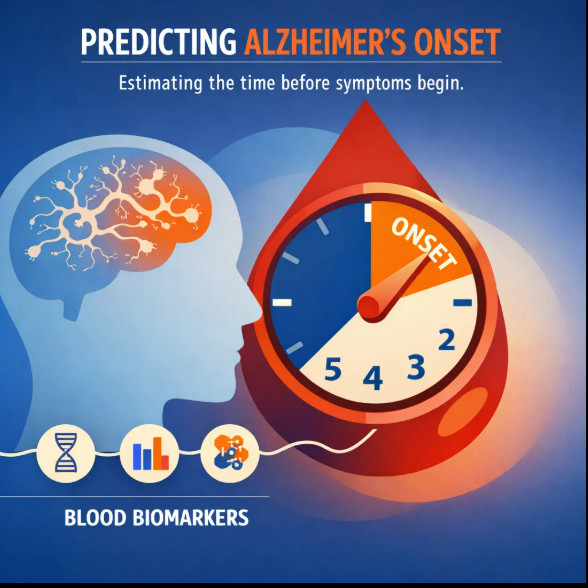
알츠하이머는 진단보다 타이밍이 더 잔인한 병이다. 증상이 나타나기 전, 뇌는 이미 긴 시간 조용히 변해 있다. 혈액 바이오마커로 증상 시작 시점을 가늠하려는 시도가 예측의 시대를 열고 있다.
어떤 연구가 있었나
미국 미주리주 세인트루이스의 워싱턴대학교 의과대학(WashU Medicine) 연구진은 “혈액검사로 알츠하이머의 증상 시작 시점을 예측할 수 있는가”라는 질문을 정면으로 다뤘다. 단순히 피에서 바이오마커를 측정해 위험을 말하는 수준이 아니라, 그 수치를 시간축에 올려 “증상이 가까운지, 먼지”를 계산해 보려는 목적이었다.
연구는 한 번의 검사로 끝나는 설계가 아니었다. 워싱턴대가 장기간 운영해 온 Knight Alzheimer Disease Research Center 코호트에서, 참가자들이 여러 해에 걸쳐 반복적으로 혈액을 제공하고 정기적인 인지·임상평가를 받도록 했다.
즉, 연구진은 “이미 증상이 뚜렷한 환자”만 보는 게 아니라, 겉으로는 멀쩡해 보이는 사람들의 시간이 어떻게 흘러가는지 추적했다. 그리고 한 기관 자료에만 기대지 않기 위해 미국 다기관 연구인 ADNI(Alzheimer’s Disease Neuroimaging Initiative) 데이터를 추가로 활용해, 서로 다른 집단에서도 같은 방식이 통하는지까지 점검했다.
연구의 중심 재료는 혈장(plasma)에서 측정한 p-tau217이었다. 다만 핵심은 p-tau217의 숫자를 한 번 보고 “높다/낮다”라고 말하는 것이 아니었다. 연구진은 인산화된 타우와 비인산화 타우의 비율을 반영한 지표(%p-tau217)를 포함해, 혈액 신호가 시간이 지나면서 어떤 궤적으로 변하는지를 잡아내려 했다. 그 궤적이 일정한 형태를 갖는다면, 현재의 혈액 값은 “질병 진행의 시간표에서 내가 어디쯤 서 있는지”로 환산될 수 있기 때문이다.
그 다음 단계가 바로 ‘시계’다. 연구진은 반복 측정된 혈액 데이터를 바탕으로 각 개인이 정상 범위에서 벗어나 ‘양성’으로 분류되는 전환 시점이 언제였는지(정확히는 전환이 일어났을 법한 나이)를 추정했고, 그 전환 시점과 실제 임상평가에서 증상이 시작되는 시점의 관계를 모델로 묶었다. 결과적으로 “혈액 시계”가 예측하는 증상 시작 시점은 대략 몇 년 단위의 오차 범위로 제시됐다.
이 연구가 흥미로운 이유는
알츠하이머에서 사람들이 진짜로 묻고 싶은 질문은 “있나요”보다 “언제 오나요”에 가깝기 때문이다. 병원에서 “위험이 있습니다”라는 말을 들었을 때, 그 말이 삶을 바꾸는 건 위험의 존재 자체가 아니라 시간의 감각이다. 20년 뒤일지 3년 뒤일지에 따라 직장, 은퇴, 보험, 저축, 가족의 돌봄 계획이 달라진다. 의료도 마찬가지다. 진행을 늦추는 치료나 개입이 존재한다면, “언제 시작해야 의미가 큰가”가 진료의 중심 질문이 된다.
기존에도 ‘언제’를 다루려는 연구는 있었다. 아밀로이드·타우 PET 같은 고가 검사나 뇌척수액을 활용해 질병 단계를 정밀하게 나누고 예후를 추정하는 모델이 등장했지만, 비용과 접근성 때문에 넓게 적용하기 어려웠다. 이번 접근이 던지는 메시지는 단순하다. 같은 질문을 훨씬 더 넓게 적용 가능한 도구로 던져보자는 것이다. 혈액검사가 ‘예측’의 언어와 결합하면, 알츠하이머는 특정 병원에서만 가능한 특수검사에서 벗어나 임상시험과 일상 진료의 전략 도구로 이동할 여지가 생긴다.
연구진은 어떻게 시간을 계산했나
이 연구의 핵심은 “전환점”을 다루는 방식이다. 사람마다 p-tau217은 시간이 지나면서 서서히 오르는데, 어느 시점에 정상 범위를 넘어 ‘양성’으로 분류될 수 있다. 문제는 그 전환이 달력처럼 딱 찍히지 않는다는 점이다. 보통은 마지막 음성(정상) 검사와 첫 양성 검사 사이의 어딘가에서 전환이 일어난다. 즉, 전환 시점은 점이 아니라 구간으로 관측된다.
연구진은 이 구간 정보를 활용해, 각 개인의 전환 나이를 추정하는 모델을 만들었다. 그런 다음 모델이 추정한 전환 나이와 관측된 구간(마지막 음성~첫 양성 사이)이 얼마나 잘 맞는지 검증했다. 또한 한 데이터셋에서 만든 시계가 다른 데이터셋에서도 통하는지 교차 검증을 수행해 “특정 집단에만 잘 맞는 과적합 시계”가 아닌지 확인했다.
임상적으로 중요한 관찰도 따라왔다. 같은 양성이라도 “양성이 된 나이”가 다르면 증상으로 가는 시간이 달라질 수 있다는 점이다. 더 나이 들어 양성이 된 경우 증상까지의 간격이 더 짧게 나타나는 경향이 관찰되면서, 단순히 전환 시점을 잡는 데서 끝나지 않고 나이 효과를 반영해 “증상 시작 시점”을 추정하는 방향으로 모델이 확장된다. 요약하면, 이 시계는 단일 지표의 예언이 아니라 개인의 나이와 혈액 신호가 만들어내는 시간표를 계산하려는 도구다.
임상시험이 먼저 바뀌고, 그 다음에 진료가 바뀐다
이런 예측 모델이 곧바로 개인에게 “몇 년 뒤 발병”을 확정해 주는 도구가 되긴 어렵다. 오차가 있고, 개인의 삶은 오차에 민감하기 때문이다. 하지만 임상시험은 성격이 다르다. 임상시험은 개인의 운명을 단정하는 것이 아니라, “어떤 사람을 어떤 시점에 모을 것인가”를 설계하는 작업이다.
예방 임상시험의 가장 큰 비용은 약이 아니라 참가자 선별이다. 아직 멀쩡한 사람들 중에서 가까운 시기에 증상으로 넘어갈 가능성이 높은 집단을 찾아야 하기 때문이다. 혈액 시계가 이 집단을 더 효율적으로 찾아준다면, 임상시험은 더 짧아지고 더 싸진다. 그러면 예방 치료제의 개발 속도도 빨라질 수 있다. 임상이 바뀌면 진료도 따라 바뀐다. “이 타이밍에 개입하면 의미가 있다”는 근거가 축적될수록, 진료실의 질문은 ‘진단’에서 ‘개입 시점’으로 이동한다. 결국 이 연구가 촉발하는 변화는 검사 유행이 아니라 알츠하이머를 다루는 의료의 시간표다.
예측이 검진이 되려면, 기술보다 시스템이 먼저다
그럼에도 이 기술이 곧바로 대중 검진으로 들어오는 장면을 상상하면 위험하다.
첫째, 다양한 인구집단에서의 검증이 더 필요하다. 특정 코호트에서 잘 맞는 모델이 실제 인구 전체에서 그대로 작동한다는 보장은 없다.
둘째, 결과를 전달하는 방식이 중요하다. 예측은 불확실성을 동반한다. 불확실성을 제대로 설명하지 못하면 예측은 정보가 아니라 공포가 된다.
셋째, 양성 이후의 경로가 있어야 한다. 혈액검사에서 위험이 높게 나오면 무엇을 할지, 어떤 추가 검사로 확진할지, 어떤 생활·약물 개입을 권고할지, 어떤 주기로 추적할지까지가 하나의 서비스로 설계돼야 한다. 예측은 검사로 끝나지 않는다. 예측은 경로 설계를 요구한다.
마지막으로 윤리와 사회 규칙이 따라온다. 알츠하이머 예측은 의료정보이면서 동시에 미래정보다. 보험과 고용, 가족 관계에 파장을 낳을 수 있다. 따라서 이 기술은 병원 안에서만 완성되지 않는다. 사회가 예측을 다루는 규칙까지 함께 진화해야 한다. 그럼에도 한 가지는 분명하다. 알츠하이머는 점점 “기억력 테스트의 질병”이 아니라 “바이오마커로 시간을 다루는 질병”으로 이동하고 있다.
Reference
Nature Medicine, 2026-02-19, “Predicting onset of symptomatic Alzheimerʼs disease with plasma p-tau217 clocks”, Kellen K. Petersen; Marta Milà-Alomà; Yan Li; Lianlian Du; Chengjie Xiong; Suzanne E. Schindler; et al.
Bringing an Alzheimer’s onset clock out of the blood
Alzheimer’s is a disease in which timing is more brutal than diagnosis. Before symptoms appear, the brain has already been changing quietly for a long time. An attempt to estimate when symptoms will begin using blood biomarkers is opening an era of prediction.
What research was done
A research team at Washington University School of Medicine in St. Louis (WashU Medicine), in St. Louis, Missouri, USA, directly addressed the question: “Can we predict the onset time of Alzheimer’s symptoms with a blood test?” The goal was not simply to measure biomarkers in blood and talk about risk, but to place those values on a time axis and calculate “whether symptoms are near or far.”
The study was not designed to end with a single test. In the Knight Alzheimer Disease Research Center cohort that Washington University has operated over the long term, participants provided blood repeatedly over multiple years and underwent regular cognitive and clinical assessments.
In other words, the researchers did not look only at “patients with clearly evident symptoms,” but tracked how time unfolds for people who appear, on the surface, to be doing fine. And to avoid relying only on data from a single institution, they additionally used data from ADNI (Alzheimer’s Disease Neuroimaging Initiative), a multi-center U.S. study, to check whether the same approach works in different groups as well.
The central material of the study was p-tau217 measured in plasma. However, the key was not to look at the p-tau217 number once and say “high/low.” The researchers sought to capture how the blood signal changes over time by including measures such as %p-tau217, an index that reflects the ratio of phosphorylated tau to non-phosphorylated tau. If that trajectory has a consistent form, a current blood value can be converted into “about where I stand on the timetable of disease progression.”
The next step is the “clock.” Based on repeatedly measured blood data, the researchers estimated when each individual transitioned out of the normal range and became classified as “positive” (more precisely, the age at which the transition likely occurred), and then tied that transition point to the time when symptoms actually began in clinical assessments as a model. As a result, the symptom onset time predicted by the “blood clock” was presented with an error range on the order of a few years.
Why this research is interesting
This is because in Alzheimer’s, the question people truly want to ask is closer to “When will it come?” than “Do I have it?” When you hear “You are at risk” at a hospital, what changes your life is not the existence of risk itself but your sense of time. Depending on whether it is 20 years away or 3 years away, plans for work, retirement, insurance, savings, and family caregiving change. Medicine is the same. If there are treatments or interventions that slow progression, then “When should we start for it to matter?” becomes the central question of care.
There has already been research that tries to deal with “when.” Models have emerged that use expensive tests such as amyloid and tau PET scans or cerebrospinal fluid to precisely separate disease stages and estimate prognosis, but it has been difficult to apply them broadly because of cost and accessibility. The message of this approach is simple: let’s pose the same question with a tool that can be applied far more widely. When a blood test combines with the language of “prediction,” Alzheimer’s may move from a specialized test available only in certain hospitals to a strategic tool for clinical trials and everyday clinical care.
How did the researchers calculate time
The key of this study is how it handles the “turning point.” For each person, p-tau217 rises gradually over time, and at some point it can cross the normal range and be classified as “positive.” The problem is that this transition is not stamped on a calendar as a single moment. Usually, the transition occurs somewhere between the last negative (normal) test and the first positive test. In other words, the transition time is observed not as a point but as an interval.
The researchers used this interval information to build a model that estimates each individual’s transition age. They then validated how well the model’s estimated transition age matched the observed interval (between the last negative and the first positive). They also performed cross-validation to check whether a clock built from one dataset also works in another, confirming that it was not an overfitted clock that works only in a specific group.
A clinically important observation followed as well. Even among people who are “positive,” the time to symptoms can differ depending on the “age at which they became positive.” A tendency was observed that when people become positive at an older age, the interval until symptoms is shorter. Accordingly, the model expands beyond simply identifying the transition point, incorporating age effects to estimate “symptom onset time.” In short, this clock is not a prophecy from a single indicator, but a tool that attempts to calculate a timetable created by a person’s age and blood signals.
Clinical trials change first, and then clinical care changes
It would be difficult for such a predictive model to become a tool that immediately confirms for an individual, “You will develop the disease in X years.” There is error, and individual lives are sensitive to error. But clinical trials are different in nature. A clinical trial is not about declaring an individual’s fate; it is about designing “which people to recruit at what time.”
The greatest cost of preventive clinical trials is not the drug but participant selection. You have to find, among people who are still functioning normally, the group that is likely to transition to symptoms in the near term. If the blood clock can find this group more efficiently, trials become shorter and cheaper. Then the development speed of preventive therapeutics can also accelerate. When trials change, clinical care follows. As evidence accumulates that “intervening at this timing has meaning,” the clinic’s core question shifts from “diagnosis” to “timing of intervention.” Ultimately, the change this research triggers is not a testing fad, but a timetable for how medicine deals with Alzheimer’s.
For prediction to become screening, systems must come before technology
Even so, it is risky to imagine this technology immediately entering mass screening.
First, more validation is needed across diverse populations. A model that fits one cohort well is not guaranteed to work identically across the entire population.
Second, the way results are communicated matters. Prediction involves uncertainty. If uncertainty is not explained properly, prediction becomes fear rather than information.
Third, there must be a pathway after a positive result. If a blood test indicates high risk, what happens next, which additional tests confirm the diagnosis, what lifestyle or pharmacological interventions are recommended, and at what interval follow-up occurs must all be designed as a single service. Prediction does not end with a test. Prediction demands pathway design.
Finally, ethics and social rules follow. Alzheimer’s prediction is medical information and also future information. It can create ripple effects in insurance, employment, and family relationships. Therefore, this technology is not completed only inside hospitals. Society must evolve together, including the rules for handling prediction. Even so, one thing is clear. Alzheimer’s is increasingly moving from being “a disease of memory tests” to “a disease of managing time through biomarkers.”
Reference
Nature Medicine, 2026-02-19, “Predicting onset of symptomatic Alzheimerʼs disease with plasma p-tau217 clocks”, Kellen K. Petersen; Marta Milà-Alomà; Yan Li; Lianlian Du; Chengjie Xiong; Suzanne E. Schindler; et al.