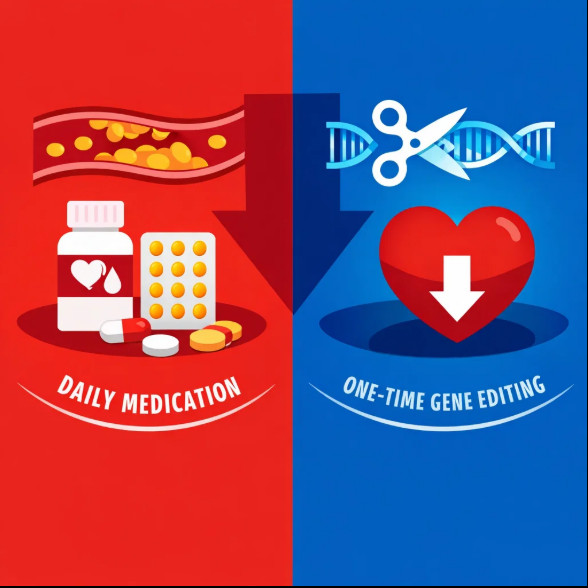
심혈관 질환 예방은 결국 LDL 콜레스테롤 관리로 모이는 경우가 많다. 문제는 약이 없어서가 아니라, 사람이 치료를 평생 흔들림 없이 이어가기 어렵다는 데 있다. 유전자 편집은 이 오래된 약점을 ‘한 번의 개입’으로 넘어설 수 있을지 묻고 있다.
매일 퍼낼 것인가, 구조를 바꿀 것인가
물이 새는 집을 떠올려보자. 바닥에 고인 물을 부지런히 닦아내면 당장은 버틸 수 있다. 그러나 진짜 해결은 고인 물을 계속 퍼내는 데 있지 않다. 어디에서 새는지 찾아, 그 지점을 손보는 데 있다. 콜레스테롤 치료를 둘러싼 최근의 상상력도 이와 닮아 있다.
지금까지의 치료는 대체로 꾸준한 관리에 가까웠다. 약을 복용하고, 수치를 확인하고, 필요하면 용량을 조절하는 방식이다. 실제로 이런 치료는 효과가 있다. LDL 콜레스테롤을 낮추면 심근경색과 뇌졸중 같은 심혈관 사건 위험이 줄어든다는 사실은 이미 오랜 시간 축적된 연구와 임상 경험으로 확인돼 왔다. 문제는 치료 수단이 부족하다는 데 있지 않다. 그 치료를 오랜 세월 흔들림 없이 이어가기 어렵다는 데 있다.
사람은 생각보다 반복에 취약하다. 혈압약이든 당뇨약이든, 혹은 콜레스테롤 약이든 매일 챙겨 먹는 일은 간단해 보여도 평생 유지하기는 쉽지 않다. 바쁜 일상에 밀려 빠뜨리기도 하고, 몸에 즉각적인 변화가 없으면 긴장이 느슨해지기도 한다. 비용 부담이나 부작용에 대한 걱정이 치료를 흔들 때도 있다. 예방 치료가 실패하는 이유는 종종 약효의 부족이 아니라, 지속성의 실패에 있다.
바로 여기서 유전자 편집은 전혀 다른 질문을 던진다. 매일 약으로 수치를 관리하는 대신, 콜레스테롤을 높이는 생물학적 경로 자체를 한 번 건드려 오랫동안 낮은 상태를 유지하게 만들 수는 없느냐는 질문이다. 다시 말해, 계속 물을 퍼내는 대신 새는 구조 자체를 바꿔보려는 시도에 가깝다. 이 기술의 핵심은 더 강한 약을 만드는 데 있지 않다. ‘평생 복용’이라는 치료의 시간을, ‘한 번의 개입’이라는 새로운 시간 구조로 바꿔보려는 데 있다.
상상은 끝났고, 임상이 시작됐다
이제 이런 접근은 더 이상 막연한 미래의 이야기가 아니다. 2025년 11월, 국제 학술지 Nature는 유전자 편집을 이용해 심장질환의 공통 원인 가운데 하나인 고 LDL 콜레스테롤을 낮추려는 흐름을 집중적으로 다뤘다. 기사에서 주목한 사례는 미국 바이오기업 버브 테라퓨틱스의 후보물질 VERVE-102였다. 이 치료는 간에서 LDL 조절에 관여하는 PCSK9 유전자를 편집해 콜레스테롤 수치를 장기적으로 낮추려는 체내 유전자 편집 접근이다.
누가 했는가. 버브 테라퓨틱스가 개발을 주도했고, 관련 초기 임상 데이터가 공개되면서 이 분야의 대표 사례로 부상했다. 무엇을 하려는가. 간세포 안의 PCSK9 경로를 겨냥해 LDL을 낮은 수준으로 오래 유지하려는 것이다. 누구에게 적용했는가. 이형접합 가족성 고콜레스테롤혈증 환자와 조기 관상동맥질환 위험이 높은 사람들을 중심으로 검토됐다. 언제, 어디서 주목받았는가. 2025년 공개된 초기 임상 중간 결과를 바탕으로, 같은 해 11월 Nature가 이 흐름을 본격적으로 조명했다. 왜 중요한가. 기존 치료의 한계가 ‘효과의 부족’보다 ‘지속의 어려움’에 있을 수 있기 때문이다. 어떤 결과가 나왔는가. 공개된 중간 결과에서는 단회 투여 뒤 LDL 수치가 용량에 따라 감소했고, 최고 용량군 일부에서는 최대 69퍼센트 감소가 보고됐다.
이 육하원칙을 따라가다 보면, 유전자 편집은 막연한 미래 기술이 아니라 매우 구체적인 치료 전략으로 다가온다. 목표는 단순히 검사 수치를 보기 좋게 만드는 데 있지 않다. 심혈관 사건의 위험을 장기적으로 낮출 수 있는 생리적 상태를 한 번의 개입으로 설계할 수 있느냐는 데 있다. 지금까지의 치료가 계속 관리해야 하는 구조였다면, 이 기술은 처음부터 낮은 상태를 오래 유지하는 구조를 만들 수 있는지를 시험하고 있다.
문제는 약이 아니라, 사람이 오래 못 버틴다는 데 있다
이 대목이 중요하다. 많은 사람은 콜레스테롤 치료를 이야기할 때 여전히 “더 좋은 약이 필요하다”고 생각한다. 물론 더 안전하고 더 편한 약이 나오면 도움이 된다. 그러나 이미 이 분야에는 꽤 강력한 약들이 있다. 스타틴은 오랜 기간 표준 치료로 자리 잡았고, 다른 계열 약물들도 꾸준히 추가돼 왔다. 문제는 그 약들이 이론상 존재한다는 사실과, 실제 삶 속에서 오랫동안 제대로 작동한다는 사실 사이에 생각보다 큰 간격이 있다는 점이다.
예방 치료는 본질적으로 불편한 구조를 가진다. 당장 통증이 줄어드는 것도 아니고, 눈앞의 증상이 사라지는 것도 아니다. 오늘 약을 먹는 이유는 대부분 내일이 아니라 몇 년 뒤의 위험을 줄이기 위해서다. 그래서 치료는 삶의 우선순위에서 자주 밀린다. 바쁜 날에는 놓치고, 수치가 좋아지면 안심하고, 몸이 특별히 아프지 않으면 긴장이 풀린다. 예방이 성공하려면 의학적 효과만큼이나 생활 속 반복이 버텨줘야 하는데, 인간은 바로 그 반복에서 자주 흔들린다.
그래서 유전자 편집이 던지는 질문은 의외로 매우 현실적이다. 사람이 흔들린다는 사실을 전제로 한다면, 매일 반복해야 하는 치료보다 한 번의 개입으로 오래 유지되는 치료가 오히려 더 실용적일 수 있지 않느냐는 것이다. 다시 말해, 이 기술이 겨냥하는 것은 콜레스테롤 수치 자체만이 아니다. 치료를 오래 지속하지 못하는 인간의 조건까지 함께 겨냥하고 있다. 콜레스테롤 관리의 미래는 더 강한 약을 찾는 경쟁이 아니라, 더 오래 유지되는 상태를 만드는 경쟁으로 옮겨갈 가능성이 크다.
한 번에 끝낼수록, 안전성의 기준은 더 높아진다
하지만 한 번의 치료가 오래 간다는 사실은, 동시에 한 번의 판단이 오래 남는다는 뜻이기도 하다. 이것이 유전자 편집의 가장 큰 매력인 동시에 가장 큰 부담이다. 오늘 복용한 약이 맞지 않으면 내일 중단할 수 있다. 그러나 유전자 편집은 그런 식으로 쉽게 되돌릴 수 없다. 예방 치료에서는 이 차이가 특히 결정적이다.
암처럼 당장 생명을 위협하는 질환에서는 강한 부작용을 감수하는 치료가 상대적으로 받아들여지기 쉽다. 그러나 콜레스테롤 관리는 대개 “지금 당장 살리느냐”의 문제가 아니라, “미래의 위험을 얼마나 줄이느냐”의 문제다. 따라서 허용 가능한 위험의 기준도 훨씬 더 엄격해질 수밖에 없다. 초기 임상에서 수치가 잘 떨어졌다는 사실만으로는 충분하지 않다. 오랜 시간이 지나도 안전한지, 예상하지 못한 문제가 뒤늦게 나타나지 않는지, 편집 효과가 시간이 흐르면서 어떤 방식으로 유지되는지까지 끝내 확인해야 한다.
모든 사람에게 같은 위험-편익 계산이 적용되는 것도 아니다. 가족력이 매우 강하고, 젊은 나이부터 LDL 수치가 높으며, 조기 심혈관 사건 위험이 큰 사람에게는 한 번의 강한 개입이 충분히 합리적일 수 있다. 반면 평균적 위험군에게는 지나치게 앞선 선택처럼 보일 수 있다. 같은 기술이라도 누구에게는 절실한 옵션이 되고, 누구에게는 아직 이른 선택이 될 수 있다는 뜻이다.
결국 이 기술이 의료 현장에 자리 잡으려면, 효과가 있느냐만으로는 부족하다. 누가 먼저 대상이 되느냐에 대한 사회적 합의가 함께 필요하다. 의료는 단지 가능하다고 해서 곧바로 널리 쓰이지 않는다. 어떤 환자군에서, 어느 수준의 위험을 가진 사람에게, 어떤 조건 아래 먼저 허용할 것인지가 정리돼야 비로소 치료 옵션으로 자리를 얻는다.
승부는 병원이 아니라 공장에서 갈린다
이 기술의 미래를 떠올릴 때 많은 사람은 연구실과 병원만 생각한다. 하지만 실제 승부는 그 바깥에서 갈릴 가능성이 크다. 유전자 편집 치료는 논문과 임상만으로 완성되지 않는다. 제조 공정, 품질관리, 공급망, 저장과 운송, 규제 기준이 함께 맞물려야 한다. 이 분야가 의학이면서 동시에 제조업이라는 말이 나오는 이유가 여기에 있다.
기존의 콜레스테롤 약은 대량생산과 표준화가 가능한 산업 위에서 움직여 왔다. 한 알의 약을 수많은 사람에게 안정적으로 공급하는 체계가 이미 갖춰져 있다. 반면 유전자 편집 치료는 훨씬 더 복잡하다. 전달체 설계, 원재료 확보, 배치 간 품질 일관성, 보관과 운송 조건까지 모두 높은 수준으로 관리돼야 한다. 기술이 아무리 뛰어나도 생산 스케일이 따라오지 못하면, 넓은 환자층으로 확장되기는 어렵다.
이 문제는 콜레스테롤 치료라는 영역에서 더욱 중요하다. 콜레스테롤 관리는 극소수의 문제가 아니라 매우 많은 사람과 연결된 분야이기 때문이다. 소수 환자를 위한 초고가 치료라면 의학적 의미는 있을 수 있다. 하지만 사회 전체의 예방 패러다임을 바꾸기는 어렵다. 결국 이 기술이 진짜 변화를 만들려면, 일부 상징적 성공을 넘어 더 넓은 환자군이 현실적으로 접근할 수 있는 비용 구조와 생산 체계를 갖춰야 한다.
그래서 이 분야의 경쟁은 실험실에서만 끝나지 않는다. 누가 더 정교한 표적을 찾느냐만큼이나, 누가 더 안정적으로 만들고 공급하느냐가 중요하다. 제조 역량이 부족하면 혁신은 곧바로 특권이 된다. 기술이 아무리 눈부셔도 소수만 쓸 수 있다면, 예방의 미래를 바꾸는 도구가 되기 어렵다.
사회는 멀쩡한 사람에게 어디까지 개입할 수 있을까
유전자 편집 콜레스테롤 치료가 던지는 더 큰 질문은 의학 바깥에 있다. 사회는 당장 아프지 않은 사람에게, 되돌리기 어려운 개입을 어디까지 허용할 수 있을까. 이 질문은 단지 기술의 수준만으로는 답할 수 없다.
사람들은 중증 환자를 위한 공격적 치료에는 비교적 관대하다. 하지만 겉으로는 멀쩡해 보이는 사람에게 미래 위험을 줄이기 위해 강한 개입을 하자고 하면 훨씬 더 조심스러워진다. 예방은 원래 설득하기 어려운 영역이다. “지금은 괜찮아 보여도 앞으로 위험하다”는 말은 통계적으로는 맞아도, 감정적으로는 쉽게 와 닿지 않는다. 더구나 유전자 편집처럼 한 번의 개입이 오래 남는 기술은 기대와 두려움을 동시에 키운다.
누군가에게 이것은 심장질환을 미리 막는 혁신처럼 보일 수 있다. 반대로 누군가에게는 아직 사회가 받아들이기엔 너무 이르고, 너무 비가역적이며, 너무 강한 기술처럼 보일 수도 있다. 실제로 예방의학은 늘 과학의 속도보다 사회적 수용의 속도가 느리게 움직여 왔다. 백신도, 건강검진도, 조기 선별도 처음에는 늘 논쟁의 대상이었다. 유전자 편집 역시 예외가 아닐 가능성이 크다.
그럼에도 심혈관 질환이 남기는 사회적 비용은 너무 크다. 한 번의 심근경색은 개인의 삶을 흔들고, 가족의 부담을 키우며, 사회 전체의 의료비와 생산성 손실로 이어진다. 그래서 고위험군 예방의 효과가 분명해질수록, 사회는 이전보다 더 적극적인 개입을 검토하게 될 가능성이 있다. 예방은 겉으로는 조심스러운 언어처럼 보이지만, 피해가 충분히 크면 오히려 더 급진적인 선택을 정당화하는 논리가 되기도 한다.
약을 지우는 기술이 아니라, 치료의 시간을 바꾸는 기술
현실적으로 보면 유전자 편집이 당장 모든 콜레스테롤 약을 밀어낼 가능성은 크지 않다. 스타틴과 기존 약물은 여전히 넓은 사람들에게 적용되는 기본 옵션으로 남을 것이다. 복용 경험이 길고, 비용 구조가 비교적 안정돼 있으며, 접근성도 훨씬 높기 때문이다. 의료는 대개 기존 체계를 한 번에 뒤집지 않는다.
더 현실적인 미래는 따로 있다. 기존 약물치료는 기본 축으로 남고, 유전자 편집은 특정 고위험군에서 강력한 장기 옵션으로 자리를 잡는 방식이다. 즉, 모든 치료를 단번에 갈아엎는 혁명이 아니라, 치료 지도에 새로운 층을 하나 더하는 변화에 가깝다. 하지만 이 끝단의 변화는 결코 작지 않다. 의료의 많은 혁신은 언제나 가장 어렵고 가장 절박한 경계선에서 먼저 시작됐고, 시간이 흐르며 점점 안쪽으로 이동해 왔다.
이렇게 보면 유전자 편집의 진짜 의미는 약을 없애는 데 있지 않다. 더 중요한 것은 치료의 시간을 바꾸는 데 있다. 지금의 콜레스테롤 관리는 기본적으로 ‘평생 관리’라는 전제 위에 서 있다. 반면 유전자 편집은 ‘한 번의 개입으로 오랜 상태를 설계할 수 있는가’라는 전혀 다른 질문을 던진다. 이것은 단순한 기술 업그레이드가 아니라, 예방의 언어 자체를 바꾸는 시도다.
물론 아직은 조심스러운 단계다. 더 긴 추적이 필요하고, 더 많은 데이터가 필요하며, 대상 역시 당분간 제한적일 가능성이 크다. 그러나 의료의 큰 변화는 늘 이렇게 시작됐다. 처음에는 일부 고위험군을 위한 낯선 옵션처럼 보이지만, 그 옵션이 열어젖힌 문이 결국 주류의 기준을 바꾼다. 콜레스테롤을 둘러싼 유전자 편집의 의미도 마찬가지다. 중요한 것은 한 번의 치료가 모든 약을 대체하느냐가 아니다. 더 중요한 것은, 이 기술이 예방 치료의 시간표를 얼마나 깊고 근본적으로 다시 쓰게 만들 수 있느냐다.
Reference
Nature, 2025.11., “CRISPR vs cholesterol: can gene editing prevent heart disease?”, Heidi Ledford
The Temptation of Lowering Cholesterol All at Once
- Can gene editing replace lifelong medication?
Prevention of cardiovascular disease often ultimately comes down to managing LDL cholesterol. The problem is not that we lack medication, but that people find it difficult to continue treatment steadily for a lifetime. Gene editing is asking whether this old weakness can be overcome with “a single intervention.”
Keep bailing it out every day, or change the structure?
Imagine a house with a leak. If you diligently wipe away the water pooling on the floor, you can hold out for a while. But the real solution does not lie in endlessly scooping out the water. It lies in finding where it is leaking and fixing that point. The recent imagination surrounding cholesterol treatment resembles this in some ways.
Until now, treatment has largely been a matter of steady management. You take medication, check your numbers, and adjust the dose if necessary. In fact, such treatments are effective. The fact that lowering LDL cholesterol reduces the risk of cardiovascular events such as heart attacks and strokes has already been confirmed through years of accumulated research and clinical experience. The problem is not a lack of treatment tools. It is that continuing that treatment steadily over many years is difficult.
People are more vulnerable to repetition than they seem. Whether it is blood pressure medicine, diabetes medicine, or cholesterol medicine, taking it every day may look simple, but maintaining that for a lifetime is not easy. In the rush of daily life, doses get missed. If there is no immediate change in the body, the sense of urgency weakens. Concerns about cost or side effects can also disrupt treatment. Preventive treatment often fails not because of a lack of drug efficacy, but because of a failure of persistence.
It is precisely here that gene editing poses a completely different question. Instead of managing numbers every day with medication, could we intervene once in the biological pathway that raises cholesterol and make it remain low for a long time? In other words, it is closer to trying to change the leaking structure itself rather than continuing to bail out the water. The core of this technology is not about creating a stronger drug. It is about trying to change the time structure of treatment from “lifelong medication” to “a single intervention.”
The age of imagination is over, and the age of trials has begun
This approach is no longer a vague story about the future. In November 2025, the international journal Nature closely examined the growing effort to use gene editing to lower high LDL cholesterol, one of the common causes of heart disease. The case highlighted in the article was VERVE-102, a candidate developed by the U.S. biotech company Verve Therapeutics. This treatment is an in vivo gene-editing approach that aims to lower cholesterol over the long term by editing the PCSK9 gene, which is involved in LDL regulation in the liver.
Who did it? Verve Therapeutics led the development, and as early clinical data were released, it emerged as one of the leading examples in this field. What is it trying to do? It aims to target the PCSK9 pathway inside liver cells so that LDL can be kept low for a long time. To whom was it applied? It was examined mainly in patients with heterozygous familial hypercholesterolemia and in people at high risk of early coronary artery disease. When and where did it draw attention? Based on interim results from early clinical trials released in 2025, Nature gave this trend full attention in November of the same year. Why is it important? Because the limit of existing treatment may lie less in a lack of efficacy than in the difficulty of sustaining it. What kind of results came out? In the published interim results, LDL levels decreased in a dose-dependent manner after a single administration, and in some patients in the highest-dose group, a reduction of up to 69 percent was reported.
If you follow this six-part framework, gene editing begins to appear not as a vague future technology but as a highly concrete treatment strategy. The goal is not simply to make lab numbers look better. It is to ask whether a physiological state that can reduce the long-term risk of cardiovascular events can be designed through a single intervention. If treatment until now has been a structure that requires continuous management, this technology is testing whether a structure can be created in which a low state is maintained from the outset for a long time.
The problem is not the drug, but that people cannot hold out for long
This is the key point. When many people think about cholesterol treatment, they still assume that what is needed is simply “a better drug.” Of course, safer and more convenient drugs would help. But this field already has fairly powerful medications. Statins have long been the standard treatment, and other classes of drugs have steadily been added. The problem is that there is a much wider gap than people think between the fact that such drugs exist in theory and the fact that they work properly over long periods in real life.
Preventive treatment is, by nature, an inconvenient structure. It does not immediately reduce pain, nor does it make visible symptoms disappear before your eyes. Most of the time, the reason you take medicine today is not to feel different tomorrow, but to reduce a risk several years down the line. That is why treatment is often pushed down the list of priorities in life. On busy days, it gets forgotten. When the numbers improve, people relax. If the body does not seem particularly unwell, vigilance fades. For prevention to succeed, everyday repetition must endure just as much as medical efficacy must. And it is precisely in that repetition that human beings so often waver.
That is why the question gene editing asks is, surprisingly, a very realistic one. If we take as a given that people waver, then would a treatment maintained for a long time through a single intervention not be more practical than one that must be repeated every day? In other words, this technology is targeting not only cholesterol levels themselves. It is also targeting the human condition that makes long-term treatment hard to sustain. The future of cholesterol management is likely to shift from a competition to find stronger drugs to a competition to create states that can be maintained longer.
The more it is finished in one shot, the higher the safety bar becomes
But the fact that a single treatment lasts a long time also means that a single decision remains with the body for a long time. That is both the greatest appeal of gene editing and its greatest burden. If a drug taken today does not suit you, you can stop it tomorrow. Gene editing, however, cannot be reversed so easily. In preventive treatment, this difference is especially decisive.
In diseases like cancer, which immediately threaten life, treatments with strong side effects are relatively easier to accept. Cholesterol management, by contrast, is generally not about “saving a life right now,” but about “reducing future risk.” Accordingly, the standard for acceptable risk inevitably becomes much stricter. It is not enough that numbers fall well in an early trial. We must ultimately confirm whether it remains safe after a long period, whether unexpected problems appear later, and how the editing effect is maintained over time.
Nor does the same risk-benefit calculation apply to everyone. For someone with a very strong family history, high LDL levels from a young age, and a high risk of early cardiovascular events, one strong intervention may be entirely reasonable. For an average-risk group, however, it may look like an option that is still too far ahead of its time. The same technology may be an urgent option for some and still an early choice for others.
In the end, for this technology to take its place in medical practice, efficacy alone is not enough. Social agreement is also needed on who should become the first target population. Medicine is not adopted widely the moment something becomes possible. Only when it is clarified which patient groups, at what level of risk, and under what conditions should be allowed to receive it first, can it truly earn its place as a treatment option.
The real contest will be decided not in hospitals, but in factories
When people think of the future of this technology, many picture only laboratories and hospitals. But the real contest is likely to be decided outside them. Gene-editing treatment is not completed by papers and clinical trials alone. Manufacturing processes, quality control, supply chains, storage and transport, and regulatory standards all have to fit together. That is why this field is described as both medicine and manufacturing.
Conventional cholesterol drugs have operated within an industry capable of mass production and standardization. A system is already in place to supply a single pill stably to vast numbers of people. Gene-editing treatment, by contrast, is much more complex. Delivery vehicle design, raw material procurement, batch-to-batch consistency, and storage and transport conditions must all be managed at a high level. No matter how excellent the technology is, if manufacturing scale does not keep up, it will be difficult to expand it to a broad patient population.
This issue matters even more in the field of cholesterol treatment. Cholesterol management is not a niche concern affecting only a few people; it is connected to an enormous number of patients. An ultra-expensive treatment for a small number of patients may still carry medical significance. But it is unlikely to transform the preventive paradigm of society as a whole. For this technology to produce real change, it must go beyond a few symbolic successes and establish a cost structure and manufacturing system that a broader patient population can realistically access.
That is why the competition in this field does not end in the laboratory. It matters not only who can find a more precise target, but also who can make and supply the treatment more reliably. If manufacturing capability falls short, innovation quickly becomes privilege. No matter how dazzling the technology is, if only a few can use it, it cannot become a tool that changes the future of prevention.
How far can society intervene in people who still seem healthy?
The larger question posed by gene-editing cholesterol treatment lies outside medicine. How far can society permit irreversible interventions in people who are not yet sick? This question cannot be answered by technical sophistication alone.
People tend to be relatively accepting of aggressive treatment for severely ill patients. But when it comes to strong intervention for someone who appears outwardly healthy in order to reduce future risk, they become much more cautious. Prevention is inherently difficult to sell. The statement “you seem fine now, but your risk is high in the future” may be statistically correct, yet it does not easily resonate emotionally. Moreover, a technology like gene editing, whose effects remain after a single intervention, magnifies both expectation and fear.
To some, this may look like an innovation that can prevent heart disease before it begins. To others, it may still seem too early, too irreversible, and too forceful a technology for society to accept. In reality, preventive medicine has always moved more slowly in terms of social acceptance than science itself. Vaccines, health screenings, and early detection were all, at first, subjects of controversy. Gene editing is likely to be no exception.
And yet the social costs left by cardiovascular disease are enormous. A single heart attack can shake an individual’s life, increase the burden on a family, and lead to higher medical costs and productivity losses across society. As the benefits of prevention in high-risk groups become clearer, society may become more willing than before to consider active intervention. Prevention may outwardly appear to be a cautious language, but when the harm is large enough, it can instead become the logic that justifies more radical choices.
Not a technology that erases drugs, but one that changes the timing of treatment
Realistically speaking, it is unlikely that gene editing will soon push out all cholesterol drugs. Statins and existing medications will remain the basic option for a wide range of people. They have long usage histories, relatively stable cost structures, and far greater accessibility. Medicine rarely overturns an existing system all at once.
A more realistic future looks different. Existing drug treatment remains the basic axis, while gene editing takes root as a powerful long-term option for specific high-risk groups. In other words, rather than being a revolution that overturns all treatment overnight, it is closer to adding a new layer to the treatment map. Yet this change at the outer edge is not small. Many medical innovations have always begun at the most difficult and most urgent frontier, and over time they have moved steadily inward.
Seen this way, the true significance of gene editing does not lie in eliminating drugs. More importantly, it lies in changing the timing of treatment. Current cholesterol management fundamentally stands on the premise of “lifelong management.” Gene editing, by contrast, asks a completely different question: can a long-lasting state be designed through a single intervention? This is not simply a technological upgrade. It is an attempt to change the very language of prevention.
Of course, this is still an early and cautious stage. Longer follow-up is needed, more data are needed, and the eligible population is likely to remain limited for some time. But major changes in medicine always begin like this. At first, they appear to be unfamiliar options for only a small group of high-risk patients, but the door they open eventually changes the standards of the mainstream. The significance of gene editing in the context of cholesterol is no different. The important question is not whether a single treatment can replace every drug. The more important question is how deeply and fundamentally this technology can rewrite the timetable of preventive treatment.
Reference
Nature, 2025-11-13, “CRISPR vs cholesterol: can gene editing prevent heart disease?”, Heidi Ledford