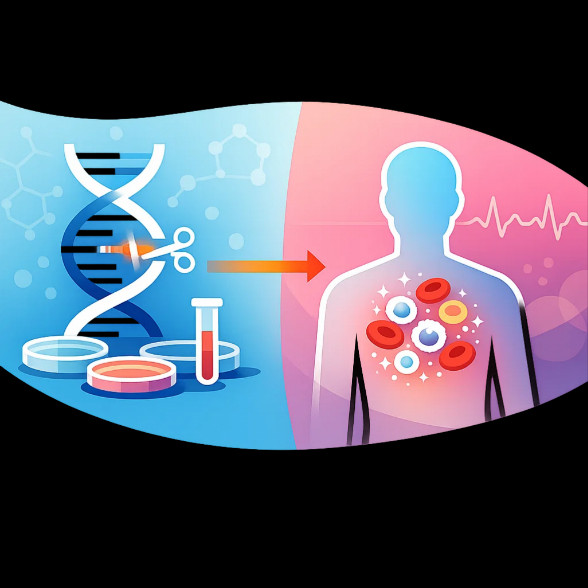
* 프라임 에디팅은 유전자 편집이 실제 환자 치료 단계로 들어섰음을 보여준다. 실험실의 가능성이 아니라, 임상과 의료 시스템의 현실이 되기 시작했다는 점이 핵심이다.
* 이 기술의 강점은 ‘더 강하게 자르는 것’이 아니라 ‘더 정교하고 안전하게 고치는 것’에 있다. 프라임 에디팅은 유전자 편집의 오랜 불안인 예측 불가능성과 원치 않는 변화를 줄이는 방향에서 주목받는다.
* 첫 인체 적용의 의미는 한 환자의 성공 여부보다, 기술이 관리와 검증의 단계로 넘어갔다는 데 있다. 이제부터는 안전성, 재현성, 장기 추적, 규제와 품질 관리가 핵심 과제가 된다.
* 유전자 치료의 승부는 편집 기술 자체만이 아니라 제조 공정과 접근성에서 갈린다. 아무리 정교한 기술도 안정적으로 생산되고 널리 제공되지 못하면 일부 환자만의 치료에 머물 수 있다.
* 프라임 에디팅의 미래는 기술만이 아니라 사회의 선택과 윤리에 달려 있다. 어디까지를 치료로 볼지, 누가 먼저 접근할지, 비용을 어떻게 감당할지 같은 질문이 앞으로 더 중요해진다.
***
프라임 에디팅은 유전자의 잘못된 부분을 더 정밀하게 고치는 유전자 편집 기술이다. 기존 크리스퍼 유전자 편집 기술(CRISPR)이 DNA를 잘라 고치는 방식에 가까웠다면, 프라임 에디팅은 원하는 부분만 골라 문장을 수정하듯 바꾸는 방식에 더 가깝다. 즉, 유전자를 통째로 세게 자르는 가위라기보다 오타를 찾아 조심스럽게 고치는 펜에 가깝고, 그래서 연구자들은 이 기술이 원치 않는 손상을 줄이면서 더 다양한 유전적 오류를 고칠 가능성이 있다고 보고 있다. 한 줄로 정리하면, 프라임 에디팅은 유전자 속 오타를 더 정확하고 안전하게 고치려는 차세대 유전자 편집 기술이다.
이러한 유전자 편집이 이제 실험실의 기술이 아니라 실제 환자를 치료하는 임상의 선택지로 들어오고 있다. 그 다음 단계는 더 세게 자르는 것이 아니라, 더 정교하고 더 안전하게 고치는 방향이다. 프라임 에디팅의 첫 인체 적용은 그 전환이 시작됐음을 보여주는 상징적인 장면이다.
사람에게 들어간 순간, 기술은 전혀 다른 문제가 된다
2025년 5월, 네이처(Nature)에 프라임 에디팅이 처음으로 실제 사람에게 쓰인 사례가 소개됐다. 대상은 태어날 때부터 유전자 이상으로 면역 기능에 문제가 생긴 희귀 질환 환자였다. 연구진은 환자 몸에서 줄기세포를 꺼내 유전자의 잘못된 부분을 고친 뒤, 그 세포를 다시 몸에 넣는 방식으로 치료를 진행했다. 이번 시험은 이 치료가 사람에게 얼마나 안전한지, 또 실제로 면역 기능을 회복시키는 데 도움이 되는지를 함께 확인하려는 목적을 가졌다. 이후 두 명의 환자에게 적용한 초기 결과가 의학 저널에 실리면서, 프라임 에디팅이 더 이상 실험실 이야기만은 아니라는 점이 분명해졌다.
이 장면이 특별한 이유는 단지 '최초'라는 상징성 때문만은 아니다. 어떤 기술이 사람에게 실제로 적용되는 순간부터, 그 기술을 둘러싼 질문은 완전히 달라진다. 실험실에서는 편집 효율, 정확도, 이론적 우수성이 중심이지만, 임상에서는 전혀 다른 언어가 등장한다. 얼마나 안전한가, 시간이 지나도 문제가 남지 않는가, 환자마다 같은 수준으로 재현되는가, 제조와 품질관리는 안정적인가, 비용은 감당 가능한가, 누가 먼저 접근할 수 있는가 같은 질문들이다. 과학의 아이디어가 의료의 현실이 되는 순간, 기술은 더 이상 연구자의 것이 아니다. 병원, 규제기관, 제조시설, 보험 체계, 환자 공동체가 함께 떠안는 사회적 대상이 된다.
그래서 첫 인체 적용은 늘 두 얼굴을 가진다. 한쪽에서는 미래가 이미 도착한 것처럼 과장하고, 다른 한쪽에서는 겨우 한 사례일 뿐이라고 축소한다. 그러나 기술사의 관점에서 보면 중요한 것은 그 중간이다. 한 사례만으로 보편성을 말할 수는 없지만, 한 사례가 있었기 때문에 이제부터는 훨씬 더 현실적인 질문을 던질 수 있다. 무엇이 잘 작동했고, 무엇이 아직 불확실한지, 어떤 환자에게 먼저 적용할 수 있는지, 어느 정도의 안전성이 쌓여야 다음 단계로 나아갈 수 있는지가 비로소 임상 언어로 검토되기 시작한다. 프라임 에디팅의 첫 인체 적용은 바로 그 문턱을 넘었다는 점에서 의미가 크다.
희귀질환에서 길을 내고, 더 넓은 질환으로 향한다
의학의 혁신은 늘 가장 절박한 곳에서 먼저 자란다. 환자 수는 많지 않더라도 질병의 원인이 비교적 분명하고, 기존 치료의 한계가 뚜렷하며, 실패를 감수하더라도 새로운 시도를 해볼 이유가 충분한 분야가 먼저 기술을 받아들인다. 유전자 치료와 유전자 편집이 희귀 유전질환에서 먼저 임상 문턱을 넘는 것도 그래서다. 어디가 잘못됐는지가 선명할수록, 증상을 늦추거나 누그러뜨리는 방식보다 결함 그 자체를 고치려는 접근이 더 직접적인 의미를 갖는다. 만성 육아종병은 이런 조건을 잘 보여주는 질환이다. 특정 유전자 이상 때문에 면역세포가 제대로 작동하지 못하고, 환자는 반복적인 감염과 염증에 시달린다. 이럴 때 유전자 수준에서 결함을 교정한다는 발상은 막연한 미래 기술이 아니라 매우 현실적인 치료 전략으로 다가온다.
하지만 희귀질환은 출발점이지, 반드시 종착점은 아니다. 유전자 편집 기술은 보통 희귀질환에서 안전성과 작동 가능성을 입증한 뒤, 점차 더 흔한 질환으로 확장되는 그림을 그린다. 실제로 최근 유전자 편집 업계는 면역질환이나 혈액질환뿐 아니라 심혈관질환처럼 환자 규모가 훨씬 큰 영역으로도 눈을 돌리고 있다. 이 흐름이 의미하는 바는 단순하다. 유전자 편집이 더 이상 극소수 환자의 예외적 치료로만 남으려 하지 않는다는 것이다. 안전성과 전달 기술, 제조 경험이 축적되면, 이 기술은 장기적으로 보다 넓은 의료 체계의 일부가 되려 한다. 프라임 에디팅의 첫 인체 적용은 그런 확장 가능성의 첫 장면으로 읽힌다.
여기서 중요한 것은 희귀질환을 “작은 시장” 정도로 보는 시선을 버리는 일이다. 의학사에서 희귀질환은 종종 가장 앞선 기술이 처음 현실화되는 장소였다. 환자 수는 적지만 병의 본질이 선명하고, 기존 치료의 결핍이 크기 때문에 기술이 실제 가치를 입증하기 좋다. 그리고 그 과정에서 쌓인 제조, 안전성, 규제 경험은 결국 더 넓은 분야로 옮겨간다. 다시 말해 희귀질환은 주변부가 아니라, 의료 혁신의 선두 실험장이 되는 경우가 많다. 프라임 에디팅도 지금 그 길을 걷고 있다.
가위보다 펜에 가까운 기술
프라임 에디팅을 이해하는 가장 쉬운 방법은 그것을 단순한 “강화된 유전자 가위”로 생각하지 않는 것이다. 기존 유전자 편집이 DNA를 절단한 뒤 세포의 복구 과정을 활용하는 방식으로 널리 알려졌다면, 프라임 에디팅은 가능한 한 불필요한 손상을 줄이면서 원하는 염기서열을 더 정교하게 바꾸려는 접근이다. 비유하자면 문장을 통째로 잘라 붙이는 작업보다, 오타가 난 한 단어를 조심스럽게 고쳐 쓰는 작업에 가깝다. 이 비유는 기술의 모든 세부를 담지는 못하지만, 왜 프라임 에디팅이 차세대 편집 도구로 불리는지는 직관적으로 보여준다. 핵심은 “더 많이 자른다”가 아니라 “더 덜 다치게, 더 정확히 바꾼다”에 있다.
이 차이는 단순한 기술 자랑의 문제가 아니다. 유전자 편집이 대중과 임상 현장에서 동시에 불러온 가장 큰 불안은 늘 예측 불가능성이었다. 목표한 위치 외에 다른 곳이 바뀌지는 않는가, 편집 과정이 세포에 과도한 스트레스를 주지는 않는가, 지금은 괜찮아 보여도 수년 뒤 뜻밖의 문제가 생기지는 않는가 하는 걱정들이다. 유전자 편집은 한번 몸 안에 들어가면 약처럼 쉽게 끊거나 되돌리기 어렵기 때문에, 사람들은 효율보다 먼저 신뢰를 묻는다. 프라임 에디팅이 기대를 모으는 이유도 여기에 있다. 그것은 더 화려한 기술이어서가 아니라, 유전자 편집의 가장 오래된 두려움인 “원치 않는 변화”를 줄일 수 있을 것이라는 기대를 품게 하기 때문이다.
의사와 환자의 입장에서 보면 이 차이는 더욱 중요해진다. 의사는 되돌리기 어려운 개입을 권할 때 훨씬 높은 수준의 확신을 필요로 한다. 환자와 가족 역시 단지 좋아질 가능성만을 보지 않는다. 혹시 돌이킬 수 없는 문제가 생기지 않을까, 지금보다 더 나빠지지 않을까를 함께 생각한다. 그래서 유전자 편집의 미래를 결정하는 것은 기술적 화려함보다, 얼마나 축적된 데이터로 안전성을 설득할 수 있느냐에 더 가깝다. 프라임 에디팅이 인체 적용 단계에 들어왔다는 것은 기술의 자랑이 시작됐다는 뜻이 아니라, 신뢰를 둘러싼 더 कठ한 시험이 시작됐다는 뜻이다.
한 사람의 치료가 시스템 전체를 움직인다
첫 인체 적용이 중요하다는 말은 단지 역사적 상징을 뜻하지 않는다. 기술이 실제 환자에게 들어가는 순간부터, 기술은 시스템의 문제로 바뀐다. 규제기관은 어떤 데이터를 기준으로 허가를 검토할지 판단해야 하고, 병원은 채취·편집·이식·추적 관리의 전 과정을 실제 절차로 설계해야 하며, 제조시설은 환자마다 일관된 품질을 유지해야 한다. 여기에 비용과 보험, 장기 부작용 감시, 환자 선별 기준, 설명과 동의 과정까지 모두 붙는다. 한 환자의 치료는 따라서 한 개인의 사건을 넘어 의료 시스템 전체를 움직이는 계기가 된다.
후속 임상 결과가 주목받는 이유도 여기에 있다. 의학 저널에 실린 내용에 따르면, 두 명의 환자에게 이 치료를 한 뒤 몸속 면역세포와 혈액세포가 비교적 빠르게 자리를 잡는 모습이 확인됐다. 또 감염과 싸우는 면역 기능도 몇 달 동안 유지되는 것으로 나타났다. 이는 유전자를 고친 줄기세포가 몸 안에서 어느 정도 제 역할을 하기 시작했음을 보여준다. 다만 치료 전에 함께 사용한 약과 관련된 부작용이 있었고, 아직 치료를 받은 환자 수가 매우 적기 때문에 오랜 시간이 지난 뒤에도 안전한지, 다른 환자에게도 비슷한 결과가 나오는지는 더 지켜봐야 한다. 다시 말해 첫걸음은 성공적으로 뗐지만, 이 길이 얼마나 멀고 안정적인지는 이제부터 확인해야 한다는 뜻이다.
이 대목에서 중요한 것은 “성공했다”는 말보다 “무엇이 아직 남아 있는가”를 함께 보는 일이다. 편집된 세포가 1년, 3년, 5년 뒤에도 안정적으로 기능할 수 있는가. 다른 유전적 배경을 가진 환자에서도 비슷한 결과가 재현되는가. 면역학적·혈액학적 이상이 뒤늦게 나타나지는 않는가. 제조 공정은 여러 의료기관과 환자군에서 같은 품질을 유지할 수 있는가. 첫 사례는 문을 열지만, 그 문을 넓혀 실제 치료 표준으로 만드는 일은 결국 반복 데이터와 시간의 몫이다. 프라임 에디팅은 이제 막 그 긴 과정의 시작선에 들어섰다.
승부는 유전자보다 공정에서 난다
유전자 치료를 떠올리면 사람들은 흔히 유전자 서열과 분자생물학의 정교함부터 생각한다. 물론 그것이 핵심인 것은 맞다. 그러나 실제 치료의 세계에서는 못지않게 중요한 것이 공정이다. 세포를 꺼내고, 편집하고, 다시 환자에게 주입하고, 그 뒤 장기 추적을 이어가는 모든 과정은 연구실의 아이디어만으로 굴러가지 않는다. 그것은 생산 시스템이고, 물류 체계이며, 품질관리 체계다. 특히 환자 맞춤형 세포 치료는 작은 오차 하나가 결과 전체를 흔들 수 있기 때문에, “한 번 가능했다”와 “반복해서 안정적으로 가능하다” 사이의 거리가 멀다.
대중은 보통 “얼마나 정확하게 고쳤는가”를 먼저 묻지만, 의료 현장에서 더 절실한 질문은 종종 다른 곳에 있다. 이 치료가 다른 병원에서도 비슷한 수준으로 구현될 수 있는가, 제조 과정에서 실패 확률을 얼마나 낮출 수 있는가, 환자별 편차를 어떻게 관리할 것인가, 긴 추적 관찰과 부작용 감시 비용은 누가 감당할 것인가 하는 문제들이다. 결국 치료의 가격은 유전자 자체보다 생산 라인과 운영 체계에서 결정되는 경우가 많다. 유전자 편집이 아무리 정교해도 공정이 불안정하면 널리 쓰일 수 없고, 가격이 지나치게 높으면 극소수만 접근 가능한 기술에 머무를 수 있다.
의학의 역사에서 세상을 바꾼 기술은 언제나 가장 놀라운 기술만은 아니었다. 종종 승자는 가장 안정적으로 굴러간 기술이었다. 더 쉽게 생산되고, 더 일관되게 제공되며, 더 많은 환자가 접근할 수 있는 기술이 결국 표준이 됐다. 프라임 에디팅 역시 같은 시험을 받게 될 가능성이 크다. 아무리 정교한 편집이라도 치료 과정이 지나치게 복잡하고 비용이 너무 높다면, 의료 체계 전체를 바꾸는 기술로 성장하기는 어렵다. 반대로 제조와 전달, 추적 관찰 체계가 정교해지면 이 기술은 희귀질환을 넘어 더 넓은 의료 현장으로 확장될 수 있다. 진짜 승부는 분자 수준의 정교함에서 끝나지 않고, 공정의 성숙도에서 갈릴 가능성이 크다.
마지막 문지기는 윤리다
기술이 강해질수록 마지막에 남는 질문은 언제나 인간의 선택이다. 어떤 경우에, 누구에게, 어디까지 적용할 것인가. 생명을 위협하는 희귀질환을 치료하는 목적과, 질병 위험을 미리 낮추거나 신체 기능을 향상시키려는 목적은 같은 유전자 편집 기술을 사용하더라도 전혀 다른 윤리적 풍경 위에 놓인다. 지금까지는 희귀질환 치료가 중심이었기 때문에 사회적 합의가 비교적 쉬웠다. 기존 치료가 부족하고, 환자의 고통이 크며, 대안이 많지 않기 때문이다. 하지만 기술이 더 넓은 질환으로 이동하고, 더 나아가 예방이나 강화의 영역까지 넘본다면 이야기는 훨씬 복잡해진다.
그때부터는 단순한 찬반 논쟁으로는 부족하다. 어디까지를 치료라고 부를 것인지, 어디서부터를 개선이라고 볼 것인지, 고가의 유전자 편집 치료가 일부 계층에 집중되면 그것을 사회가 어떻게 받아들일 것인지, 공공 보험은 어디까지 부담할 것인지 같은 문제가 한꺼번에 쏟아진다. 의료는 기술로 시작하지만, 결국 규칙과 제도와 우선순위의 체계 위에서 완성된다. 프라임 에디팅의 첫 인체 적용은 그래서 “유전자 편집이 더 강력해졌다”는 선언이라기보다, 이제 이 기술을 사회가 실제 선택지로 다뤄야 한다는 신호에 가깝다. 사람에게 들어간 기술은 더 이상 미래형 논쟁으로만 남지 않는다.
결국 프라임 에디팅의 진짜 시험장은 실험실만이 아니다. 병원, 규제기관, 보험 체계, 환자 공동체, 그리고 기술을 바라보는 대중의 인식이 모두 이 기술의 미래를 결정한다. 그래서 첫 인체 적용은 완성이 아니라 시작이다. 유전자 편집은 이제 과학의 영역을 넘어 의료와 산업, 제도와 윤리의 영역으로 들어오고 있다. 그리고 바로 그 이유 때문에, 프라임 에디팅의 첫걸음은 단지 한 명의 환자 이야기가 아니라 앞으로 의료가 어디까지 달라질 수 있는지를 보여주는 긴 서사의 첫 문장으로 읽힌다.
Reference
Nature, 2025-05-19, “World first: ultra-powerful CRISPR treatment trialled in a person”
Prime Editing, the Next Generation of Gene Scissors, Enters the Human Body
[Key Message]
* Prime editing shows that gene editing has entered the stage of actual patient treatment. The key point is that it is no longer just a laboratory possibility, but is beginning to become a reality within clinical medicine and healthcare systems.
* The strength of this technology lies not in “cutting more aggressively,” but in “correcting more precisely and safely.” Prime editing is drawing attention because it moves in the direction of reducing the long-standing anxieties surrounding gene editing: unpredictability and unwanted changes.
* The significance of the first human application lies less in whether one patient succeeded than in the fact that the technology has moved into a stage of management and verification. From now on, safety, reproducibility, long-term follow-up, regulation, and quality control become the central tasks.
* The fate of gene therapy will be decided not only by the editing technology itself, but by manufacturing processes and accessibility. No matter how precise the technology is, if it cannot be produced stably and provided broadly, it may remain a treatment only for a limited number of patients.
* The future of prime editing depends not only on technology, but on society’s choices and ethics. Questions such as where treatment ends, who gets access first, and how the costs should be borne will become increasingly important.
***
Prime editing is a gene-editing technology that corrects faulty parts of genes with greater precision. While conventional CRISPR is closer to a method of cutting DNA and then repairing it, prime editing is closer to selecting only the desired part and changing it as if revising a sentence. In other words, rather than being like scissors that cut through a gene all at once, it is more like a pen that carefully finds and corrects a typo, which is why researchers believe this technology may be able to fix a wider range of genetic errors while reducing unwanted damage. In one line, prime editing is a next-generation gene-editing technology that aims to correct typos in genes more accurately and safely.
Gene editing is no longer just a laboratory technology; it is entering clinical medicine as an option for treating actual patients. The next step is not about cutting more aggressively, but about correcting more precisely and more safely. The first human application of prime editing is a symbolic scene showing that this transition has begun.
The Moment It Enters a Person, the Technology Becomes Something Entirely Different
In May 2025, Nature introduced the first case in which prime editing was used in an actual person. The patient was someone with a rare disease in which an inherited genetic abnormality causes problems with immune function from birth. The researchers carried out the treatment by taking stem cells out of the patient’s body, correcting the faulty part of the gene, and then putting those cells back into the body. The purpose of this trial was to examine both how safe this treatment is in humans and whether it can actually help restore immune function. Later, initial results from its use in two patients were published in a medical journal, making it clear that prime editing is no longer just a laboratory story.
What makes this moment special is not simply its symbolism as a “first.” The moment any technology is actually applied to a person, the questions surrounding it change completely. In the laboratory, the focus is on editing efficiency, accuracy, and theoretical superiority. In the clinic, however, a very different language appears. How safe is it? Will problems remain over time? Can it be reproduced at the same level in different patients? Are manufacturing and quality control stable? Is the cost manageable? Who gets access first? The moment a scientific idea becomes a medical reality, the technology no longer belongs only to researchers. It becomes a social object borne collectively by hospitals, regulators, manufacturing facilities, insurance systems, and patient communities.
That is why the first human application always has two faces. One side exaggerates it as though the future has already arrived, while the other dismisses it as merely a single case. But from the perspective of the history of technology, what matters lies somewhere in between. One case cannot establish generalizability, but because that one case exists, it becomes possible to ask far more realistic questions. What worked well, what remains uncertain, which patients can be treated first, and how much safety data must accumulate before moving to the next stage can finally begin to be examined in the language of clinical medicine. The first human application of prime editing is significant precisely because it crossed that threshold.
It Opens the Way Through Rare Diseases, Then Moves Toward Broader Disorders
Medical innovation tends to grow first in the places of greatest urgency. Even when patient numbers are small, fields in which the cause of disease is relatively clear, the limits of existing treatment are obvious, and there is sufficient reason to take the risk of trying something new are the ones that first adopt a technology. That is why gene therapy and gene editing first cross the clinical threshold in rare genetic diseases. The clearer it is where the problem lies, the more meaningful it becomes to try to correct the defect itself rather than simply slow or ease the symptoms. Chronic granulomatous disease shows these conditions well. Because of a specific genetic abnormality, immune cells fail to function properly, and patients suffer repeated infections and inflammation. In such a case, the idea of correcting the defect at the genetic level does not feel like some vague future technology; it becomes a very realistic therapeutic strategy.
But rare disease is a starting point, not necessarily the destination. Gene editing technologies generally aim to prove safety and functional feasibility in rare diseases first, then gradually expand into more common conditions. In fact, the gene editing industry has recently begun looking not only at immune and blood disorders but also at much larger fields such as cardiovascular disease. The meaning of this trend is simple: gene editing no longer intends to remain only an exceptional treatment for a very small number of patients. As safety, delivery technology, and manufacturing experience accumulate, it seeks in the long term to become part of a much broader healthcare system. The first human application of prime editing can be read as the opening scene of that potential expansion.
What matters here is abandoning the view of rare disease as merely a “small market.” In the history of medicine, rare diseases have often been the place where the most advanced technologies first became real. The number of patients may be small, but the essence of the disease is clear and the gaps in existing treatment are large, making it an ideal setting for a technology to demonstrate real value. And the manufacturing, safety, and regulatory experience built in that process ultimately carries over into wider fields. In other words, rare disease is not the periphery; it is often the front-line testing ground of medical innovation. Prime editing is now walking that very path.
A Technology Closer to a Pen Than to Scissors
The easiest way to understand prime editing is not to think of it simply as “an upgraded pair of gene scissors.” If conventional gene editing became widely known as a method that cuts DNA and then relies on the cell’s repair process, prime editing is an approach that seeks to make the desired sequence changes more precisely while minimizing unnecessary damage. To use an analogy, it is closer to carefully correcting a misspelled word than to cutting up and pasting back an entire sentence. This analogy does not capture every technical detail, but it does show intuitively why prime editing is called a next-generation editing tool. The essence lies not in “cutting more,” but in “changing more accurately while causing less harm.”
This difference is not just a matter of technological boasting. The greatest anxiety that gene editing has generated both among the public and in clinical settings has always been unpredictability. Will something other than the intended target also be changed? Does the editing process place excessive stress on cells? Even if everything looks fine now, could an unexpected problem emerge years later? Because gene editing, once introduced into the body, is not as easily stopped or reversed as a drug, people ask about trust before they ask about efficiency. Prime editing draws attention for this reason. It is not because it is a more dazzling technology, but because it inspires hope that it may reduce “unwanted changes,” the oldest fear surrounding gene editing.
From the perspective of doctors and patients, this distinction becomes even more important. A doctor needs a much higher level of confidence before recommending an intervention that is difficult to reverse. Patients and families also do not look only at the possibility of improvement. They think at the same time about whether something irreversible might happen, whether things could become worse than they are now. That is why what will determine the future of gene editing is not technological flashiness, but whether safety can be convincingly established through accumulated data. The fact that prime editing has entered the stage of human application does not mean the era of technological self-congratulation has begun; it means a far stricter test centered on trust has begun.
One Person’s Treatment Sets the Entire System in Motion
Saying that the first human application is important does not merely refer to its historical symbolism. The moment a technology enters an actual patient, it becomes a systems problem. Regulators must decide what data standards to use in evaluating approval. Hospitals must design actual procedures for cell collection, editing, reinfusion, and follow-up management. Manufacturing facilities must maintain consistent quality from patient to patient. In addition, questions of cost and insurance, long-term adverse-event monitoring, patient selection criteria, and informed consent all come attached. A single patient’s treatment therefore becomes more than an individual event; it becomes a trigger that moves the entire medical system.
This is also why the follow-up clinical results are drawing attention. According to what was published in a medical journal, after this treatment was given to two patients, their immune cells and blood cells were seen to settle into the body relatively quickly. It also appeared that the immune function needed to fight infections was maintained for several months. This suggests that the gene-corrected stem cells had begun to do their job to some extent inside the body. However, there were side effects related to a drug that was used before the treatment, and because the number of patients treated so far is still very small, it remains necessary to watch more closely whether the treatment is still safe after a long period of time and whether similar results will appear in other patients. In other words, the first step was taken successfully, but how long and how safe this path will be still has to be confirmed from this point on.
At this point, what matters is not simply saying “it succeeded,” but also seeing clearly “what still remains unresolved.” Can the edited cells continue to function stably after one year, three years, five years? Will similar results be reproduced in patients with different genetic backgrounds? Could immunologic or hematologic abnormalities appear later? Can the manufacturing process maintain the same quality across multiple medical centers and patient groups? The first case opens the door, but widening that door and turning the approach into an actual standard of care will ultimately depend on repeated data and time. Prime editing has only just entered the starting line of that long process.
The Real Contest Is Decided More by Process Than by Genes
When people think of gene therapy, they often picture gene sequences and the precision of molecular biology first. Of course, that is central. But in the real world of treatment, process matters just as much. The entire chain of removing cells, editing them, reinfusing them into the patient, and continuing long-term follow-up does not run on laboratory ideas alone. It is also a production system, a logistics system, and a quality-control system. Especially in personalized cell therapy, even a small deviation can shake the entire outcome, so the distance between “it worked once” and “it can be done repeatedly and stably” is great.
The public usually asks first, “How accurately was it corrected?” But in clinical settings, the more urgent questions often lie elsewhere. Can this treatment be implemented at a similar level in other hospitals? How much can the failure rate in the manufacturing process be reduced? How will variation among patients be managed? Who will bear the cost of long-term follow-up and adverse-event monitoring? In the end, the price of treatment is often determined less by the gene itself than by the production line and operational system. No matter how precise gene editing becomes, if the process is unstable it cannot be widely used, and if the cost is too high it may remain a technology accessible only to a tiny few.
In the history of medicine, the technologies that changed the world were not always the most astonishing ones. Often, the winners were the technologies that operated most reliably. Technologies that could be produced more easily, delivered more consistently, and reached more patients ultimately became the standard. Prime editing is likely to face the same test. No matter how precise the editing may be, if the treatment process remains too complex and the cost too high, it will be difficult for it to grow into a technology that changes the healthcare system as a whole. Conversely, if manufacturing, delivery, and follow-up systems mature, this technology may expand beyond rare diseases into much broader areas of medicine. The real contest will not end at molecular precision; it will likely be decided by the maturity of the process.
The Final Gatekeeper Is Ethics
The stronger a technology becomes, the more the final question always comes down to human choice. In what cases, for whom, and how far should it be applied? Using the same gene editing technology to treat life-threatening rare disease and to lower disease risk in advance or enhance physical function places that technology in entirely different ethical landscapes. So far, social consensus has been relatively easy because the focus has been on rare-disease treatment. Existing therapies are insufficient, patient suffering is great, and alternatives are few. But if the technology moves into broader disorders, and beyond that into the realms of prevention or enhancement, the story becomes far more complex.
At that point, a simple pro-versus-con debate is no longer enough. Questions come all at once: what should count as treatment, where enhancement begins, how society should respond if expensive gene editing therapies become concentrated in certain classes, and how far public insurance should go in covering them. Medicine begins with technology, but in the end it is completed on top of rules, institutions, and systems of priority. The first human application of prime editing is therefore less a declaration that “gene editing has become more powerful” than a signal that society must now deal with this technology as a real option. Once a technology has entered a person, it no longer remains only a debate about the future.
In the end, the true testing ground for prime editing is not the laboratory alone. Hospitals, regulators, insurance systems, patient communities, and the public’s perception of the technology will all shape its future. That is why the first human application is not the end, but the beginning. Gene editing is now moving beyond the realm of science into the realms of medicine and industry, institutions and ethics. And for precisely that reason, the first step of prime editing should be read not simply as the story of one patient, but as the first sentence in a long narrative about how far medicine itself may change.
Reference
Nature, 2025-05-19, “World first: ultra-powerful CRISPR treatment trialled in a person”