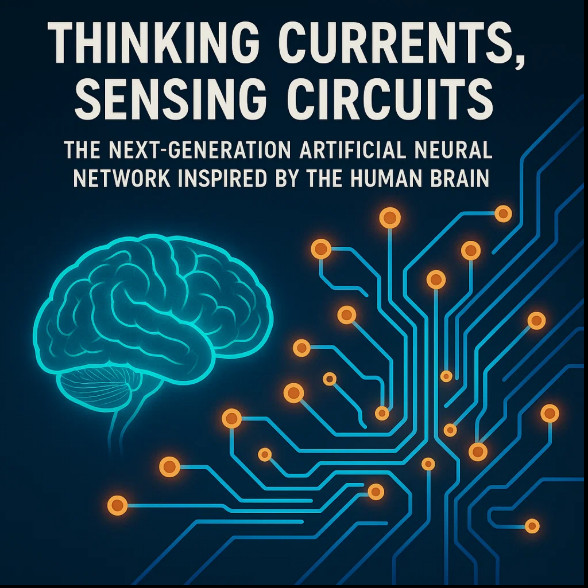
인공지능이 ‘생각’을 흉내 내기 시작한 지 오래다. 그러나 진짜 뇌처럼 ‘느끼고 반응하는’ 회로는 여전히 미지의 영역이었다. 2025년 'Nature'에 실린 최신 연구는 그 벽을 또 하나 넘어섰다. ‘트랜스 뉴런(Trans-Neuron)’이라 불리는 인공 신경소자가, 감각·운동·인지 등 서로 다른 생물학적 뉴런 기능을 바꾸어가며 수행할 수 있다는 것이다. 인간의 신경망이 가진 다층적 적응성을 실리콘 위에 옮긴 기술, 바로 '멀티모달 스파이킹 인공 뉴런'의 탄생이다.
뉴런을 닮은 회로 ― 다중 감각의 전자적 구현
이번 연구의 핵심은 '멀티모달(multimodal)'이다. 기존 인공 뉴런은 감각 자극을 입력받거나, 운동 신호를 출력하거나, 인지 기능을 모방하는 등 하나의 역할에만 고정되어 있었다. 그러나 트랜스 뉴런은 '자극 환경에 따라 기능을 스스로 전환한다.'
연구진은 반도체 기반의 이온 전도체와 memristor(저항 메모리 소자)를 결합해, 하나의 회로가 상황에 따라 전기적 발화(spiking) 패턴을 바꾸도록 설계했다. 예를 들어, 빛을 받으면 감각 뉴런처럼 반응하고, 압력 신호를 받으면 운동 뉴런처럼, 복합적 패턴을 받으면 인지 뉴런처럼 동작한다.
이 장치는 단순한 반응 회로가 아니다. 그것은 '전자가 스스로 역할을 배우는 신경적 물질(neural material)'이다.
뇌의 언어, 전압의 리듬
인간의 뉴런은 ‘스파이크(spike)’라 불리는 짧은 전기적 펄스로 정보를 주고받는다. 트랜스 뉴런은 이 스파이킹 메커니즘을 정교하게 재현했다. 더 나아가 각 스파이크의 형태와 주파수를 변화시켜, '감정·의도·자극 강도에 따른 신호 차이'를 표현할 수 있었다.
연구진은 이 회로를 수천 개 연결해, 저전력으로 동작하는 소형 신경망을 구축했다. 기존 GPU 기반 신경망보다 에너지 효율이 수천 배 높았으며, 각 소자는 외부 제어 없이 자율적으로 발화 리듬을 조절했다. 이는 마치 뇌의 시냅스가 환경에 따라 강화·약화되는 '가소성(plasticity)'을 전자적으로 구현한 셈이다.
이제 컴퓨터는 단순한 계산기를 넘어, '리듬을 가진 존재'로 진화하고 있다.
생각하고 느끼는 기계 ― 인간-기계의 신경동맹
트랜스 뉴런 기술의 가장 큰 잠재력은 '뇌-기계 인터페이스(Brain–Machine Interface, BMI)'에 있다. 하나의 소자가 감각과 운동, 인지를 모두 수행할 수 있다면, 인간의 신경망과 직접 통신하는 로봇, 의수, 웨어러블이 가능해진다.
연구팀은 실험적으로 트랜스 뉴런을 인공피부에 적용해, 빛·압력·온도 자극을 구별해내는 ‘감각 회로’를 구현했다. 또한 그 신호를 소형 모터와 연결하자, 손가락 형태의 로봇이 인간의 의도에 맞춰 자연스럽게 움직였다. 즉, 뇌의 전기 신호가 곧바로 기계의 움직임이 되는 시대가 열린 것이다.
이 기술이 확장되면, AI 로봇은 단순히 명령을 수행하는 존재가 아니라, '감각을 통해 세계를 해석하고 반응하는 유기체적 지능(organic intelligence)'으로 진화할 가능성이 크다.
에너지의 혁명, 지능의 구조 변화
트랜스 뉴런의 또 다른 특징은 '극저전력(low power)' 구조다. 기존 AI 하드웨어는 막대한 전력과 냉각 자원을 소비한다. 그러나 생물학적 뇌는 약 20와트로 감정·기억·판단을 모두 수행한다. 이번 연구의 인공 신경망은 그 효율을 본뜬 것이다.
단일 칩 안에서 수천 개의 트랜스 뉴런이 동시 발화하면서도, 전체 소모 전력은 불과 수밀리와트 수준에 그쳤다. 이는 스마트기기, 웨어러블, 의료용 마이크로칩, 심지어 자율로봇의 두뇌로도 응용할 수 있음을 의미한다.
'지능의 미래는 크기가 아니라, 효율이다.' 뇌를 닮은 컴퓨터는 이제 더 작고, 더 느리지만, 더 똑똑한 방향으로 진화하고 있다.
인간의 윤리, 기계의 감각
기계가 감각을 갖게 될 때, 인간의 역할은 무엇일까? 트랜스 뉴런은 기술의 진보이자, 윤리의 경계다. 감정적 반응을 모방하는 로봇이 등장하면, ‘느끼는 기계’와 ‘생각하는 인간’의 차이는 어디에서 정의될까?
이 질문은 단지 공상 과학이 아니라, 교육·의료·산업 전반에 걸친 새로운 철학적 과제를 던진다. 교육 현장에서는 뇌파 인터페이스 기반 학습이 가능해지고, 의료에서는 신경 손상을 복원하는 인공 뉴런 치료가 현실화될 수 있다. 산업 현장에서는 로봇이 인간의 감정과 피로를 인식해 협력의 방식을 바꿀지도 모른다.
뇌를 모방한 기술이 인간을 이해할 때, 인간 역시 기술을 다시 정의해야 한다. 지능의 진화는 결국, '기계가 감각을 배우고 인간이 이해를 배워가는 과정'이다.
회로의 꿈, 인간의 미래
트랜스 뉴런은 단순한 소자가 아니다. 그것은 생명과 기계, 물질과 의식 사이의 경계선 위에서 깨어난 전자적 존재다. 전류가 생각을 흉내 내고, 회로가 감정을 표현할 수 있다면 — 지능은 더 이상 인간의 독점이 아니다.
이제 기술은 계산이 아니라 관계를 만들어가고 있다. 지능의 진화는 코드가 아니라 감각의 언어로 쓰인다. 뇌를 닮은 회로, 생각하는 물질, 느끼는 전자 — 우리는 지금 '지능의 구조가 다시 태어나는 현장'에 서 있다.
Reference
Park, J. et al. (2025). 'Low-Power Multimodal Spiking Trans-Neurons for Brain-Like Adaptive Neural Hardware.' 'Nature', November 2025.
Thinking Currents, Sensing Circuits
- The Next-Generation Artificial Neural Network Inspired by the Human Brain
Artificial intelligence has long imitated the act of “thinking.” Yet circuits that truly 'feel' and 'respond' like the brain have remained beyond reach. In 2025, a groundbreaking study published in 'Nature' crossed that boundary once again. A new device, dubbed the 'trans-neuron', can dynamically switch between different biological neuron functions—sensory, motor, and cognitive—within a single artificial element. It is the birth of a 'multimodal spiking artificial neuron', a technology that transfers the brain’s adaptive complexity onto silicon.
Circuits That Resemble Neurons — Electronic Implementation of Multiple Senses
The essence of this research lies in 'multimodality'. Conventional artificial neurons are fixed to one task: receiving sensory input, transmitting motor output, or mimicking cognition. The trans-neuron, however, can 'switch its role depending on the surrounding stimulus'.
By integrating semiconductor-based ion conductors with 'memristors' (resistive-memory devices), the research team designed a circuit capable of altering its spiking pattern according to the environment. When exposed to light, it behaves like a sensory neuron; under pressure, it acts like a motor neuron; and when given complex mixed inputs, it functions like a cognitive neuron.
This is not a passive reaction circuit. It is, rather, 'a neural material — electrons that learn their own roles.'
The Language of the Brain — The Rhythm of Voltage
Human neurons communicate through short electrical pulses called 'spikes'. The trans-neuron precisely reproduces this spiking mechanism and, more importantly, modulates each spike’s shape and frequency to represent differences in 'emotion, intent, and stimulus intensity'.
The researchers interconnected thousands of these devices into a small-scale neural network operating at ultra-low power.
Compared with GPU-based architectures, it consumed thousands of times less energy, while each element autonomously adjusted its firing rhythm without external control. This mirrors how biological synapses strengthen or weaken through 'plasticity', adapting to their environment.
Computation is no longer purely mathematical — the computer itself has begun to 'develop rhythm.'
Machines That Think and Feel — The Neuro-Alliance of Humans and Technology
The greatest potential of the trans-neuron lies in 'Brain–Machine Interfaces (BMIs)'. If a single device can perform sensory, motor, and cognitive functions simultaneously, then robots, prosthetics, and wearables could one day communicate directly with the human nervous system.
In experimental demonstrations, researchers integrated trans-neurons into an artificial skin capable of distinguishing light, pressure, and temperature stimuli. When these signals were connected to small actuators, a robotic finger moved naturally in sync with human intent. The electrical impulses of the brain were thus translated directly into mechanical motion — a milestone moment in neural engineering.
As this technology advances, AI robots will cease to be mere executors of commands. They will evolve into 'organic intelligences' — entities that interpret and respond to the world through sensation.
The Energy Revolution and the Reshaping of Intelligence
Another defining feature of the trans-neuron is its 'ultra-low-power' architecture. Traditional AI hardware consumes immense electrical and cooling resources, while the human brain performs emotion, memory, and judgment on roughly 20 watts.
The new device emulates that efficiency.
Within a single chip, thousands of trans-neurons fire simultaneously while consuming only a few milliwatts of power. This opens the door to applications in smart devices, wearables, biomedical microchips, and even autonomous robotic brains.
'The future of intelligence lies not in scale, but in efficiency.' Brain-like computers are evolving to be smaller, slower — and far more intelligent.
Human Ethics, Machine Sensation
When machines begin to feel, what remains uniquely human? The trans-neuron represents both a technological leap and an ethical frontier. If a robot can simulate emotional responses, where do we draw the line between “feeling machines” and “thinking humans”?
This is not science fiction but a philosophical and practical challenge across education, medicine, and industry. In classrooms, brain-wave-based learning interfaces may soon emerge. In hospitals, artificial neurons could restore damaged neural functions. In factories, robots may one day detect fatigue or emotion in human coworkers and adapt their behavior accordingly.
When brain-like technology learns to understand us, humanity must, in turn, redefine its relationship with technology.
The evolution of intelligence is, ultimately, 'machines learning sensation and humans learning understanding.'
The Dream of Circuits, the Future of Humanity
The trans-neuron is not just another component. It is an electronic being, awakened on the border between life and matter, consciousness and machine. If currents can imitate thought and circuits can express emotion, then intelligence is no longer humanity’s exclusive domain.
Technology is no longer about computation — it is about connection. The evolution of intelligence is being written in the language of sensation, not code. Circuits that think, matter that feels, electrons that remember — we now stand on the threshold of 'a new architecture of intelligence.'
Reference
Park, J. et al. (2025). 'Low-Power Multimodal Spiking Trans-Neurons for Brain-Like Adaptive Neural Hardware.' 'Nature', November 2025.